Definition & Meaning
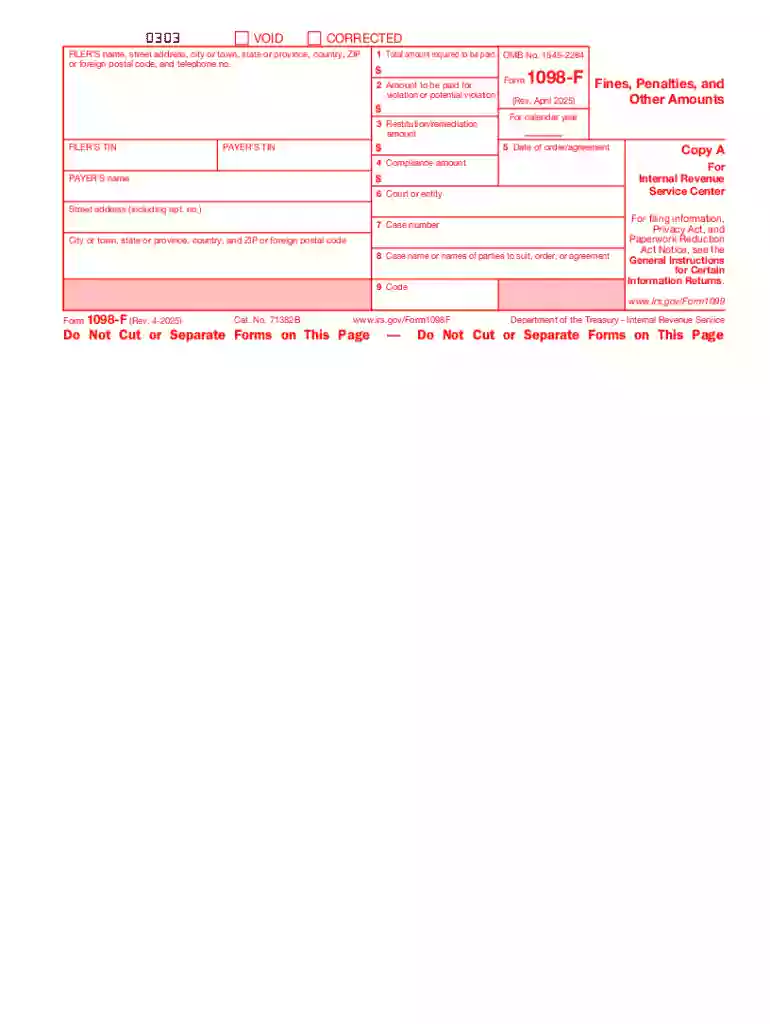
Form 1098-F (Rev April 2025) is a tax form used by the IRS to document fines, penalties, and other amounts paid due to legal violations. This form is an essential part of record-keeping for legal and tax purposes, ensuring that financial obligations arising from violations are accurately reported. The purpose of this form is to provide a clear account of financial penalties incurred by taxpayers, which can impact their overall tax liabilities.
Nuances and Edge Cases
- Specific Violations: The form is applicable only to payments related to certain violations. Understanding which violations require reporting can ensure compliance and reduce the risk of penalties.
- Multiple Violations: If multiple violations occur, each with its respective penalty, separate entries are required. This ensures clarity and comprehensive reporting.
How to Use the Form 1098-F (Rev April 2025)
Using Form 1098-F involves reporting detailed information about any legal financial obligations paid or incurred by taxpayers. Accurate completion of this form necessitates understanding the specifics of the reported penalties, including their origin and context.
Step-by-Step Process
- Identify Applicable Penalties: Determine which fines or penalties need reporting.
- Gather Documentation: Assemble necessary documents that detail the incurred penalties.
- Report Amounts: Accurately fill out the form by entering specific amounts paid as penalties.
- Review Submission Requirements: Ensure compatibility with online or mail submission frameworks.
Practical Examples
- Corporate Penalties: A corporation fined for an environmental regulation violation must report this using the form.
- Individual Compliance: For individuals fined due to tax-related infractions, applicable penalties are reported accordingly.
Steps to Complete the Form 1098-F (Rev April 2025)
Completing Form 1098-F requires precision and attention to detail. The steps below outline the process of accurately filling out and submitting the form.
Detailed Steps
- Access the Form: Retrieve the form from the IRS website or authorized distribution points.
- Accurate Entry of Information: Carefully enter personal and financial information, ensuring all data aligns with IRS standards.
- Verification: Cross-check each entry to prevent errors, which could lead to submission delays or rejection.
- Submission: Choose the preferred submission method—electronically or by mail—and send the completed form to the IRS promptly.
Considerations for Submission
- E-Filing Benefits: Provides quicker processing times and reduces paper use.
- Mail Submissions: Ensure the form is well-packaged to avoid damage or loss in transit.
Important Terms Related to Form 1098-F (Rev April 2025)
Understanding key terms related to Form 1098-F enhances comprehension and proper usage. These terms provide clarity on the legal and procedural aspects of the form.
Key Terms
- Legal Violation: Any act in breach of statutory laws resulting in fines.
- Penalty: Monetary charges imposed as a result of legal infractions.
- Settlement Costs: Amounts paid to resolve a violation without admitting guilt.
- Reporting Entity: The individual or organization responsible for submitting Form 1098-F.
Clarifications
- Scope of Penalties: Not all penalties require reporting on Form 1098-F; understanding applicable violations is key.
- Legal Definitions: Differentiating between penalties and settlements ensures accuracy in reporting.
IRS Guidelines
The IRS provides procedural guidelines and requirements crucial for the proper completion and submission of Form 1098-F.
Procedural Requirements
- Documentation: Maintain accurate records of all reported penalties.
- Compliance: Adhere strictly to IRS guidelines to avoid discrepancies in reporting.
Review and Updates
- Annual Changes: Stay informed about revisions or updates to the form which might affect its completion requirements.
- Guideline Options: The IRS offers resources and FAQs for additional assistance with completing the form.
Filing Deadlines / Important Dates
Awareness of filing deadlines for Form 1098-F is critical for ensuring compliance and avoiding late submission penalties.
Key Deadlines
- Annual Submission: Generally, the due date is aligned with the taxpayer's annual tax filing deadline.
- Late Submission Penalties: Failing to meet these deadlines could result in additional fines or penalties.
Notable Date Trends
- Year-End Preparation: It's prudent to begin gathering necessary documents well before the filing deadline to ensure timely submissions.
- Communication: Reach out to the IRS if deadlines cannot be met, as extensions may be available under certain circumstances.
Required Documents
Proper completion of Form 1098-F demands accompanying documentation to support reported penalties and fines.
Documentation List
- Legal Rulings: Copies of official rulings or judgments related to the violation.
- Payment Receipts: Proof of payment for reported fines.
- Settlement Agreements: Documents outlining terms for any negotiated settlements.
Document Verification
- Authenticity: Ensure all submitted documents are bona fide and reflect accurate information.
- Record Keeping: Maintain a comprehensive file of all documents submitted for future reference and IRS inquiries.
Penalties for Non-Compliance
Failing to comply with filing and reporting requirements related to Form 1098-F can result in significant penalties.
Types of Penalties
- Fines for Late Submission: Monetary penalties for each day the form is late after the deadline.
- Underreporting Penalties: Additional fines if reported amounts do not correspond with actual fines incurred.
Impact of Non-Compliance
- Increased Government Scrutiny: Non-compliance can lead to more in-depth review from tax authorities.
- Legal Consequences: Receiving inaccurate documentation or incomplete submissions may result in legal actions.
Digital vs. Paper Version
Choosing between digital and paper versions of Form 1098-F affects how one interacts with and submits the form to the IRS.
Considerations
- Digital Submissions: Generally quicker and more efficient, allowing for immediate receipt confirmation.
- Paper Versions: Offer a tangible method of verification but require more time due to postal delays.
Software Compatibility
- Online Platforms: Use of recognized tax software like TurboTax can simplify the form’s electronic filing.
- Manual Verification: Digital submissions allow for simpler error-checking via automation, unlike paper-based methods that require manual review.