




01. Edit your form online
Type text, add images, blackout confidential details, add comments, highlights and more.

Type text, add images, blackout confidential details, add comments, highlights and more.

Draw your signature, type it, upload its image, or use your mobile device as a signature pad.

Send it via email, link, or fax. You can also download it, export it or print it out.
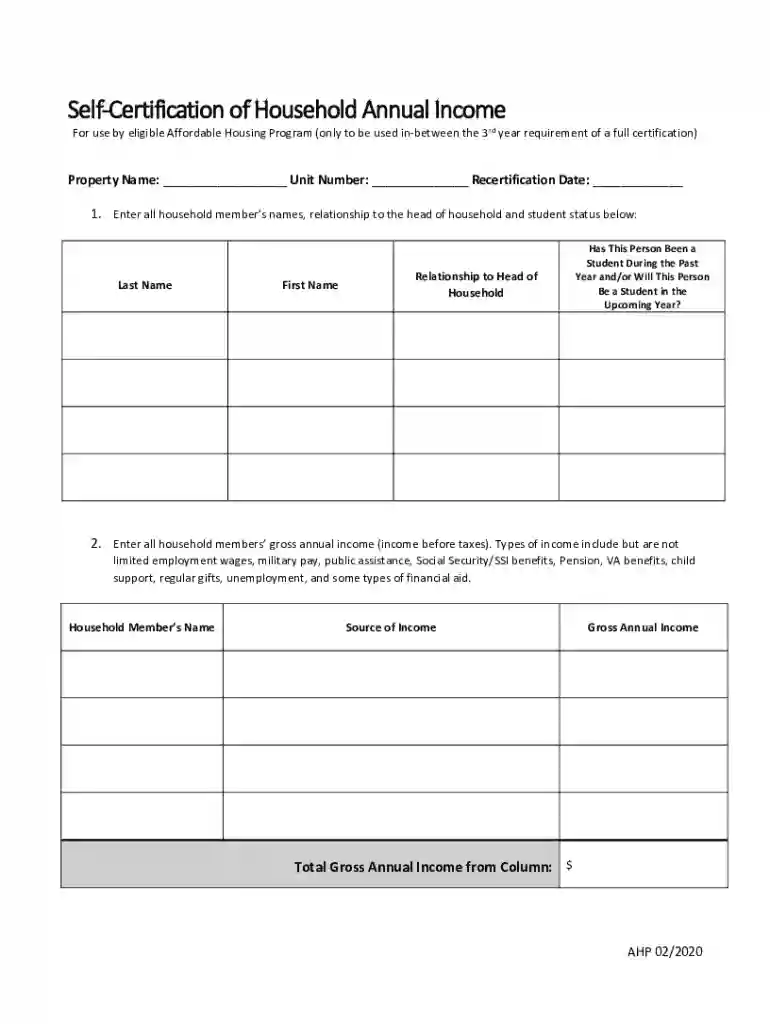
The CDBG Self-Certification of Annual Income Form is utilized by households participating in Affordable Housing Programs. This form allows participants to self-report their annual income and asset values between full certifications. It plays a crucial role in maintaining up-to-date financial information, ensuring compliance with program requirements. Participants must provide detailed income sources and asset values, thereby enabling accurate verification processes for program eligibility.
Using this form effectively requires a clear understanding of its components and sections. It is imperative to gather all necessary documentation before beginning the self-certification process. This preparation ensures all information is accurately captured, significantly impacting program participation eligibility.
This form can be accessed through various HUD resources or directly from participating affordable housing program offices. It's crucial to ensure that you have the correct version pertinent to your specific program requirements.
Completing the CDBG Self-Certification of Annual Income Form involves a systematic approach, ensuring all details are accurate and verifiable.
This form is a vital tool in maintaining transparency and compliance within affordable housing programs. It aids in evaluating ongoing eligibility and ensures resources are allocated to deserving participants.
This form is primarily utilized by households already enrolled in any CDBG-funded affordable housing initiatives. It's vital for both participants and administrators.


Understanding the critical elements of the form assists in accurate completion and submission, preserving the form's integrity.
Adhering to the legal requirements associated with this form is essential for both participants and program administrators.
Failure to comply with the form's requirements can lead to significant consequences, affecting both the individual and program funding.
Exploring various versions of the CDBG Self-Certification of Annual Income Form can help tailor the process to specific needs or changes in program requirements.
At DocHub, your data security is our priority. We follow HIPAA, SOC2, GDPR, and other standards, so you can work on your documents with confidence.


service beneficiaries must be documented as income eligible using the Departments Income Self-Certification form. This is similar to public service activities
For questions or comments, call 1-800-767-7468 or send email to OnDemand.Mail@hud.gov. State CDBG Program Grants. B State CDBG Program Grant Close-out


