
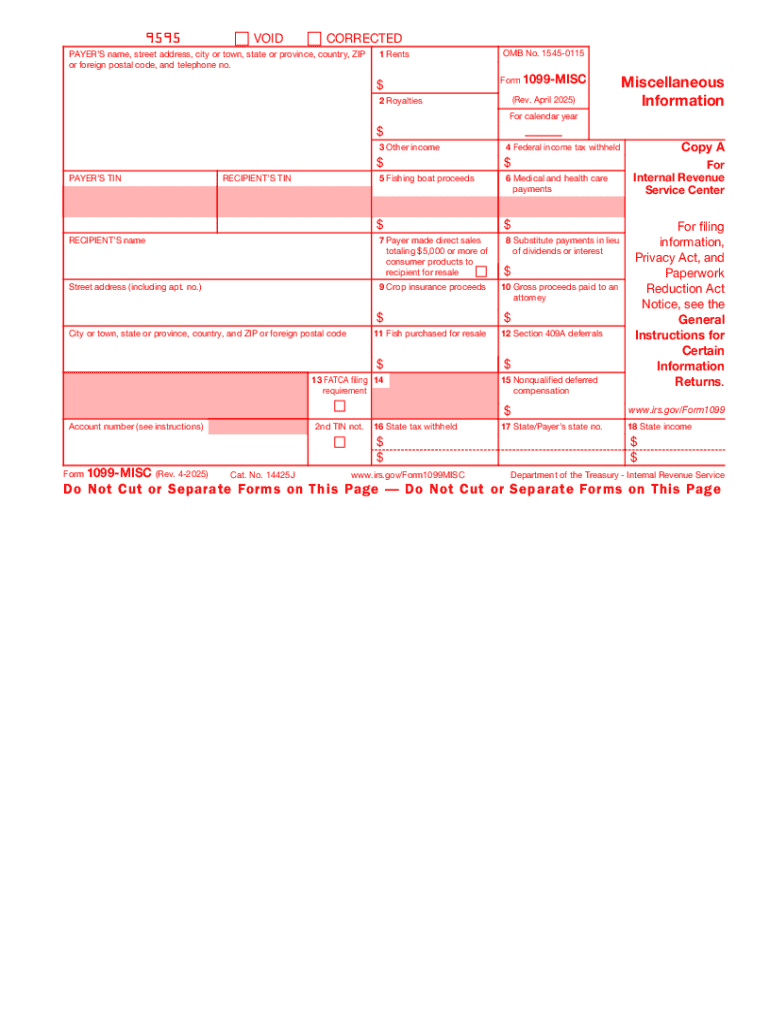







Definition & Key Purpose of Form 1099-MISC (Rev April 2025)
The IRS Form 1099-MISC, revised in April 2025, is a pivotal document used for reporting various types of income that are not covered under traditional employment. This form is specifically employed to capture miscellaneous income types, such as non-employee compensation, rent, prizes, awards, and other forms of income. Importantly, it is a standard requirement for businesses that have made payments of $600 or more to a recipient within a tax year. This form aids both the payer and the recipient in ensuring all relevant income is reported to the IRS for tax purposes.
How to Use the Form 1099-MISC (Rev April 2025)
Utilizing the Form 1099-MISC requires adherence to specific guidelines to ensure accurate reporting. Businesses must gather and verify the necessary information from recipients, such as legal names, addresses, and taxpayer identification numbers (TINs), to complete the form correctly. The payer must determine which categories of income the payments fall under, such as rents or royalties, and clearly outline these on the designated parts of the form. This information, once completed, should be shared with the respective recipients and filed with the IRS as part of the annual tax reporting process.
Detailed Steps to Complete the Form
-
Gather Recipient Information:
- Collect the recipient's full name, address, and TIN.
- Confirm the correct income type and payment amount.
-
Complete Form Sections:
- Fill in the payer's details, followed by the recipient's.
- Enter the appropriate income amount in the designated boxes, like Box 1 for rents or Box 7 for nonemployee compensation.
-
Review & Submit:
- Verify all entered data for accuracy.
- Provide Copy B to the recipient and file Copy A with the IRS.
Who Typically Uses the Form 1099-MISC (Rev April 2025)
A broad range of businesses and organizations rely on Form 1099-MISC for compliance with IRS regulations. Typical users include:
- Independent Contractors: For documenting payments received outside of traditional employment.
- Landlords & Property Managers: For reporting rental income.
- Service Providers: Such as freelancers who are compensated over $600 for their services.
- Prize & Award Administrators: To report non-monetary and monetary prizes awarded.


IRS Guidelines and Compliance
Adherence to IRS guidelines is crucial when using Form 1099-MISC. The form must be filed by any entity that has paid qualifying amounts for the respective categories within the calendar year. It's crucial for payers to follow IRS-specific instructions regarding due diligence, such as furnishing the form to recipients and the IRS by the specified deadlines. Proper reporting ensures compliance and reduces potential penalties or audit risks.
Important Terms Related to Form 1099-MISC (Rev April 2025)
Understanding certain key terms helps in accurate filling and filing of the form:
- Payer: The entity making the payment.
- Recipient: The individual or business receiving the payment.
- Nonemployee Compensation: Payments for services rendered that are not employee wages.
- Miscellaneous Income: Various income types not classified under specific tax forms.
Filing Deadlines and Important Dates
To maintain compliance, it's critical to adhere to the Form 1099-MISC filing deadlines. Generally, copies must be furnished to recipients by January 31 of the year following the payment year. The form must also be filed with the IRS by February 28 for paper filings or March 31 if filing electronically. Prompt filing avoids late penalties and maintains good IRS standing.
Penalties for Non-Compliance
Non-compliance with Form 1099-MISC requirements can lead to significant penalties. Typical penalties arise from errors such as failing to file on time, incorrect form completion, or neglecting to furnish recipient copies. The penalties escalate based on the size of the business and the duration of delay, emphasizing the need for accuracy and punctuality.
Software Compatibility and Integration
Given the importance of digital processes in business, Form 1099-MISC can be integrated with tax preparation software like TurboTax and QuickBooks. These programs simplify the creation, filing, and tracking of the form, ensuring a streamlined approach to managing tax documents and reducing errors.
By adhering to these guidelines, businesses ensure accurate reporting of miscellaneous income, thus aligning with IRS requirements and maintaining fiscal responsibility.




