PRE TRAVEL RISK ASSESSMENT FORM Please complete this 2026

Get Form
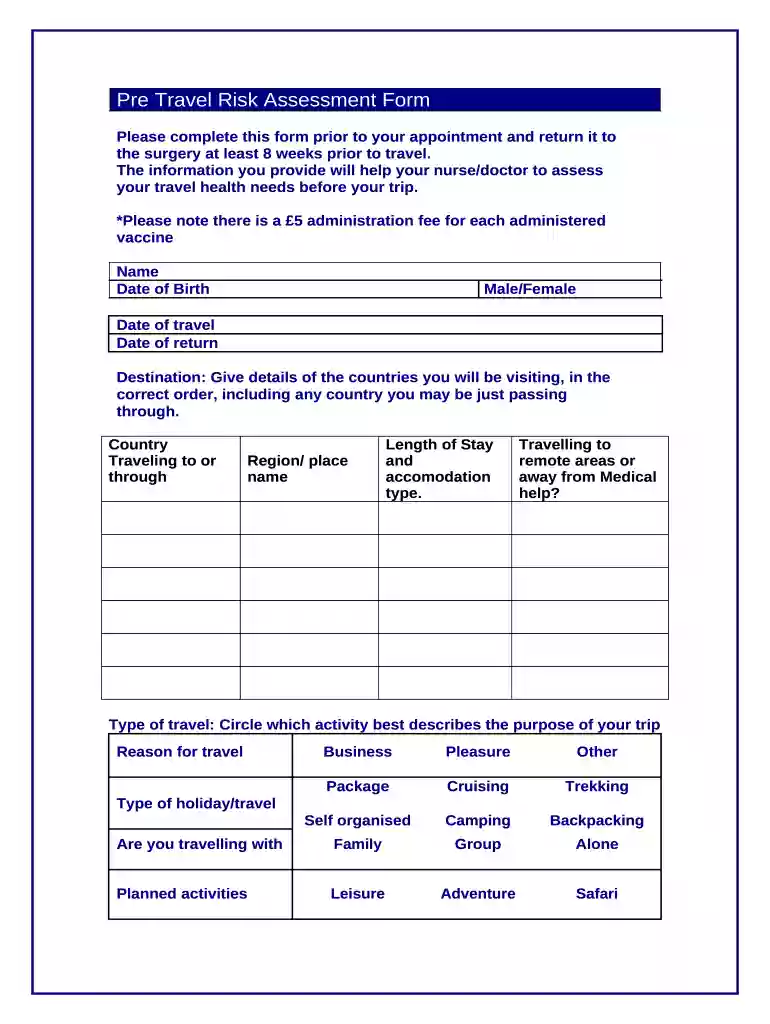
PRE TRAVEL RISK ASSESSMENT FORM Please complete this Preview on Page 1

Here's how it works

01. Edit your form online
Type text, add images, blackout confidential details, add comments, highlights and more.

02. Sign it in a few clicks
Draw your signature, type it, upload its image, or use your mobile device as a signature pad.

03. Share your form with others
Send it via email, link, or fax. You can also download it, export it or print it out.

Definition and Purpose of the Pre Travel Risk Assessment Form

The Pre Travel Risk Assessment Form is a specialized document designed to gather vital information from individuals planning to travel. The form includes sections related to a traveler’s itinerary, medical history, vaccination status, and intended destinations. Its primary purpose is to enable healthcare professionals to assess health risks and provide appropriate medical advice tailored to the traveler’s specific needs. By offering a comprehensive overview of a person’s travel plans and medical background, the form facilitates informed decisions regarding necessary vaccinations, preventive medications, and other health precautions.

How to Use the Pre Travel Risk Assessment Form

To effectively utilize the Pre Travel Risk Assessment Form, individuals should follow specific steps to ensure all relevant information is accurately captured:

  1. Begin by filling out personal information, including name, contact details, and travel dates.
  2. Provide a detailed travel itinerary, specifying destinations, modes of transport, and accommodations.
  3. Disclose any existing medical conditions or allergies, as well as their current treatment plans.
  4. Record vaccination history, emphasizing immunizations pertinent to the travel region.
  5. Indicate if malaria medication is needed by consulting with a healthcare provider.
  6. Review and double-check entries for accuracy before submission.

This structured approach ensures the collected data is thorough and supports the healthcare provider's evaluation.

Steps to Complete the Pre Travel Risk Assessment Form

Completing the Pre Travel Risk Assessment Form involves careful attention to detail and full disclosure of pertinent information across various sections:

  1. Personal Details:

    • Enter full name, date of birth, and passport number.
    • Include emergency contact information.
  2. Travel Itinerary:

    • List all countries and cities to be visited with corresponding dates.
    • Identify potential health risks associated with each destination.
  3. Type of Travel:

    • Specify the purpose of travel (e.g., business, leisure, work) and activities planned.
  4. Medical History:

    • Note any chronic illnesses, past surgeries, and ongoing treatments.
    • Mention any known allergies to medicines or environmental factors.
  5. Vaccination History:

    • Provide records of past vaccinations, including dates and booster shots.
    • Highlight any required vaccines specific to the travel region.
  6. Malaria Medication:

    • Discuss with a healthcare provider if preventive medication is necessary.

Completing each section with precision is crucial to obtaining a tailored pre-travel consultation.

Key Elements of the Pre Travel Risk Assessment Form

The effectiveness of the Pre Travel Risk Assessment Form hinges on several key elements designed to capture comprehensive information:

  • Personal Identification: Ensures the traveler is accurately identified alongside emergency contacts.
  • Detailed Itinerary: Helps evaluate potential exposure to region-specific diseases.
  • Medical and Vaccination Records: Necessary for assessing vulnerabilities and recommendations.
  • Intended Activities: Offers insight into additional health precautions needed for activities like hiking or swimming.
  • Travel Timeframe: Affects medication regimes and vaccination timing.

These elements combine to offer a holistic view of a traveler’s profile, enabling personalized health guidance.

Who Typically Uses the Pre Travel Risk Assessment Form

The Pre Travel Risk Assessment Form is commonly used by:

  • Individuals Traveling Abroad: Particularly those visiting areas with higher health risks.
  • Healthcare Providers: Who utilize the form to offer tailored medical advice.
  • Travel Agencies: Which might use it for organizing and advising on travel plans.
  • Employers: Arranging travel for employees, ensuring compliance with health and safety standards.

Its usage spans diverse sectors, ensuring travelers are well-informed and protected.

decoration image ratings of Dochub

Important Terms Related to the Pre Travel Risk Assessment Form

Understanding specific terminology enhances the efficacy of the Pre Travel Risk Assessment Form:

  • Immunization: The process of becoming immune to certain diseases through vaccination.
  • Prophylaxis: Preventive treatment against diseases such as malaria.
  • Risk Assessment: Evaluation of the potential health risks a traveler may encounter.
  • Chronic Conditions: Long-term health issues that may impact travel.
  • Vector-Borne Diseases: Illnesses transmitted by organisms like mosquitoes and ticks.

Familiarity with these terms aids in accurately completing the assessment.

Legal Use of the Pre Travel Risk Assessment Form

The Pre Travel Risk Assessment Form involves significant legal considerations:

  • Informed Consent: Travelers must consent to share medical information for risk assessments.
  • Confidentiality: Personal and medical information is protected under privacy laws.
  • Professional Liability: Healthcare providers must ensure advice is evidence-based and region-specific.
  • Compliant Record-Keeping: Necessary to comply with healthcare documentation standards.

Adhering to these legal parameters ensures the ethical use of the form.

Examples of Using the Pre Travel Risk Assessment Form

Practical use cases for the Pre Travel Risk Assessment Form include:

  • Business Travelers: Employees visiting regions with ongoing outbreaks receive guidance through completed forms.
  • Student Exchanges: Institutions use the forms to prepare students for international programs.
  • Adventure Tourists: Individuals engaging in high-risk activities abroad use the form for specialized advice.
  • Family Vacations: Families traveling with children complete the form to ensure adequate vaccinations.

These examples illustrate how varying travel contexts benefit from thorough risk assessments.

be ready to get more

Complete this form in 5 minutes or less

Get form

Got questions?

We have answers to the most popular questions from our customers. If you can't find an answer to your question, please contact us.
Contact us
2. Steps needed to manage risk Identify hazards. Assess the risks. Control the risks. Record your findings. Review the controls.
How to Do a Risk Assessment for a School Trip Identify Any Possible Hazards. Outline Who May be Affected by Each Hazard. Determine a System to Rank the Hazards. Describe Suitable Control Measures and Precautions. Record Your Findings.
The risk assessment and mitigation plan should include planning for a pre-departure orientation that will incorporate a discussion of potential health and security risks, the measures to be taken to avoid them, and the steps that need to be taken should serious problems arise.
The travel risk assessment should address hazards associated not only with the travel but may need to include the local situation (for example political unrest), any work activities at the destination.
A risk assessment is a process used to identify potential hazards and analyze what could happen if a disaster or hazard occurs. There are numerous hazards to consider, and each hazard could have many possible scenarios happening within or because of it. Use the Risk Assessment Tool to complete your risk assessment.

Security and compliance

At DocHub, your data security is our priority. We follow HIPAA, SOC2, GDPR, and other standards, so you can work on your documents with confidence.
Learn more
ccpa2
pci-dss
gdpr-compliance
hipaa
soc-compliance
be ready to get more

Complete this form in 5 minutes or less

Get form

People also ask

There are four main types of risk assessments that organisations commonly utilize: qualitative, quantitative, subjective, and objective. In this article, we will explore each type of risk assessment in-depth, discussing their importance, processes, benefits, and limitations.
There are a few general principles to follow to make sure you implement effective risk mitigation and assessment as part of your overall travel risk management strategy. Identify environmental threats. Consider the individuals risks. Evaluate the risks and decide on mitigation measures. Communication and training.

Related links