01. Edit your form online
Type text, add images, blackout confidential details, add comments, highlights and more.

Type text, add images, blackout confidential details, add comments, highlights and more.

Draw your signature, type it, upload its image, or use your mobile device as a signature pad.

Send it via email, link, or fax. You can also download it, export it or print it out.
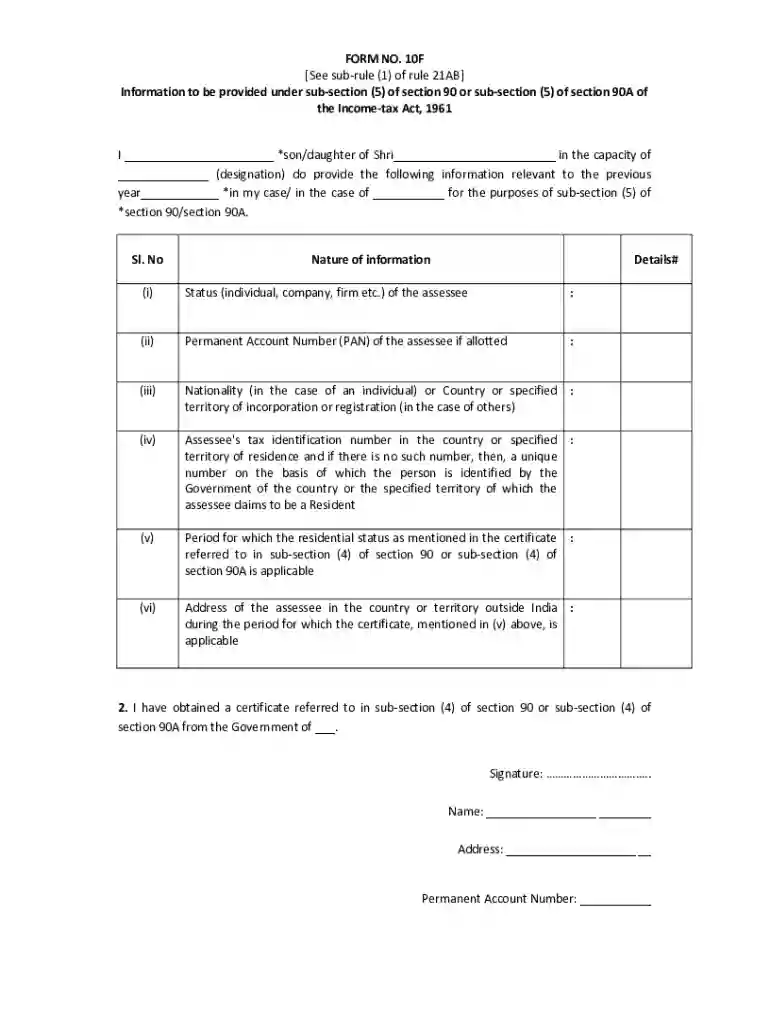
FORM NO. 10F is designed for individuals and entities seeking to claim tax benefits under the Income-tax Act, 1961. Specifically, the form is required under sections 90 and 90A to provide information necessary for availing benefits outlined in taxation treaties between India and other countries. Completing this form involves providing confidential details about the applicant's tax status, ensuring that those requesting treaty benefits meet eligibility criteria.
You can acquire FORM NO. 10F from various sources, including the official website of the Indian Income Tax Department. Additionally, many tax consultancy services and software platforms offer downloadable versions of this form. For those preferring digital solutions, tools like DocHub can facilitate the straightforward acquisition and completion of the form, integrating well into existing digital document workflows for ease and efficiency.
Completing FORM NO. 10F requires careful attention to detail to ensure accuracy and compliance. Below is a step-by-step guide to help you navigate the process:
FORM NO. 10F is crucial for anyone seeking to leverage tax treaties between India and other countries. By accurately completing this form, applicants can benefit from reduced tax rates or exemptions on various sources of income, preventing double taxation and optimizing their tax liabilities in compliance with international agreements.
Typically, FORM NO. 10F is utilized by non-resident individuals, foreign companies, and other entities with income derived from India who wish to claim treaty benefits. This includes businesses operating internationally, expatriates with income from Indian sources, and foreign investors in Indian markets. Understanding who should complete this form is essential for compliance and to leverage available tax reliefs.
The legal framework governing FORM NO. 10F stems from the need to uphold international tax treaties. The form ensures applicants are eligible under the specified treaty provisions, maintaining accurate records for both Indian tax authorities and the applicant's home country. Legal experts advise confirming the applicability of the relevant treaty articles before proceeding with the form submission.
A typical FORM NO. 10F includes several vital elements:
Supporting documentation is necessary when submitting FORM NO. 10F. Documents typically required include:
Ensuring these documents are accurate and up-to-date is critical for a successful application.
You can submit FORM NO. 10F through various channels. The preferred method is often online submission via the Income Tax Department's official portal, providing a convenient and time-efficient option. For those who prefer traditional methods, submission by mail or in person at an authorized tax office is also available. It's crucial to keep proof of submission, especially for audit purposes.
Failure to complete and submit FORM NO. 10F accurately can lead to penalties, including fines and interest on unpaid taxes. Additionally, neglecting to provide this form may result in a denial of treaty benefits, leading to higher tax liabilities. Non-compliance can also tarnish an individual's or company's record with tax authorities, with potential repercussions for future agreements.
While both digital and paper versions of FORM NO. 10F serve the same legal purpose, digital versions offer significant benefits. They are easier to edit and submit, reduce paper waste, and typically come with built-in guidance to prevent errors. When using platforms like DocHub, users can seamlessly fill in their form, integrate necessary attachments, and submit them electronically, ensuring compliance with digital documentation standards.
Understanding and accurately completing FORM NO. 10F is essential for anyone interacting with India's tax system who wishes to benefit from international tax treaties. By following the structured guidance above, you can ensure a smooth and compliant process.
At DocHub, your data security is our priority. We follow HIPAA, SOC2, GDPR, and other standards, so you can work on your documents with confidence.