Definition & Meaning
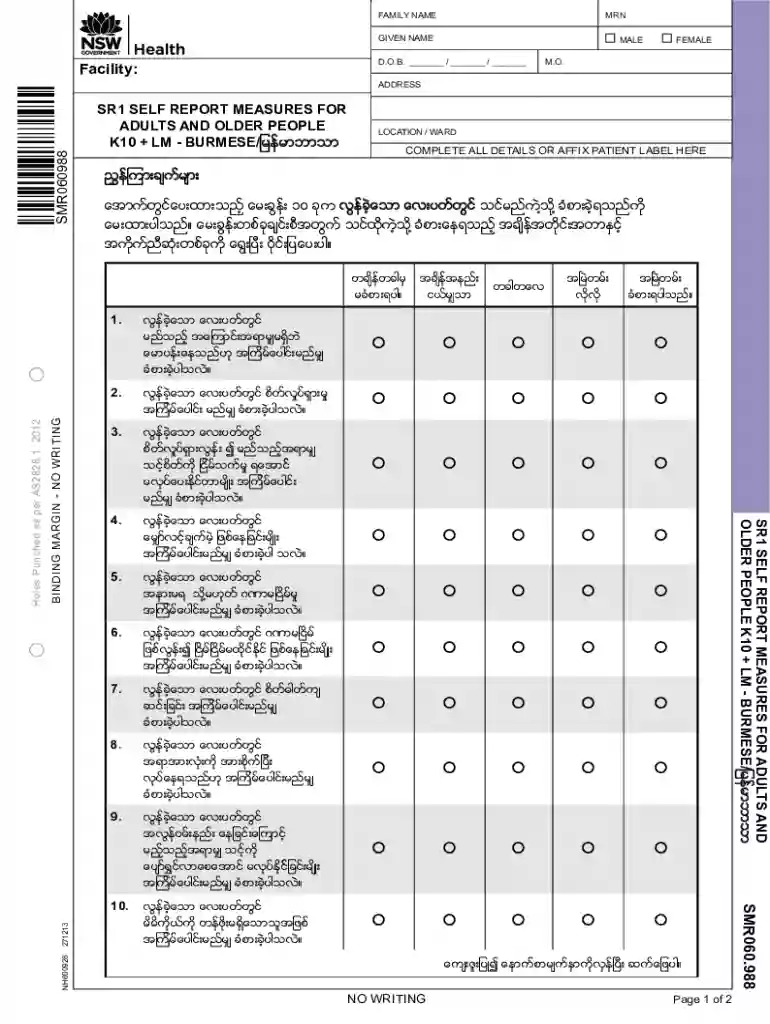
The Kessler 10 (K10) assessment form is a psychological screening tool used primarily to measure a person's emotional well-being. Developed by Dr. Ronald C. Kessler, the K10 is designed to identify levels of psychological distress through a series of ten questions that focus on anxiety and depression symptoms experienced over a four-week period. Respondents assess the frequency of their feelings using a scale ranging from "none of the time" to "all of the time." By evaluating these responses, healthcare professionals can gauge the severity of mental health concerns, playing a crucial role in early intervention and treatment planning.
How to Use the Kessler 10 (K10) Assessment Form
To effectively use the Kessler 10 (K10) assessment form, follow these steps to ensure accurate and comprehensive results:
- Understand the Purpose: Familiarize yourself with the objective of the K10, which is to assess psychological distress levels.
- Create a Comfortable Environment: Ensure the respondent feels at ease to promote honest and accurate responses.
- Guide Respondents: Explain each question clearly, highlighting that there are no right or wrong answers.
- Record Responses: Collect responses accurately, noting how often the respondent has felt certain emotions.
- Scoring: Calculate the total score by summing the values assigned to each response. The total score helps in determining the need for further mental health evaluation.
- Interpret Results: Use established guidelines to interpret the scores, identifying potential anxiety or depression levels.
How to Obtain the Kessler 10 (K10) Assessment Form
Accessing the K10 assessment form is straightforward. Here are several methods to acquire it:
- Healthcare Providers: Many medical professionals offer the K10 in their practice as part of mental health screenings.
- Online Resources: Various mental health websites provide downloadable versions of the form, often for free.
- Mental Health Organizations: Organizations such as the American Psychological Association may offer resources to obtain the assessment form.
- Educational Institutions: Universities with psychology programs might have the form available for use in research and clinical settings.
Steps to Complete the Kessler 10 (K10) Assessment Form
Completing the K10 involves a series of clear steps to gather meaningful data:
- Read Each Question Carefully: Ensure that each question is understood fully.
- Reflect on Your Feelings: Think back over the past four weeks as you consider your responses.
- Respond Honestly: Accurately indicate how often you have experienced each symptom, using the provided frequency scale.
- Double-Check Responses: Review your answers to confirm they reflect your mental state.
- Submit the Form: Depending on the purpose, submit your form to the appropriate healthcare provider or platform for analysis.
Key Elements of the Kessler 10 (K10) Assessment Form
Several crucial components comprise the K10:
- Questions: Ten questions focusing on experiences of nervousness, fatigue, worthlessness, and sadness.
- Rating Scale: A scale ranging from "none of the time" to "all of the time" to quantify distress levels.
- Scoring Guidelines: The score ranges from ten to fifty, with higher values indicating greater psychological distress.
- Instructions for Completion: Clear directions to help respondents understand the process.
Examples of Using the Kessler 10 (K10) Assessment Form
Consider these practical scenarios for applying the K10:
- Clinical Assessment: A counselor uses the K10 to evaluate a new patient presenting with signs of depression.
- Mental Health Research: Researchers employ the K10 in a study assessing stress levels in a post-pandemic environment.
- Community Health Programs: Non-profit organizations conduct mental health screenings using the K10 during outreach events.
Digital vs. Paper Version
Both digital and paper versions of the K10 have distinct advantages:
Digital Version:
- Facilitates quick dissemination and collection of responses.
- Allows for automatic scoring and analysis.
- Ensures accessibility across various devices.
Paper Version:
- Suitable for environments with limited internet access.
- Provides a tactile option that some individuals may prefer.
- Useful in remote areas without reliable technology.
Software Compatibility
Digital tools often support the K10, enhancing its utility:
- Integrated Platforms: Certain medical record software may include the K10 as part of patient assessment modules.
- Standalone Applications: Mobile apps allow for easy completion and scoring of the K10.
- Compatibility with Other Tools: Software like DocHub can facilitate form editing and results sharing without conversion.
Form Variants (Related or Older Versions)
The Kessler 10 has related forms and variants that serve different needs:
- Kessler 6 (K6): A shorter version with six questions, often used for broader public health surveys.
- International Versions: Modified to accommodate cultural differences and language variations to maintain accuracy across diverse populations.
- Expanded Questionnaires: Some research institutions develop tailored versions to target specific demographics or conditions.