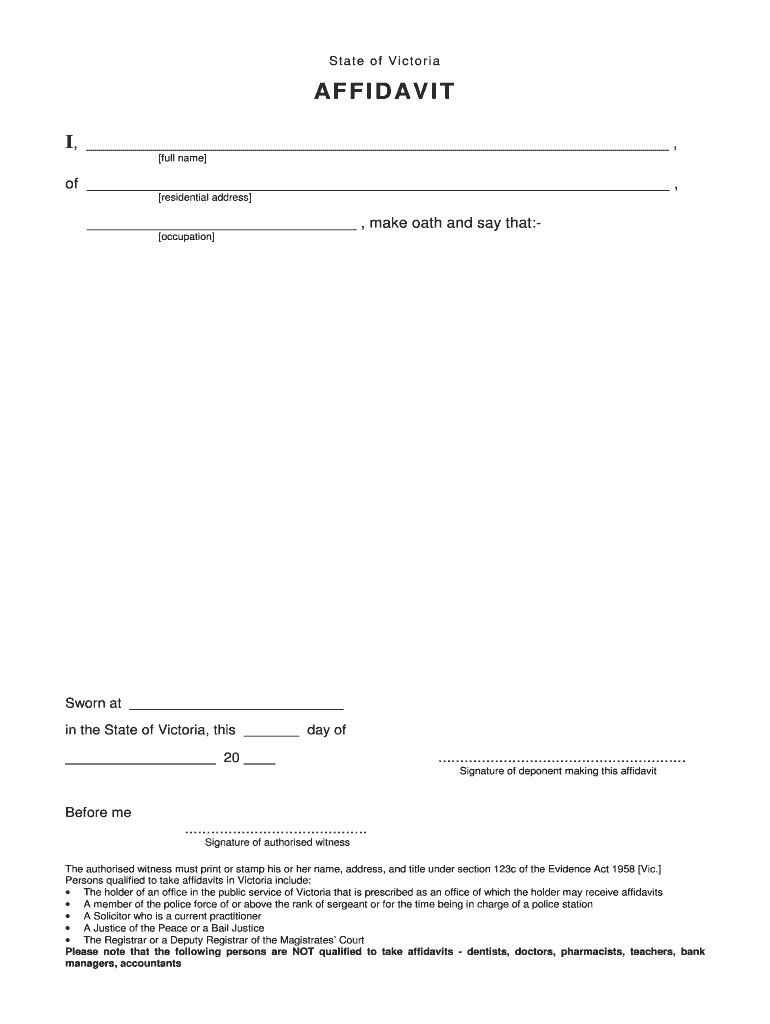







Definition and Meaning of the State of Victoria AFFIDAVIT - Community Law
The State of Victoria AFFIDAVIT - Community Law is a legal document used within the jurisdiction of Victoria, Australia, to formally affirm the truthfulness of a statement or fact. This form is essential in legal proceedings, where the deponent—an individual making the sworn statement—asserts the veracity of their testimony under oath. Completing this form allows for the representation of facts in a manner recognized by the courts. The affidavit is typically witnessed by an authorized party, ensuring that the information provided is reliable and holds legal weight.
Key Elements of the State of Victoria AFFIDAVIT - Community Law
The affidavit consists of several critical components that must be accurately filled out to ensure compliance with legal standards:
- Deponent’s Details: This includes the full name, address, and occupation of the person making the affidavit.
- Statement of Facts: Clearly articulated claims that the deponent wishes to declare under oath.
- Authorized Witness Signature and Details: The affidavit must be signed by an authorized witness. Individuals qualified to take affidavits may include legal professionals like solicitors or public officials assigned to this duty.
- Date and Place: The affidavit must specify where and when it was completed.
Steps to Complete the State of Victoria AFFIDAVIT - Community Law
- Gather Information: Prepare all necessary details, including personal information and facts related to the issue.
- Draft the Statement: Write the facts clearly and concisely, ensuring that each point is truthful and relevant.
- Check Qualifications: Verify that the individual witnessing the affidavit is legally authorized to do so under the Evidence Act 1958.
- Arrange Witnessing: Find an appropriate location and time for the deponent to sign the affidavit in the presence of the authorized witness.
- Complete and Sign: The deponent signs and dates the affidavit, followed by the witness who verifies their identity and the accuracy of the process.
Legal Use and Importance of the Affidavit
Affidavits are integral to legal processes, serving as evidence in court proceedings or as supportive documentation in various legal contexts. The statement’s truth is sworn to, which can lead to legal consequences if dishonesty is proven. Affidavits can be used in civil litigation, probate matters, and other legal processes where factual representation is required.
Who Typically Uses the State of Victoria AFFIDAVIT - Community Law
Individuals who need to submit factual evidence in legal settings commonly utilize this form. These users may include:
- Litigants: Parties involved in court proceedings use affidavits to present their version of facts.
- Legal Professionals: Solicitors or barristers often prepare affidavits on behalf of clients.
- Public Officials: Certain governmental or administrative functions require affidavits for decision-making or regulatory compliance.


Required Documents for Completing the Affidavit
To prepare the affidavit accurately, certain documents may be required:
- Identification Documents: Such as a passport or driver’s license to confirm the deponent's identity.
- Supporting Documentation: Any records or additional documents that validate the facts stated in the affidavit.
State-Specific Rules for the Affidavit
Victoria has specific laws governing affidavit completion and submission:
- Authorized Witness Requirements: Only certain individuals may witness the signing, as outlined in the Evidence Act 1958.
- Oath or Affirmation: The deponent must make a solemn promise of truthfulness, either through an oath (religious) or affirmation (non-religious).
Examples of Using the State of Victoria AFFIDAVIT - Community Law
Various scenarios may require an affidavit, such as:
- Estate and Probate Matters: When verifying claims related to a deceased person's will or estate.
- Family Law Cases: To present facts in custody or divorce proceedings.
- Business Transactions: For sworn statements regarding agreements or disputes between parties.
Penalties for Non-Compliance
Failing to comply with affidavit requirements can lead to serious consequences:
- Perjury Charges: Providing false information in an affidavit may lead to legal action against the deponent.
- Invalid Affidavit: Improper witnessing or incomplete information can render the affidavit useless in legal proceedings.
Digital vs. Paper Version of the Affidavit
Creating an affidavit can be done in both digital and paper formats:
- Digital Affidavits: Some jurisdictions may allow electronic submission, simplifying the process and enhancing accessibility.
- Paper Affidavits: Traditional formats remain valid but require physical signing and witnessing.
How to Obtain the State of Victoria AFFIDAVIT - Community Law
The affidavit form can be acquired through legal aid services or downloaded from court-related websites in Victoria. Legal professionals may also provide assistance in acquiring and completing the form accurately, ensuring all legal requirements are met.