




01. Edit your form online
Type text, add images, blackout confidential details, add comments, highlights and more.

Type text, add images, blackout confidential details, add comments, highlights and more.

Draw your signature, type it, upload its image, or use your mobile device as a signature pad.

Send it via email, link, or fax. You can also download it, export it or print it out.
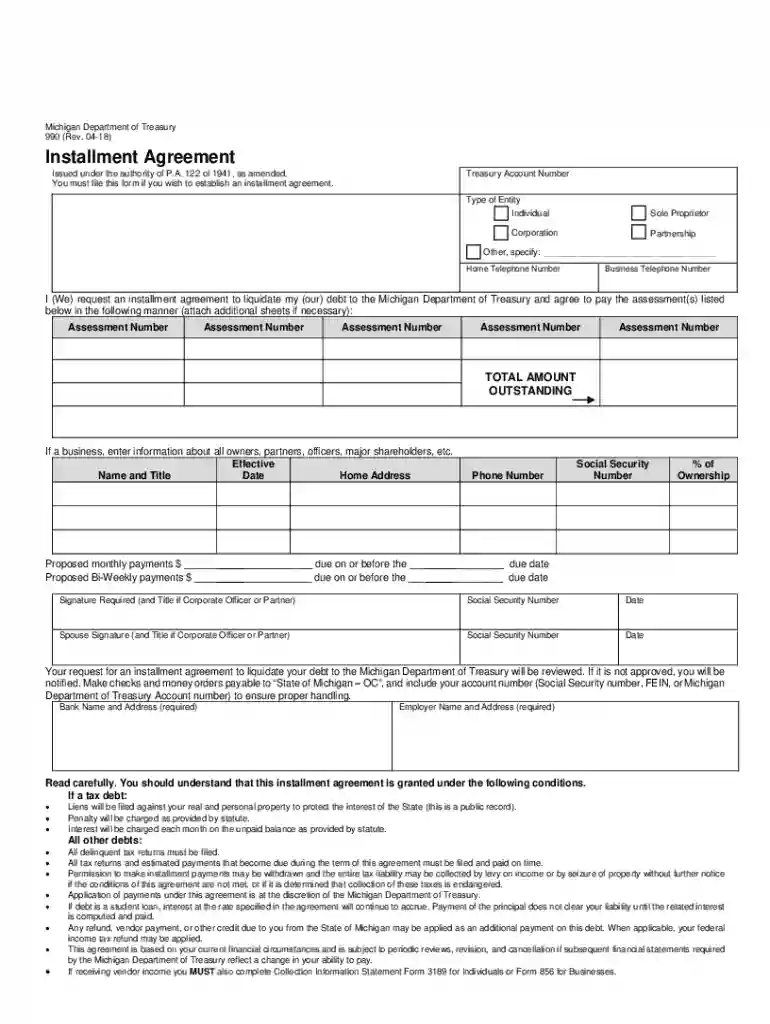
The Michigan Installment Agreement Form 990US Legal Forms is designed to assist individuals and entities in arranging structured payments with the Michigan Department of Treasury. This form facilitates the negotiation of payment terms for outstanding debts, enabling applicants to avoid immediate full payment obligations. It's an essential document in financial planning and debt management, especially for those seeking to distribute their tax liabilities over time instead of making a lump sum payment. The structured nature of the form ensures applicants are aware of their financial commitments and the conditions under which these would be met.
To effectively use the Michigan Installment Agreement Form 990US Legal Forms, it's crucial to begin by collecting accurate financial information. This includes current debts, income sources, and expenses. Once your documentation is gathered, follow these steps:
Examples of submissions vary depending on the debt amount and individual circumstances, so consulting a tax professional may be beneficial.
Completing the Michigan Installment Agreement Form 990US Legal Forms involves precise steps to ensure the form’s acceptance. Here is a step-by-step approach:
Each step requires attention to detail, ensuring your proposal is realistic and sustainable, avoiding potential defaults.
Understanding key terms can facilitate smoother form completion and ensure compliance with legal obligations. Critical terms include:
Familiarity with these terms can provide clarity, reduce confusion during form completion, and reinforce compliance with agreed terms.
Eligibility to use the Michigan Installment Agreement Form 990US Legal Forms is contingent upon several factors, including:
Applicants should review the eligibility criteria closely and, if necessary, consult with tax advisors to confirm their status aligns with applicable requirements.


Using the Michigan Installment Agreement Form legally requires adherence to established procedures and accurate representation of information. Legality encompasses:
Understanding these legal imperatives provides the foundation for a seamless experience and reinforces a trustful relationship with state authorities.
Failure to comply with the terms of the Michigan Installment Agreement Form can have significant repercussions, such as:
Preventing such outcomes involves regular payments and immediate communication with the Michigan Department of Treasury should financial circumstances change.
In preparing to submit the Michigan Installment Agreement Form, certain documents must accompany the application to validate the financial condition:
Ensuring all required documents accompany your form will help streamline processing, potentially expediting approval.
We've got more versions of the Michigan Installment Agreement Form 990US Legal Forms form. Select the right Michigan Installment Agreement Form 990US Legal Forms version from the list and start editing it straight away!
At DocHub, your data security is our priority. We follow HIPAA, SOC2, GDPR, and other standards, so you can work on your documents with confidence.




A party with the right to access a restricted document can still request a paper copy by contacting the Clerks Office in the appropriate seat of Court.Read more
Annual Reports Legal and Financial Jobs and Internships. Technology Transfer, Intellectual Property, and Innovation i trade agreement violations


