Publication 785 2026

Get Form
publication 785 Preview on Page 1

Here's how it works

01. Edit your publication 785 online
Type text, add images, blackout confidential details, add comments, highlights and more.
02. Sign it in a few clicks
Draw your signature, type it, upload its image, or use your mobile device as a signature pad.
03. Share your form with others
Send it via email, link, or fax. You can also download it, export it or print it out.

How to use or fill out publication 785 with our platform

Form edit decoration
9.5
Ease of Setup
DocHub User Ratings on G2
9.0
Ease of Use
DocHub User Ratings on G2
  1. Click ‘Get Form’ to open publication 785 in the editor.
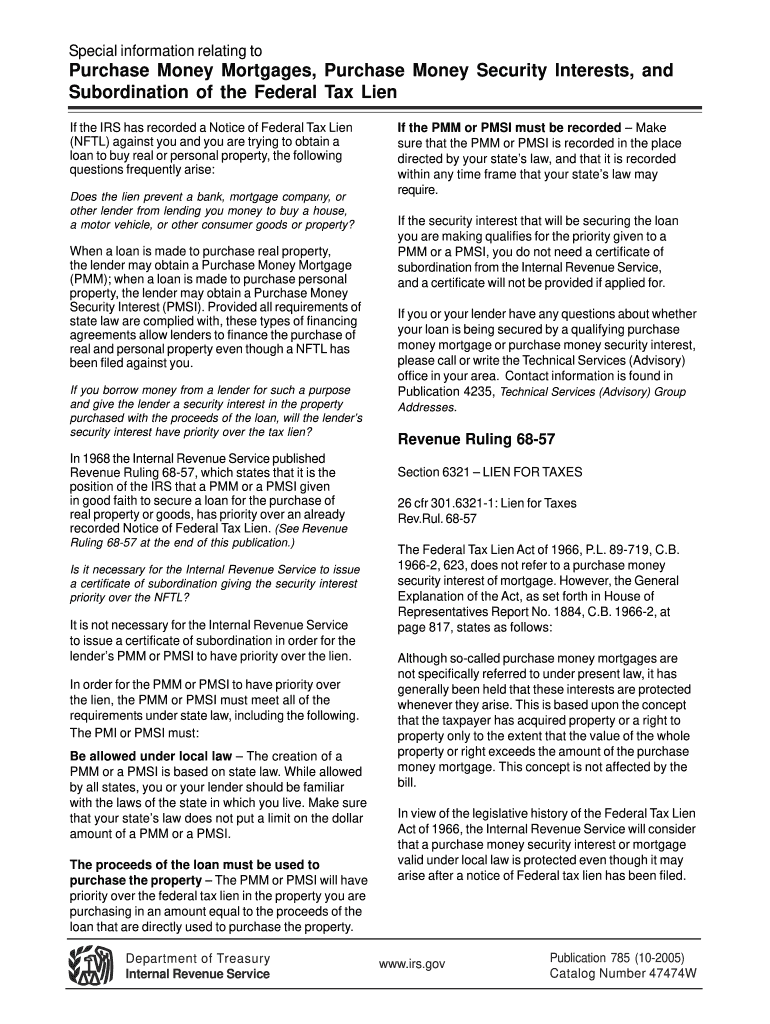
  2. Begin by reviewing the introductory section, which outlines the implications of a Notice of Federal Tax Lien (NFTL) on obtaining loans for real or personal property.
  3. Fill in your personal information in the designated fields, ensuring accuracy as this will be crucial for any lender's assessment.
  4. In the section regarding Purchase Money Mortgages (PMM) and Purchase Money Security Interests (PMSI), indicate whether you are applying for a loan secured by these types of financing agreements.
  5. Ensure that you understand and comply with your state’s laws regarding PMM and PMSI, as indicated in the form. This may involve checking local regulations about recording requirements.
  6. Review all filled sections carefully before submitting to ensure that all necessary information is complete and accurate.

Start using our platform today to easily fill out publication 785 online for free!

See more publication 785 versions

We've got more versions of the publication 785 form. Select the right publication 785 version from the list and start editing it straight away!
Versions Form popularity Fillable & printable
2005 4.9 Satisfied (57 Votes)
be ready to get more

Complete this form in 5 minutes or less

Get form

Got questions?

We have answers to the most popular questions from our customers. If you can't find an answer to your question, please contact us.
Contact us
If you ignore an IRS tax lien, it can lead to serious consequences. The IRS might take money from your bank accounts. They can also garnish your wages. This means they take a part of your paycheck before you even see it.
A lien secures the governments interest in your property when you dont pay your tax debt. A levy actually takes the property to pay the tax debt. If you dont pay or make arrangements to settle your tax debt, the IRS can levy, seize and sell any type of real or personal property that you own or have an interest in.
Tax lien investments can be risky In these instances, investors will profit off the interest portion they collect that exceeds the price they paid for the debt at auction. But, some homeowners will be unable to repay their debts or will file for bankruptcy.
If there is a federal tax lien on your home, you must satisfy the lien before you can sell or refinance your home. There are a number of options to satisfy the tax lien.
How to get rid of a lien. Paying your tax debt - in full - is the best way to get rid of a federal tax lien. The IRS releases your lien within 30 days after you have paid your tax debt.

Security and compliance

At DocHub, your data security is our priority. We follow HIPAA, SOC2, GDPR, and other standards, so you can work on your documents with confidence.

Learn more
ccpa2
pci-dss
gdpr-compliance
hipaa
soc-compliance

People also ask

Federal tax liens typically last for 10 years, which is the same as the statute of limitations for tax debt collection. This period begins on the date the IRS assesses your tax liability and ends when the debt is no longer legally enforceable.
My Property Has a Lien Now What? Pay Off the Lien Once you determine that the lien is valid, the simplest method for removing it is to pay it off. Request a Release-of-Lien Form After paying off the balance of your debt in full, the creditor will file a release-of-lien form.
While tax liens do not appear on credit reports, they are still considered a public record. That means potential lenders could be aware that you owe this money, and this could affect your chances of getting approved for loans, mortgages and more.

Related links