




01. Edit your form 2350 online
Type text, add images, blackout confidential details, add comments, highlights and more.

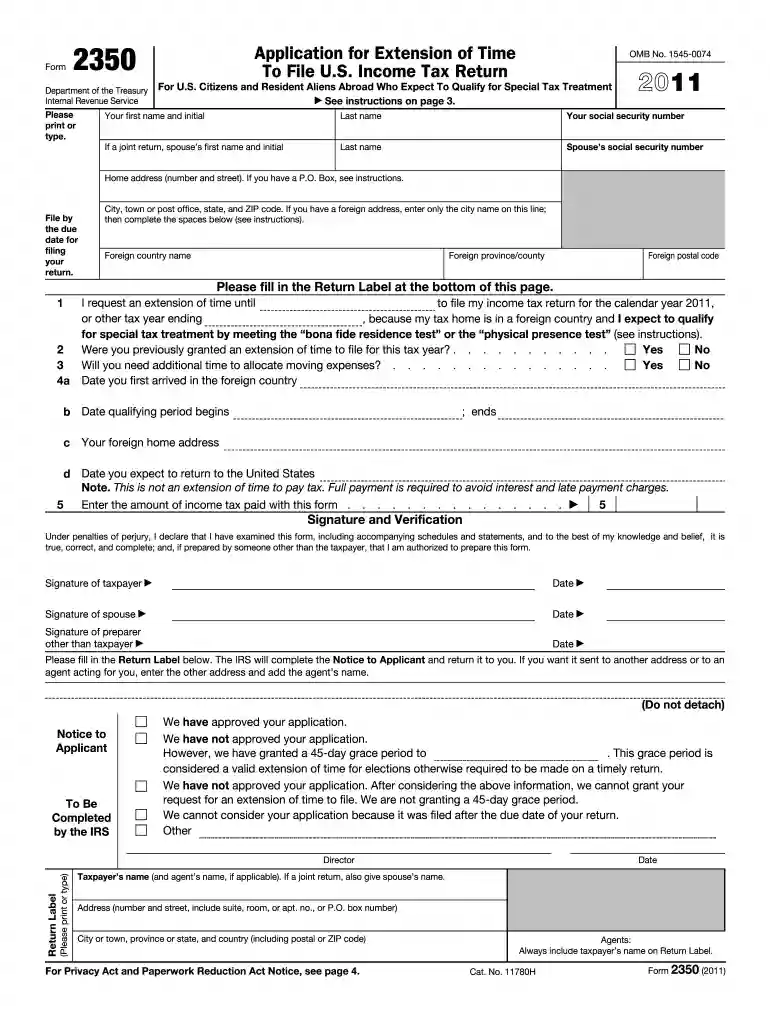
Type text, add images, blackout confidential details, add comments, highlights and more.

Draw your signature, type it, upload its image, or use your mobile device as a signature pad.

Send form 4868 vs 2350 via email, link, or fax. You can also download it, export it or print it out.
The Tax Exempt Form 2350, officially recognized as the "Application for Extension of Time to File U.S. Income Tax Return," serves a specific purpose for U.S. citizens and resident aliens living abroad. Intended primarily for those who anticipate qualifying for special tax treatment, this form provides an extension for filing their income tax returns while ensuring compliance with IRS regulations. However, it is crucial to understand that this extension does not extend the time to pay any taxes due. The form demands detailed information from taxpayers, including personal data and justification for the requested extension, alongside guidelines to file electronically or via mail.
Gather Required Information: Before beginning the form, collect all necessary personal and financial details. This includes full name, address, social security numbers, and estimated tax liability if any.
Complete Personal Details Section: Accurately fill in personal information as required. Be meticulous, as mistakes here can delay your extension approval.
State Reason for Extension: Clearly outline the reasons why an extension is necessary. This should be detailed enough for the IRS to understand your circumstances and may include specific conditions for those living abroad.
Estimate and Record Tax Liability: Calculate and enter any estimated liability. Ensure accuracy, as underestimating can result in penalties.
Review and Submit Form: Conduct a thorough review to ensure all information is correct. Submit the completed form using your preferred method—mail or electronic submission. Keep a copy for your records.
This form primarily supports U.S. citizens and resident aliens residing overseas who need additional time to qualify for specific tax treatments. This includes:


The IRS provides essential guidelines for filling out and submitting Form 2350. These instructions focus on:
Failing to file an extension by April 15 or to pay owed taxes can result in:
Delving into each of these blocks ensures you possess comprehensive insights and guidelines for completing and understanding the implications of using the Tax Exempt Form 2350 Fillable 2011.
We've got more versions of the form 2350 form. Select the right form 2350 version from the list and start editing it straight away!
| Versions | Form popularity | Fillable & printable |
|---|---|---|
| 2025 | 4.1 Satisfied (54 Votes) | |
| 2024 | 4.3 Satisfied (49 Votes) | |
| 2023 | 4.8 Satisfied (57 Votes) | |
| 2022 | 4.4 Satisfied (39 Votes) | |
| 2021 | 4.8 Satisfied (127 Votes) | |
| 2020 | 4.4 Satisfied (205 Votes) | |
| 2019 | 4.3 Satisfied (120 Votes) | |
| 2018 | 4.3 Satisfied (142 Votes) | |
| 2017 | 4.1 Satisfied (62 Votes) | |
| 2016 | 4.4 Satisfied (586 Votes) | |
| 2015 | 4.3 Satisfied (47 Votes) | |
| 2014 | 4 Satisfied (50 Votes) | |
| 2013 | 4.2 Satisfied (35 Votes) | |
| 2012 | 4.2 Satisfied (51 Votes) | |
| 2011 | 4 Satisfied (37 Votes) |
At DocHub, your data security is our priority. We follow HIPAA, SOC2, GDPR, and other standards, so you can work on your documents with confidence.
2a Tax-exempt interest . . . 2a b Taxable interest . . . . . 2b. 3a Qualified dividends . . . 3a b Ordinary dividends . . . . . 3b. 4a IRA distributions .Read more
Product Number Form 2350 Title Application for Extension of Time to File U.S. Income Tax Return, Revision Date 2020 ; Product Number Form 4868 TitleRead more


