







Definition and Meaning of Oscillatory Patterns in Temporal Lobe
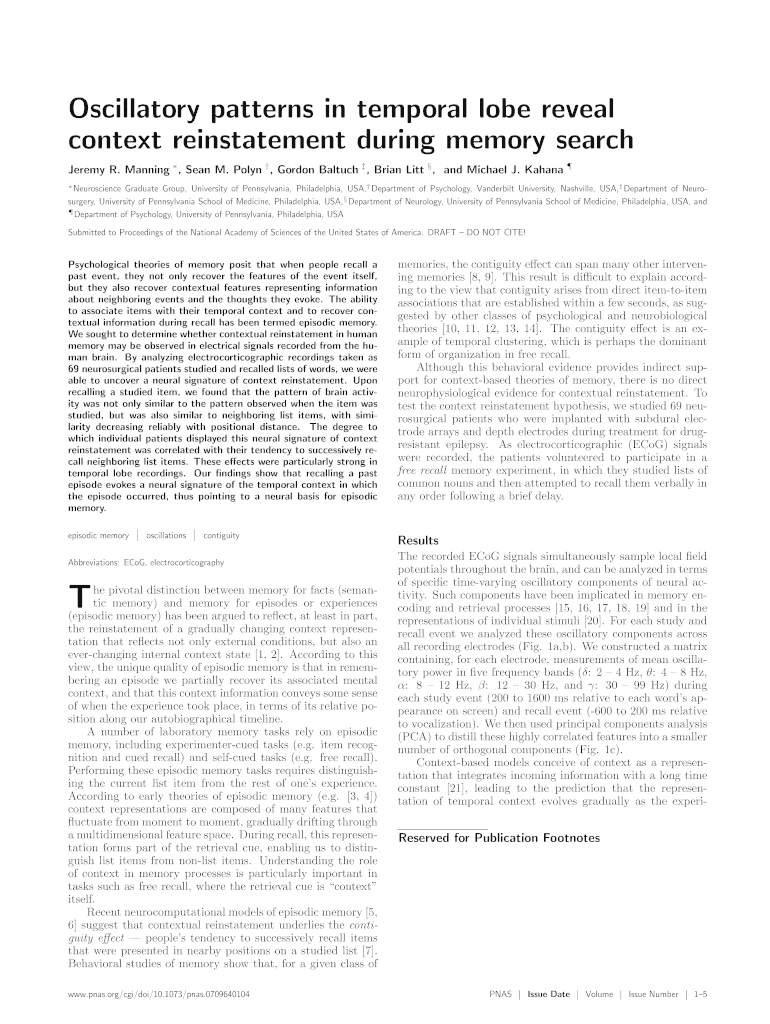
Oscillatory patterns in the temporal lobe are brain activities characterized by rhythmic fluctuations of electrical signals. These patterns play a crucial role in neural processes associated with episodic memory, which involves the retrieval of specific events intertwined with contextual information. In the realm of neuroscience, these patterns are essential clues for understanding how the brain reconstructs past experiences during memory recall. Context reinstatement, a core concept in this theory, suggests that recalling a memory involves reactivating both the primary event and its peripheral details, thus demonstrating the interconnectedness of memory elements within the temporal lobe.
How to Use Oscillatory Patterns for Context Reinstatement
Exploring oscillatory patterns within the temporal lobe requires a detailed approach involving both physiological measurement and analytical interpretation. To employ these patterns for understanding context reinstatement:
- Data Collection: Utilize electrocorticographic recordings to capture brain activity from subjects during memory recall tasks.
- Pattern Analysis: Identify neural patterns corresponding to the learned items and their contextual details.
- Context Matching: Compare current neural patterns with those during the learning phase to determine the strength and accuracy of context reinstatement.
- Result Interpretation: Assess how these patterns fluctuate with varying memory tasks and what that reveals about episodic memory mechanisms.
Key Elements of Oscillatory Patterns and Context Reinstatement
Several elements are central to understanding the role of oscillatory patterns in context reinstatement:
- Rhythmic Signals: Rhythmic patterns serve as markers for specific cognitive processes during memory tasks.
- Temporal Lobe Involvement: As a critical region, the temporal lobe facilitates storage and retrieval of contextual information.
- Signal Comparison: Similarity of current oscillatory patterns to past experiences indicates the level of successful context reinstatement.
- Neurosurgical Studies: Insights are often derived from patient studies, which allow for precise localization and measurement of these neural activities.
Who Typically Uses Oscillatory Pattern Analysis
Research on oscillatory patterns and their role in context reinstatement is predominantly carried out by:
- Neuroscientists: Engaged in research to elucidate the brain's memory mechanisms.
- Cognitive Psychologists: Interested in the implications of memory processes for behavior and cognition.
- Neurologists: Focused on understanding and treating memory-related disorders.
This knowledge is instrumental in developing therapeutic strategies for conditions like Alzheimer's disease, where context reinstatement is severely impaired.
Legal Use of Oscillatory Patterns Research
The research surrounding oscillatory patterns in the temporal lobe must adhere to ethical and legal standards:
- Consent: Participants must provide informed consent before being involved in studies involving neural recordings.
- Privacy: Data collection processes are designed to protect patient identities and maintain confidentiality.
- Use in Treatment: Clinical applications of this research require regulatory approvals, reflecting the medical and therapeutic potential of findings.
Examples and Practical Scenarios
- Memory Rehabilitation: Techniques derived from understanding context reinstatement can aid in therapeutic interventions for memory loss patients.
- Neural Prosthetics: Developing brain-machine interfaces that leverage these patterns to restore lost cognitive functions.
- Educational Tools: Applications in enhancing learning and memory retention techniques, through targeted cognitive training methods.
State-Specific Research Variations
Neuroscientific research, including oscillatory pattern studies, may vary based on state regulations:
- Ethical Boards: Approval by institutional review boards ensuring studies meet local ethical standards.
- Resource Availability: Variations in funding, equipment, and expertise across states might impact the scope and depth of research projects.
- Collaborative Networks: Some states have established networks promoting collaborative research initiatives to facilitate broader understanding.
Digital Tools and Analysis Software
Specialized software and tools are used to analyze oscillatory patterns:
- EEG/ECG Processing Software: Analyzes electrocorticographic data for pattern detection and significance analysis.
- Machine Learning Algorithms: Enhance pattern recognition capabilities, enabling more nuanced investigation of neural activity related to memory and context.
- Data Visualization Tools: Provide clear insights into patterns and context interactions for better interpretation and outreach.
These tools complement traditional neuroscientific methods, offering enhanced precision and enabling detailed exploration of complex neural phenomena.




