




01. Edit your form online
Type text, add images, blackout confidential details, add comments, highlights and more.

Type text, add images, blackout confidential details, add comments, highlights and more.

Draw your signature, type it, upload its image, or use your mobile device as a signature pad.

Send it via email, link, or fax. You can also download it, export it or print it out.
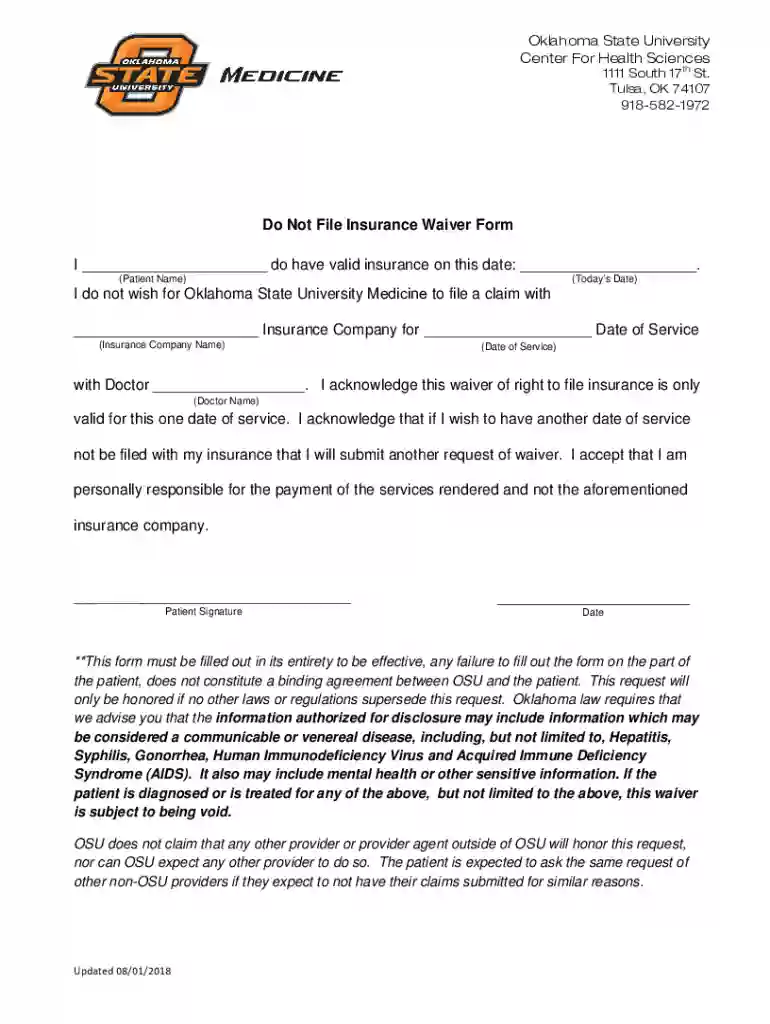
The "Do Not File Insurance Waiver Form" is designed for patients or individuals who choose to decline the submission of their insurance claims for a particular service or treatment. This form explicitly transfers the responsibility of payment from the insurance provider to the individual, ensuring that they acknowledge their valid insurance coverage and agree to pay out of pocket. By completing this form, users can bypass typical insurance claim procedures, opting for direct service payment instead.
To effectively utilize the waiver form, users must follow a structured approach:
Verification of Insurance Status: Ensure active and valid insurance coverage. The form is strictly for those who want to opt-out of insurance claims for specific services.
Completion of Form Fields: Fill out all required fields on the form, which usually include personal details, insurance information, and specific dates of service. Be meticulous in completing each section to avoid submission errors.
Acknowledgment of Terms: Thoroughly review and accept all terms and conditions outlined in the form. This often includes understanding the implications of opting out of insurance claims.
Submission: Once completed, submit the form to the relevant healthcare provider or administrative office. Check if it requires submission through their website, email, or in-person, depending on their preferred method.
Completing the waiver form involves several steps:
Gather Necessary Information: Before starting, collect all relevant personal and insurance documents, as well as details about the healthcare service in question.
Form Access: Obtain the form from the issuing body, usually a healthcare provider or institution such as Oklahoma State University Center for Health Sciences.
Accurate Data Entry: Fill out the form, ensuring all data entries like name, insurance policy number, and date of service are correct.
Double-Check Information: Verify all entered information. Cross-check with original documents to confirm accuracy.
Sign and Date the Form: Authenticate the form by signing it, acknowledging personal responsibility for the payment.
The form contains several crucial sections:
Patient Information: Includes the individual's name, contact information, and insurance identification.
Service Details: Specifies the healthcare services for which they choose to opt-out of filing insurance claims.
Acknowledgment Section: Contains legal disclaimers and terms requiring the individual's acceptance and understanding of personal payment responsibility.
Signature Section: Requires the form to be signed and dated for validation purposes.
The waiver form is legally binding once signed and serves as a formal agreement between the patient and the healthcare provider. It protects both parties by explicitly clarifying that the individual accepts fiscal responsibility, thereby waiving insurance claim rights for specified services. Legal disclaimers include privacy policies about health information.
Variations in state laws may affect the use and application of the form. For instance, certain states might have specific regulations regarding insurance waivers or consumer protection laws. Users should consult local legal guidance or the issuing body for state-specific requirements before submitting the form.
Understanding key terminology is crucial:
Valid Insurance: Insurance that is currently active and meets the service coverage.
Out of Pocket: Payment made directly by the individual without insurance intervention.
Legal Disclaimers: Statements on the form outlining user rights, data sharing, and responsibilities.
Failing to submit a fully completed form or not abiding by the waiver terms can result in the denial of the waiver's benefits, compelling the healthcare provider to revert to standard insurance filing procedures. Non-compliance might also lead to potential surcharges or cancellation of offered payment plans, depending on the provider's policies.
At DocHub, your data security is our priority. We follow HIPAA, SOC2, GDPR, and other standards, so you can work on your documents with confidence.



To initiate the waiver process, log into Axess to view and complete the insurance to do item. Then follow next steps to submit your waiver request.
They contain an arbitration agreement, jury and class action waivers, limitations on Jack in the Boxs liability and other provisions that affect your legalRead more


