South Dakota Quit Claim Deed Form 2026

Get Form
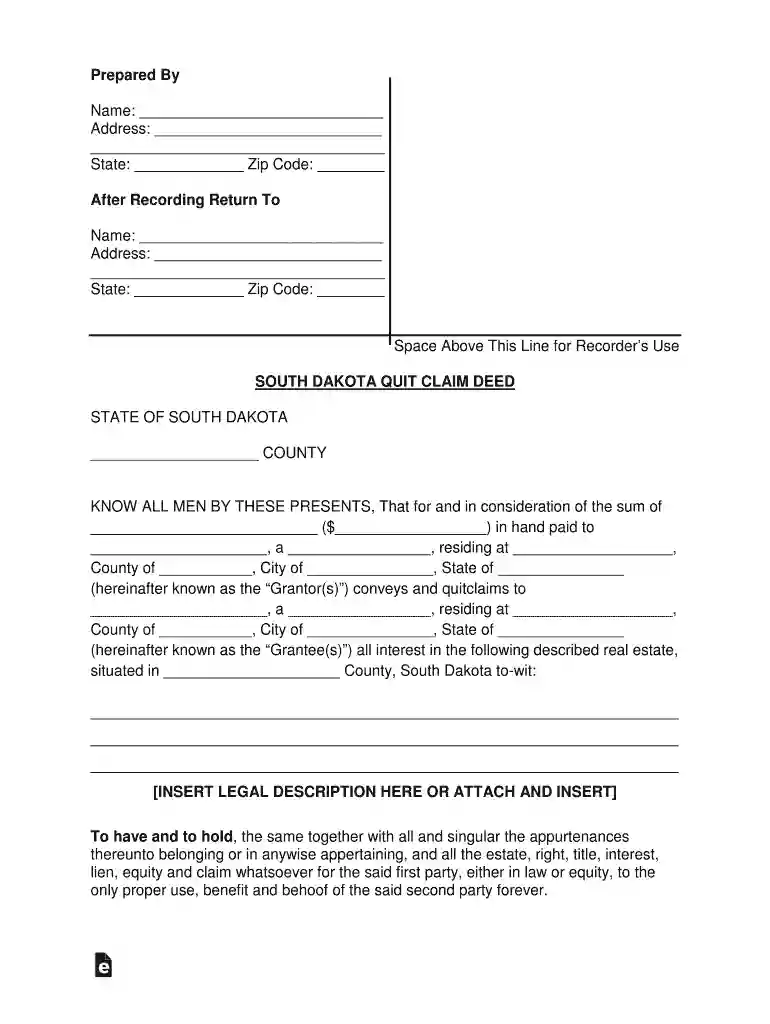
South Dakota Quit Claim Deed Form Preview on Page 1

Here's how it works

01. Edit your form online
Type text, add images, blackout confidential details, add comments, highlights and more.

02. Sign it in a few clicks
Draw your signature, type it, upload its image, or use your mobile device as a signature pad.

03. Share your form with others
Send it via email, link, or fax. You can also download it, export it or print it out.

Definition & Meaning

A South Dakota Quit Claim Deed Form is a legal document used to transfer ownership of real estate from one party, known as the Grantor, to another party, the Grantee. Unlike warranty deeds, a quit claim deed does not guarantee clear title; it simply conveys whatever ownership interest the Grantor may have in the property at the time of the transfer. This form is often used among family members, to clear up title issues, or to add or remove an owner's name from the title.

Key Elements of the South Dakota Quit Claim Deed Form

The form contains several critical elements necessary for its validity:

  • Names of Grantor(s) and Grantee(s): The legal names of the individuals transferring and receiving the property must be precisely stated.
  • Property Description: An accurate legal description of the property, often including the lot number, block, and plat details, that clearly identifies the parcel being conveyed.
  • Consideration: While it may be nominal, like "for the sum of one dollar," it legally states the value exchanged for the property transfer.
  • Signatures: The Grantor's signature is mandatory, and it is often advisable for all involved parties to sign.
  • Notarization: The document must be notarized to confirm the identity of the Grantor and authenticate the signatures.

Steps to Complete the South Dakota Quit Claim Deed Form

  1. Gather Necessary Information: Before starting, ensure you have the complete legal names of the Grantor and Grantee, a detailed property description, and any consideration involved.
  2. Fill Out the Form: Enter the provided information carefully into the corresponding sections of the form.
  3. Sign the Document: Have the Grantor sign the document in front of a notary public to verify the authenticity of the signature.
  4. Notarization: Meet with a notary public, who will verify the identity of the Grantor and notarize the deed.
  5. Record the Deed: Submit the completed and notarized form to the Register of Deeds in the county where the property is located. Recording the deed is essential to offer public notice of the transfer.

Legal Use of the South Dakota Quit Claim Deed Form

The South Dakota Quit Claim Deed Form is legally permissible for several specific purposes:

  • Family Transfers: Commonly used for gifting property among family members due to its simplicity.
  • Title Corrections: Useful in correcting names or removing clouded titles without providing warranty.
  • Divorce Settlements: Frequently used during the division of property as part of divorce proceedings.
  • Business Transactions: Employed within business reorganization or transfer contexts when simplicity is prioritized.

Important Terms Related to the South Dakota Quit Claim Deed Form

Understanding key terms is essential for properly executing the form:

  • Grantor: The individual or entity transferring their interest in the property.
  • Grantee: The individual or entity receiving interest in the property.
  • Consideration: The value exchanged in return for the transfer (monetary or non-monetary).
  • Notarization: The process of certifying the document's signatures through a notary public.

State-Specific Rules for the South Dakota Quit Claim Deed Form

While the basic format of a quit claim deed is standardized, South Dakota enforces several specific rules:

  • Statutory Compliance: Adherence to South Dakota Codified Laws, Title 43 regarding property transfers.
  • Recording Requirements: It mandates recording the deed with the county's Register of Deeds to ensure legal acknowledgment.
  • Transfer Tax: Depending on the transaction, there may be transfer taxes applicable, necessitating disclosure at the time of recording.

Examples of Using the South Dakota Quit Claim Deed Form

  • Property Transfers Between Relatives: For instance, transferring a property title from a parent to a child without any mortgage complications.
  • Assets Reallocation in a Divorce: When one spouse relinquishes rights to a jointly owned property to the other.
  • Resolution of Title Disputes: Such as when correcting clerical errors in the property title by mutual consent.

Required Documents

To effectively complete the transfer, certain supporting documents may be necessary:

  • Previous Deeds: Copies of past deeds to ensure proper transfer chain validation.
  • Identification: Valid government-issued ID for the Grantor to aid in notarization.
  • Tax Certificates or Affidavits: Potential requirement for tax purposes, ensuring compliance with tax obligations.

Who Typically Uses the South Dakota Quit Claim Deed Form

The form is predominantly used by:

  • Family Members: For straightforward, non-compliant property transfers such as gifts.
  • Co-Owners: Individuals seeking to alter co-ownership arrangements.
  • Business Partners: Changing property rights among partnership members.
decoration image ratings of Dochub
be ready to get more

Complete this form in 5 minutes or less

Get form

Got questions?

We have answers to the most popular questions from our customers. If you can't find an answer to your question, please contact us.
Contact us
The quitclaim deed simply transfers any interest they may have to the other party. Because of the lack of title guarantees, quitclaim deeds are most often used to transfer property between two parties who know and trust each other, such as family members.
Recording Requirements: Per SD Codified Laws 43-28-1, quitclaim deeds must be recorded with the County Register of Deeds Office where the real property is situated. Transfer Tax: Yes. The transfer tax is $0.50 for each $500 of value. The grantor must pay the fee (SD Codified Laws 43-4-21).
Ultimately, the main problem with quitclaim deeds is their lack of any guaranty on the part of the person transferring their ownership interest in the property. With a quitclaim deed, the grantor only states that they are transferring any interest they may have in the propertywhatever that interest may be.
Quitclaim deeds offer a quick, simple way to transfer property ownership, particularly between trusted parties like family members or spouses. However, they come with risks and limitations, making them unsuitable for many property transactions where the buyer wants full protection of their purchase.
A quitclaim deed is best suited for the following situations. Transferring Property Between Family Members. Adding A Spouses Name To A Deed. Transferring Property Between Spouses During A Divorce. Removing A Name From Your Mortgage And Deed. Transferring Property Interest To A Business Partner. Fixing Title Errors.

Security and compliance

At DocHub, your data security is our priority. We follow HIPAA, SOC2, GDPR, and other standards, so you can work on your documents with confidence.
Learn more
ccpa2
pci-dss
gdpr-compliance
hipaa
soc-compliance
be ready to get more

Complete this form in 5 minutes or less

Get form

People also ask

Its most commonly used in non-sale situations, such as transfers between family members, or to update or clarify ownership titles. However, because it offers no warranties or guarantees, it carries risk for the grantee. Quitclaim deeds should be used cautiously and under appropriate circumstances.

Related links