FIN 492, Certificate of Exemption - Production Machinery and Equipment pletion of this certificate a 2026

Get Form
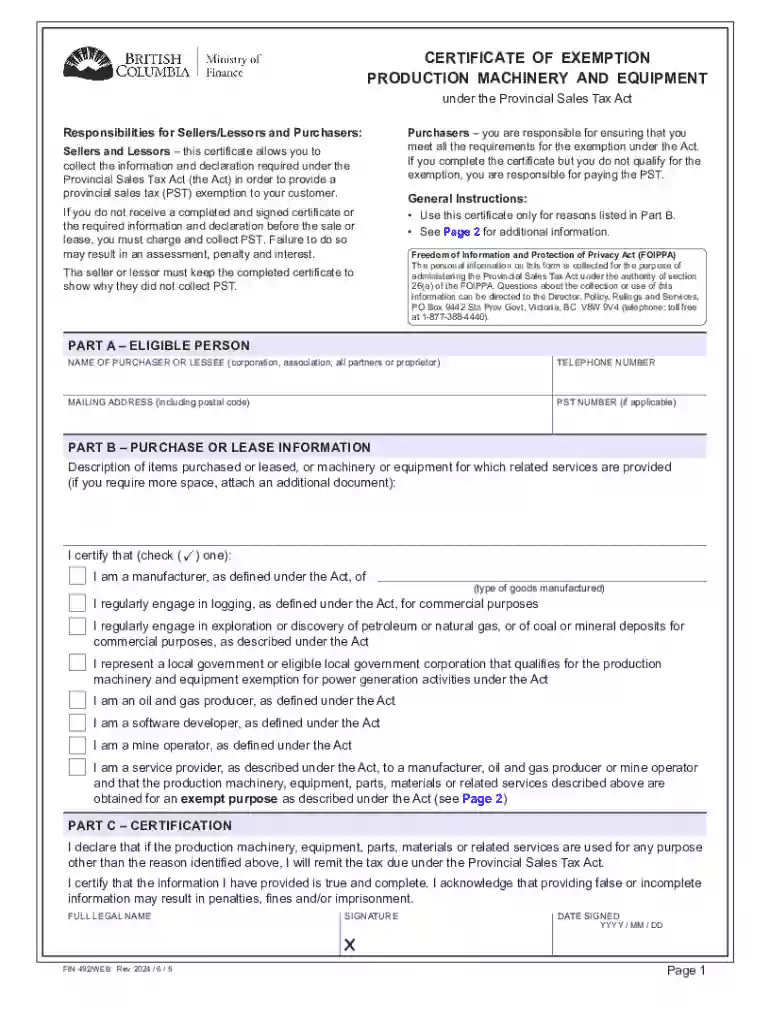
FIN 492, Certificate of Exemption - Production Machinery and Equipment pletion of this certificate a Preview on Page 1

Here's how it works

01. Edit your form online
Type text, add images, blackout confidential details, add comments, highlights and more.

02. Sign it in a few clicks
Draw your signature, type it, upload its image, or use your mobile device as a signature pad.

03. Share your form with others
Send it via email, link, or fax. You can also download it, export it or print it out.

Understanding the FIN 492: Certificate of Exemption for Production Machinery and Equipment

The FIN 492 Certificate of Exemption for Production Machinery and Equipment is a critical document under the Provincial Sales Tax Act. It provides eligible businesses the ability to purchase or lease production machinery and equipment without incurring provincial sales tax (PST). This certificate supports businesses in industrial sectors like manufacturing and processing, allowing them to allocate resources more efficiently towards production rather than tax expenditures.


Using the FIN 492 Certificate

When utilizing the FIN 492 Certificate, businesses must ensure that they comply with the regulations set forth in the Provincial Sales Tax Act. This involves presenting the certificate to sellers or lessors at the time of purchase or lease to validate the tax exemption. It is crucial for businesses to verify that the equipment falls under the eligible categories as specified by the act.

  • Common eligible items include machinery used directly in the production process such as conveyor belts, drilling equipment, and assembly line machinery.
  • Non-eligible items might include office furniture or vehicles primarily used for transportation.

How to Obtain the FIN 492 Certificate

To obtain the FIN 492 Certificate, businesses need to complete an application process which involves:

  1. Downloading the application form from the appropriate government website or office.
  2. Filling out all necessary fields with accurate business information.
  3. Providing necessary documentation that verifies the eligibility of the machinery and equipment for tax exemption.

The completed application must then be submitted through the designated channels, which may include online submission, postal mail, or direct delivery to a government office.


Steps to Complete the FIN 492 Form

Completing the FIN 492 Certificate involves several precise steps to ensure compliance and eligibility:

  1. Identification Information: Enter the legal name of the business, contact details, and business identification number.
  2. Machinery and Equipment Details: List the machinery and equipment to be purchased or leased, including product details and intended use.
  3. Eligibility Confirmation: Check the appropriate boxes to confirm that the machinery meets the exemption criteria.
  4. Signature and Date: Include an authorized signature to certify the correctness of the information provided.

Typical Users of the FIN 492 Certificate

The FIN 492 Certificate is commonly used by businesses engaged in:

  • Manufacturing: Factories and workshops producing components or finished goods.
  • Processing: Facilities involved in altering or refining materials.
  • Large-scale industrial operations: Companies utilizing heavy machinery for production.

These businesses often have substantial investments in machinery, where tax exemptions can significantly reduce operational costs.


Key Elements of the FIN 492 Certificate

When working with the FIN 492 Certificate, it is essential to understand the key elements that make up this document:

  • Eligibility Criteria: Clearly defined conditions under which machinery and equipment qualify for PST exemption.
  • Detailed Descriptions: Specific information regarding the use and nature of the machinery being exempted.
  • Compliance Clauses: Ensure adherence to provincial regulations to maintain exemption status.

Legal Considerations of the FIN 492 Certificate

Using the FIN 492 Certificate entails certain legal obligations.

  • Compliance with the Provincial Sales Tax Act: Non-compliance may result in penalties or loss of exemption status.
  • Record Keeping: Businesses must retain copies of the completed certificates and all related transactions for audit purposes.
  • Accurate Information: Providing false or misleading information can lead to severe legal consequences, including fines or legal action.

Penalties for Non-Compliance

Failure to adhere to the rules associated with the FIN 492 Certificate can result in several penalties:

  • Financial Penalties: Businesses may have to pay back the exempted tax amount along with additional fines.
  • Legal Consequences: Persistent non-compliance may lead to legal proceedings.
  • Suspension of Privileges: Repeated infractions can result in the suspension of eligibility for future exemptions.

Filing Deadlines and Important Dates

It is crucial for businesses to be aware of timelines associated with the FIN 492 Certificate:

  • Renewal Dates: Certificates must be renewed periodically, with deadlines set by the issuing authority.
  • Document Submission: Ensure that all applications and supporting documents are submitted before any stated deadlines to avoid processing delays.

Who Issues the FIN 492 Certificate

The FIN 492 Certificate is issued by provincial tax authorities. Businesses often need to consult these authorities for guidelines on maintaining compliance and understanding updates to the Provincial Sales Tax Act. It's advisable to maintain open communication with these entities to address queries or clarifications related to tax exemptions for production machinery and equipment.

be ready to get more

Complete this form in 5 minutes or less

Get form

Got questions?

We have answers to the most popular questions from our customers. If you can't find an answer to your question, please contact us.
Contact us
Children are exemptions, or deductions, on tax forms; the more children you have the less taxes you pay. Some non-profits are tax-exempt; their exemption means they pay no taxes at all. Exemptions also spare people from fighting in wars and doing some jobs.
To claim exempt, write EXEMPT under line 4c. You may claim EXEMPT from withholding if: o Last year you had a right to a full refund of All federal tax income and o This year you expect a full refund of ALL federal income tax.
A person moving back into the province or is moving here for the first time will be able to apply for settlers effects exemption. Applying for this through ICBC Autoplan will allow the BC resident to not have to pay the PST on their vehicle.
Log in to the iTax Portal using your PIN and password. On the registration form, your PIN and name will be auto populated. Capture the remarks to support the application and click on the submit button. reprinted using the Consult and reprint functionality available under.
Exemption Certificate Definition An exemption certificate is a document that grants an individual or organization relief from certain taxes or fees. These certificates are usually issued by a state agency and are meant to provide a financial break for those who meet certain criteria.

Security and compliance

At DocHub, your data security is our priority. We follow HIPAA, SOC2, GDPR, and other standards, so you can work on your documents with confidence.
Learn more
ccpa2
pci-dss
gdpr-compliance
hipaa
soc-compliance
be ready to get more

Complete this form in 5 minutes or less

Get form

People also ask

In the United States, exemption certificates are commonly associated with sales tax. These certificates serve as official documents issued by state and local governments to specific individuals or entities that meet certain criteria, granting them exemptions from sales tax on designated purchases.
The exemption certificate is properly completed and legible: Name and address of the purchaser. Description of the item to be purchased. The reason the purchase is exempt. Signature of purchaser and date; and. Name and address of the seller.

Related links