




01. Edit your form online
Type text, add images, blackout confidential details, add comments, highlights and more.

Type text, add images, blackout confidential details, add comments, highlights and more.

Draw your signature, type it, upload its image, or use your mobile device as a signature pad.

Send it via email, link, or fax. You can also download it, export it or print it out.
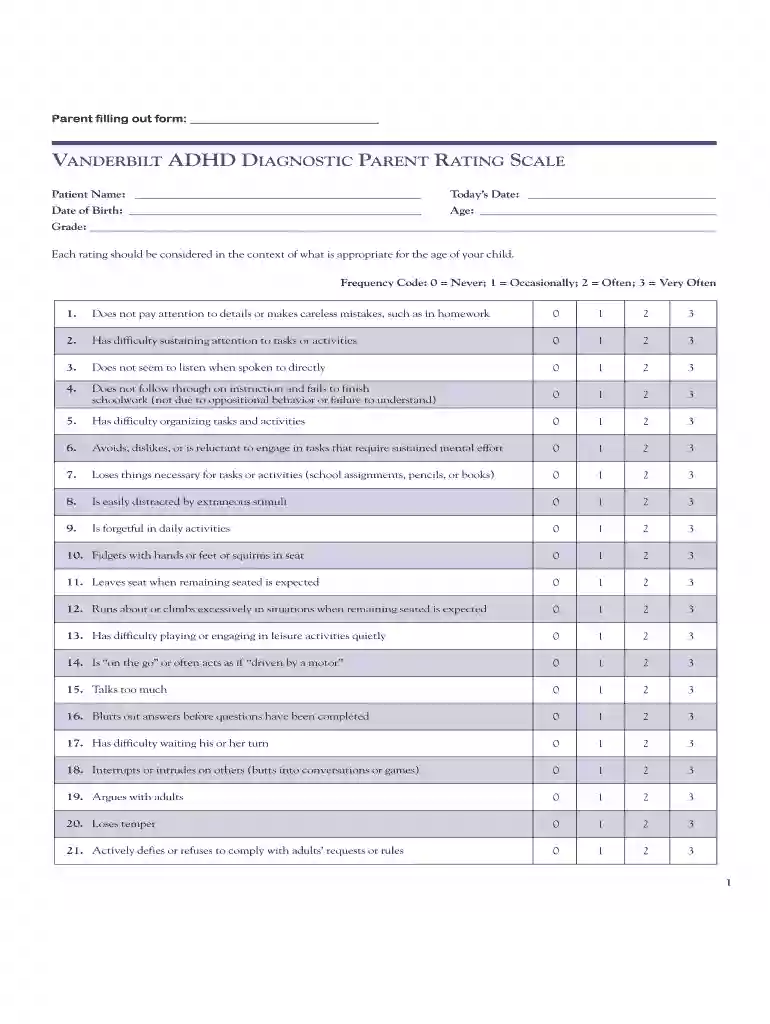
The Vanderbilt ADHD Diagnostic Parent Rating Scale is a crucial tool designed for parents to assess their child's behavior and performance in the context of Attention Deficit Hyperactivity Disorder (ADHD). By providing ratings on the frequency of various behaviors and evaluating academic performance, this form aids in understanding the child's potential ADHD symptoms. Its use extends to educational and medical settings, helping professionals develop tailored interventions based on comprehensive parental insights.
To effectively use the Vanderbilt ADHD Diagnostic Parent Rating Scale, parents need to follow a structured approach. It involves systematically observing their child's behavior over a set period, typically a few weeks, to capture an accurate representation of symptoms:
Familiarize Yourself with the Sections: The form is divided into behavior frequency ratings and sections assessing academic and classroom behavior.
Observe and Record: Regularly monitor your child's behavior across different settings, such as home and school, documenting occurrences of noted behaviors.
Rate Based on Frequency: Assign ratings reflecting how often each behavior is observed, using the scale provided. This helps pinpoint specific areas of concern.
Submit to Relevant Professionals: Once completed, share the form with healthcare providers or educators to facilitate a collaborative approach to your child’s care.
Completing the Vanderbilt ADHD Diagnostic Parent Rating Scale requires careful attention to detail. Follow these steps for an accurate completion:
Read Each Question Thoroughly: Start by understanding the specific behavior or academic performance question.
Consistency in Observations: Make sure to observe your child in different contexts and settings to gather diverse behavioral data.
Accurate Rating Entries: Use the scale provided on the form to rate each question based on your observations.
Check for Completion: Ensure all questions and sections are filled out, as incomplete forms may lead to misinterpretations.
Review and Verify: Double-check entries for accuracy and honesty before submission to the relevant professional.
The Vanderbilt ADHD Diagnostic Parent Rating Scale is made up of several integral parts:
The primary users of the Vanderbilt ADHD Diagnostic Parent Rating Scale are parents tasked with providing vital insights into their child's behavior for professionals. Additionally:


Understanding specific terms can greatly enhance the accuracy and effectiveness of the form:
Accessing the Vanderbilt ADHD Diagnostic Parent Rating Scale can be done through various channels:
Healthcare Provider: Request the form directly from your child’s pediatrician or specialist.
Educational Institutions: School psychologists or counselors may provide the form as part of their evaluation process.
Online Access: Some mental health and educational websites may offer downloadable versions for at-home use.
Parents and professionals can choose between digital and paper versions of the Vanderbilt ADHD Diagnostic Parent Rating Scale, each offering distinct advantages:
Several real-world scenarios showcase the utility of the Vanderbilt ADHD Diagnostic Parent Rating Scale:
New School Year Evaluation: A parent uses the form to provide fresh insight into their child's behavior for the beginning of a new academic year.
Supplementing Parent-Teacher Meetings: The completed form is used as a discussion tool during meetings to align on observed behaviors and educational strategies.
Part of Ongoing ADHD Management: Regular re-assessments help track symptom progression or improvement, aiding long-term care strategies.
At DocHub, your data security is our priority. We follow HIPAA, SOC2, GDPR, and other standards, so you can work on your documents with confidence.



Mar 27, 2024 The scales include a parent version and a teacher version with both intended for completion. The initial assessment screens for symptoms thatRead more
by NP Anderson 2022 Cited by 59 The VADPRS can be used to assess the presence of diagnostic behaviors, comorbidities, and level of impairment in one setting (the home). ThisRead more


