






Understanding the Characteristics of Parabolas
Parabolas are U-shaped graphs defined by quadratic equations. Analyzing these shapes involves understanding several key characteristics: the direction of opening, zeroes, the y-intercept, the axis of symmetry, the vertex, and maximum or minimum values. This analysis forms the foundation of graph interpretation in mathematics and practical applications such as physics and engineering.
Direction of Opening
The direction a parabola opens is dictated by the leading coefficient in its quadratic equation:
- If positive, the parabola opens upwards.
- If negative, the parabola opens downwards.
This property is crucial for determining whether the parabola will have a maximum or minimum value at its vertex.
Identifying Zeroes
Zeroes, or roots, are the x-values where the parabola intersects the x-axis:
- Parabolas can have zero, one, or two real roots.
- Zeroes provide critical solutions to the equation, revealing points of intersection with the x-axis.
Graphing can be a straightforward way to visually determine these intersections.
How to Use the Worksheet for Parabolas
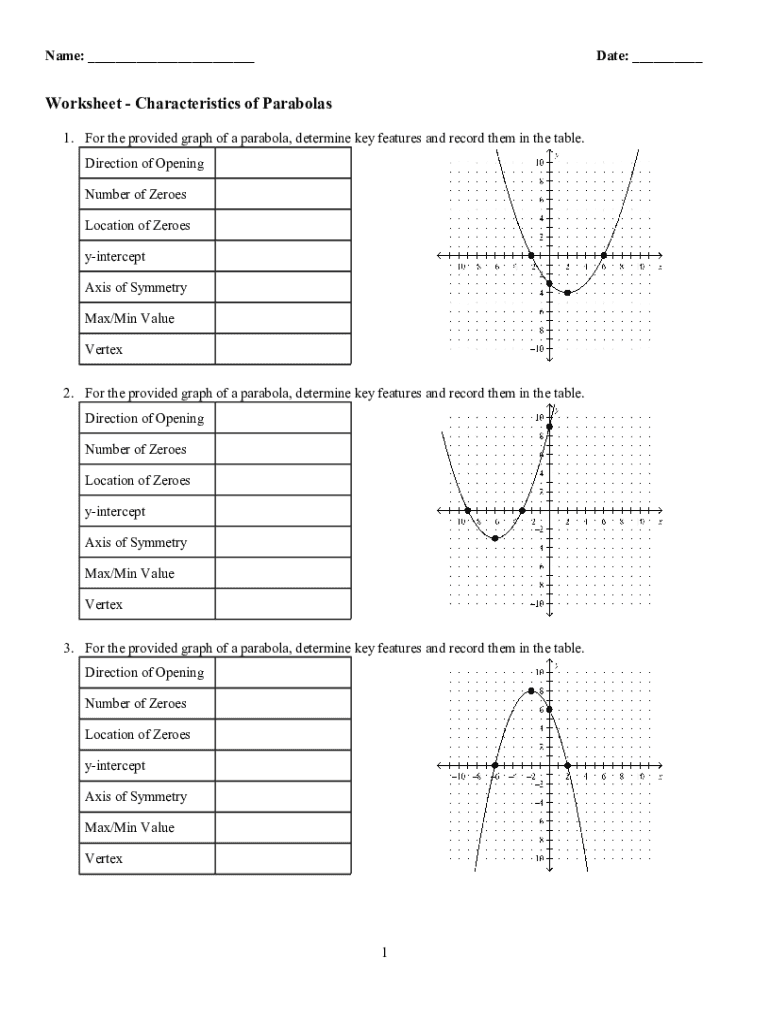
Using the "1 - Worksheet - Characteristics of Parabolas" involves understanding how to record and analyze different attributes of these curves. This is a structured process designed to aid students and professionals in capturing all the necessary data points.
Recording Key Features
When working with the worksheet, users should follow these steps to accurately capture the parabola's characteristics:
- Confirm the equation used to define the parabola.
- Plot the parabola using critical points such as the vertex and intercepts.
- Use the table on the worksheet to document:
- Direction of opening
- Location of zeroes
- y-intercept
- Axis of symmetry
Utilizing Graphs
Graphs integrated into the worksheet guide users through identifying visible features:
- Graphs should be detailed, including labeled axes and scales for clarity.
- Engaging with these graphs helps reinforce understanding through visual aids.
Steps to Complete the Parabola Worksheet
Completing the worksheet methodically ensures a thorough understanding of parabola characteristics. Below is a step-by-step guide:
-
Calculate and Record the Vertex:
- Use the formula ((h, k)) where (h = -b/(2a)) and substitute back to find (k).
-
Determine the Axis of Symmetry:
- This line passes through the vertex and is calculated as (x = h).
-
Identify Zeroes and y-Intercept:
- Solve the quadratic equation to find zeroes.
- Substitute (x = 0) to find the y-intercept.
-
Indicate the Maximum or Minimum Value:
- Derived from the vertex (k), depending on the direction of opening.
-
Fill out the Worksheet:
- Ensure every relevant section is completed based on the analysis and calculations.
Who Typically Uses the Parabola Worksheet
The "1 - Worksheet - Characteristics of Parabolas" is versatile across different educational and professional settings. It is frequently used by:
- High school students in algebra classes
- University students in calculus or physics courses
- Educators designing curriculums focused on quadratic functions
- Engineers and architects utilizing parabolic structures


Key Elements of the Parabola Worksheet
Each component of the worksheet plays a crucial role in ensuring a comprehensive analysis:
- Tables: Used for structured data entry, ensuring no detail is overlooked.
- Graph Sections: Allows users to visually analyze the parabolas.
- Formulas: Incorporated to simplify calculations of characteristics such as vertex and zeroes.
Examples of Using the Parabola Worksheet
Practical scenarios provide insights into how the worksheet can be utilized:
- Academic Assignments: Students may be tasked with comparing two different parabolas, noting differences in their features.
- Research Projects: Researchers could use the worksheet to model trajectories and paths in physics experiments.
- Design Proposals: Architects might analyze structural curves using parabolas for bridges or arches.
Important Terms Related to Parabolas
Understanding specific terminology enhances the effectiveness of the worksheet:
- Vertex: The peak or lowest point of a parabola.
- Axis of Symmetry: A line dividing the parabola into symmetrical halves.
- Intercepts: Points where the parabola intersects the axes (x and y).
Comprehending these terms solidifies the foundational knowledge needed to accurately apply the worksheet's guidance.