







Definition and Meaning
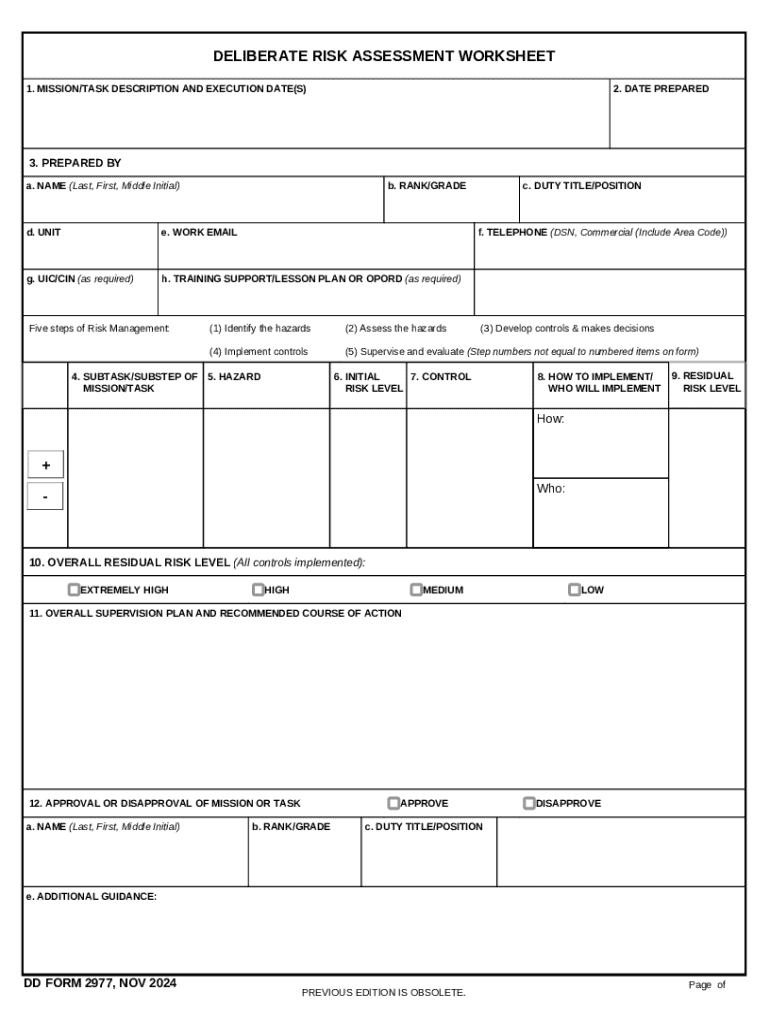
The Deliberate Risk Assessment Worksheet (often referenced as DD Form 2977) is a structured document used mainly within military contexts to systematically evaluate and manage risks associated with missions or tasks. This strategic tool helps in identifying potential hazards, assessing the level of risk they pose, and determining suitable control measures to mitigate these risks. The focus is on ensuring the safety and readiness of personnel by offering a comprehensive overview of potential threats and how they can be managed effectively.
Key Elements of the Deliberate Risk Assessment Worksheet
The Deliberate Risk Assessment Worksheet is divided into specific sections, each serving a unique purpose in the risk assessment process.
- Mission or Task Description: This section requires detailed information about the mission or task, including its objectives and scope.
- Hazard Identification: This part involves identifying possible hazards that could arise during the mission.
- Risk Assessment Levels: Users must assess and categorize the level of risk (low, medium, or high) associated with each identified hazard.
- Control Implementation: It outlines the control measures that should be put in place to either eliminate or reduce the identified risks.
- Residual Risk Evaluation: After implementing controls, residual risks are assessed to ensure they are within an acceptable range.
- Approval Process: This involves specifying the authority responsible for approving the risk assessment before the mission proceeds.
Steps to Complete the Deliberate Risk Assessment Worksheet
Completing the Deliberate Risk Assessment Worksheet involves a systematic approach and thorough analysis.
- Identify the Mission: Clearly define the mission or task details, objectives, and parameters.
- List Hazards: Brainstorm potential hazards that could occur during the mission. Consider environmental, technical, and operational factors.
- Assess Initial Risk Level: Assign a risk level to each hazard identified based on the likelihood and severity of its occurrence.
- Develop Controls: For each high-risk element, develop strategies and controls aimed at mitigating the associated risks.
- Reassess Risks: With control measures in place, reevaluate the risk levels to determine residual risks.
- Documentation and Approval: Document the assessment findings and submit them for review and approval by the designated authority.
Why You Should Use the Deliberate Risk Assessment Worksheet
The primary purpose of using the Deliberate Risk Assessment Worksheet is to enhance mission safety and efficiency.
- Safety Assurance: By systematically identifying and addressing potential risks, organizations can significantly reduce the likelihood of accidents.
- Enhanced Planning: Understanding potential pitfalls allows for better contingency planning and resource allocation.
- Compliance: Many military operations mandate the use of risk assessments as part of the procedural compliance requirements.
- Decision-Making: Encourages informed decision-making by providing comprehensive risk data to stakeholders.
Who Typically Uses the Deliberate Risk Assessment Worksheet
Primarily, the Deliberate Risk Assessment Worksheet is utilized by military personnel involved in planning and executing missions. However, the principles can also be applicable to:
- Training Instructors: Responsible for developing training programs that require risk evaluation.
- Operational Commanders: Who need to assess risks before mission execution.
- Risk Management Officers: In charge of organizational safety protocols.


Legal Use of the Deliberate Risk Assessment Worksheet
The worksheet not only aids in risk management but also serves as a legal document ensuring compliance with safety regulations.
- Audit Trail: Provides a documented trail of safety measures considered and implemented.
- Liability Reduction: Demonstrates proactive risk management, which can be crucial in legal or regulatory audits.
- Standardized Documentation: Conforms with military paperwork requirements, ensuring uniformity and consistency across operations.
Important Terms Related to Deliberate Risk Assessment Worksheet
Familiarity with certain terminology is crucial when using the worksheet:
- Hazard: A potential source of harm or adverse effect.
- Risk Level: The degree of likelihood that a hazard may occur, often rated as low, medium, or high.
- Controls: Strategies put in place to mitigate risks.
- Residual Risk: The level of risk remaining after controls are implemented.
Examples of Using the Deliberate Risk Assessment Worksheet
Consider a military training exercise involving live ammunition. Using the worksheet:
- Hazards Identified: Misfire or stray bullet risks, terrain challenges.
- Controls Established: Safety briefings, secured training zones, use of protective gear.
- Risk Levels Assessed: Initial high risk reduced to low after controls.
- Residual Risk Evaluation: Acceptable with standard safety measures in place.
These examples illustrate the worksheet’s role in creating informed, safer operational conditions.




