Big idea canvas 2026

Get Form
big idea canvas Preview on Page 1

Here's how it works

01. Edit your big idea canvas online
Type text, add images, blackout confidential details, add comments, highlights and more.

02. Sign it in a few clicks
Draw your signature, type it, upload its image, or use your mobile device as a signature pad.

03. Share your form with others
Send it via email, link, or fax. You can also download it, export it or print it out.

Definition and Meaning of the Big Idea Canvas

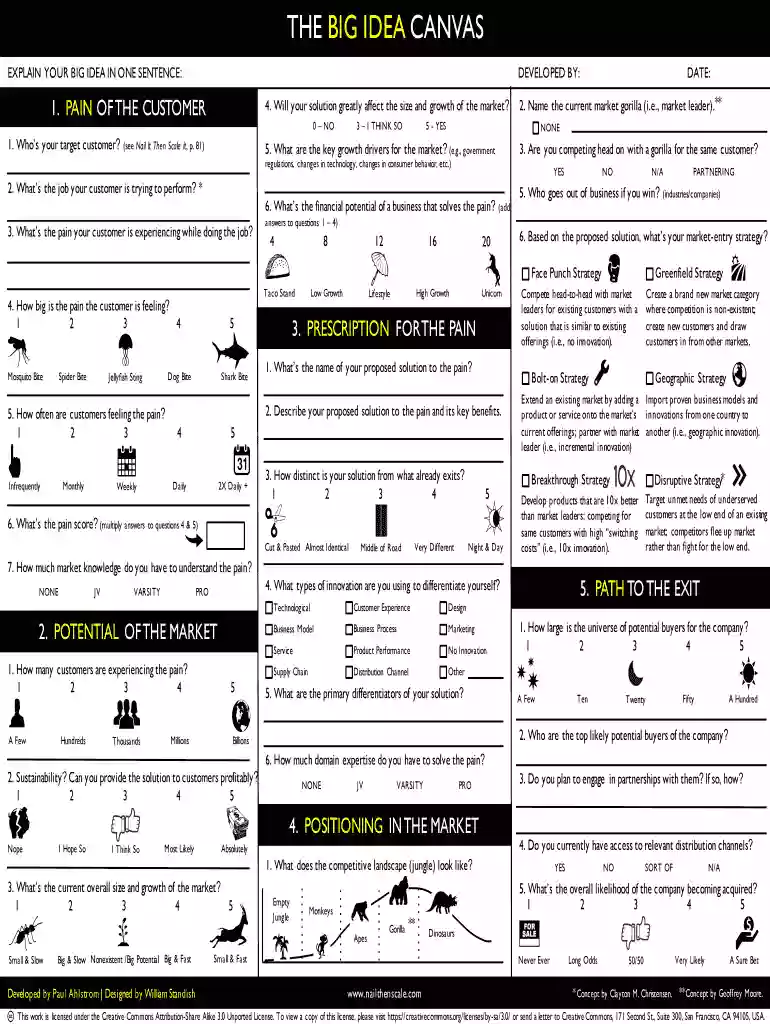
The Big Idea Canvas is a strategic framework designed to help entrepreneurs articulate and test their business ideas. It provides a structured approach to identify and validate critical aspects of a business concept. The canvas includes sections for outlining customer pain points, assessing market potential, analyzing the competitive landscape, and formulating a Big Idea Hypothesis. This framework is instrumental in clarifying the business concept and aligning strategy before engaging with potential customers or developing prototypes. It is an invaluable tool for entrepreneurs seeking to ensure that their business idea is robust and viable.

Key Elements of the Big Idea Canvas

The Big Idea Canvas comprises several key sections, each focusing on different aspects of a business strategy. These elements include:

  • Customer Pain Points: Identify the specific problems or challenges that the business idea aims to solve.
  • Market Potential: Evaluate the size and growth potential of the market.
  • Competitive Landscape: Analyze existing competitors and determine the business's unique value proposition.
  • Big Idea Hypothesis: Formulate a clear hypothesis about your business concept, detailing how it will succeed in the market.

Each section requires thoughtful consideration to ensure the comprehensive evaluation of the business idea.

Steps to Complete the Big Idea Canvas

Completing the Big Idea Canvas involves a series of methodical steps, each requiring careful analysis and documentation:

  1. Identify Customer Needs: Conduct market research to understand the specific needs and pain points of your target audience.
  2. Assess Market Dynamics: Analyze the market size, growth trends, and demographic shifts to gauge the market potential.
  3. Evaluate Competition: Research direct and indirect competitors to identify strengths and weaknesses.
  4. Craft the Hypothesis: Develop a hypothesis that outlines your business concept and its potential impact.

Attention to detail in each step ensures a well-rounded business strategy.

How to Use the Big Idea Canvas

Using the Big Idea Canvas effectively requires an understanding of its purpose and structure. This framework is typically used during the early stages of business development to ensure all critical aspects are addressed:

  • Brainstorming: Collaborate with team members to gather diverse perspectives.
  • Documentation: Capture insights and data in each section of the canvas for future reference.
  • Iteration: Iteratively refine the canvas based on feedback and new information.

This process helps entrepreneurs maintain a focused approach to business development.

Examples of Using the Big Idea Canvas

Real-world examples can illustrate the practical application of the Big Idea Canvas:

  • Tech Startups: A tech startup may use the canvas to identify a unique software solution that addresses a gap in the market for productivity tools.
  • Retail Businesses: A new retail business might leverage the canvas to uncover customer pain points related to e-commerce experiences.
  • Nonprofits: Nonprofit organizations can use the framework to clarify their mission and reach stakeholders more effectively.

These scenarios demonstrate the versatility of the Big Idea Canvas across different industries.

Who Typically Uses the Big Idea Canvas

The Big Idea Canvas is primarily used by entrepreneurs and business developers. However, it is also valuable for:

  • Innovation Teams: Within established companies seeking to explore new product lines or services.
  • Consultants: For advising clients on strategic planning and business development.
  • Educators: As a teaching tool in business courses to illustrate real-world business planning.

The canvas is widely applicable across various sectors and organizational roles.

decoration image ratings of Dochub

Business Types That Benefit Most from the Big Idea Canvas

Certain business types particularly benefit from the strategic insights provided by the Big Idea Canvas:

  • Startups and New Ventures: For crafting and validating initial business strategies.
  • Small and Medium Enterprises (SMEs): Looking to expand or pivot their market positioning.
  • Innovative Enterprises: Seeking to incorporate disruptive technologies or business models.

These businesses gain a clearer strategic direction through the structured approach of the canvas.

Legal Use of the Big Idea Canvas

While the Big Idea Canvas is primarily a business planning tool, its use must adhere to legal and ethical standards:

  • Confidentiality: Protect sensitive business information shared during brainstorming sessions.
  • Intellectual Property: Safeguard any innovative ideas documented within the canvas.
  • Regulatory Compliance: Ensure the business strategies comply with industry-specific regulations.

Adhering to these legal considerations ensures ethical use of the Big Idea Canvas and protects the business's strategic interests.

be ready to get more

Complete this form in 5 minutes or less

Get form

Got questions?

We have answers to the most popular questions from our customers. If you can't find an answer to your question, please contact us.
Contact us
The Big Idea Hypothesis This Big Idea Hypothesis represents your idea about the solution to the pain you observed and is where you create the future by inventing it. The Big Idea Hypothesis can be a breakthrough hypothesis or a better faster cheaper hypothesis.
Big ideas are concepts, debates, or theories that are at the core of a discipline and that you, as a teacher, can choose to put at the core of your course. What drives you to do what you do as a teacher, a researcher, an academic?
Here are a few examples of big ideas from brands you know: Google: to organize the worlds information and make it universally accessible and useful. Amazon: to be earths most customer-centric company; to build a place where people can come to find and discover anything they might want to buy online.
Its simple but powerful. With this rule, you: -Focus on just three key messages about your brand or product -Choose three core audience segments to target -Invest in three marketing channels where your audience spends time Why does this work so well? It forces you to simplify and clarify what matters most.
Big Idea in marketing and advertising is a term used to symbolize the foundation for a major undertaking in these areas - an attempt to communicate a brand, product, or concept to the general public, by creating a strong message that pushes brand boundaries and resonates with the consumers.

Security and compliance

At DocHub, your data security is our priority. We follow HIPAA, SOC2, GDPR, and other standards, so you can work on your documents with confidence.
Learn more
ccpa2
pci-dss
gdpr-compliance
hipaa
soc-compliance
be ready to get more

Complete this form in 5 minutes or less

Get form

People also ask

The Big Idea boils down the so-what of your overall communication even further: to a single sentence. This is a concept that Nancy Duarte discusses in her book, Resonate. She says the Big Idea has three components: It must articulate your unique point of view; It must convey whats at stake; and.

Related links