




01. Edit your form online
Type text, add images, blackout confidential details, add comments, highlights and more.

Type text, add images, blackout confidential details, add comments, highlights and more.

Draw your signature, type it, upload its image, or use your mobile device as a signature pad.

Send it via email, link, or fax. You can also download it, export it or print it out.
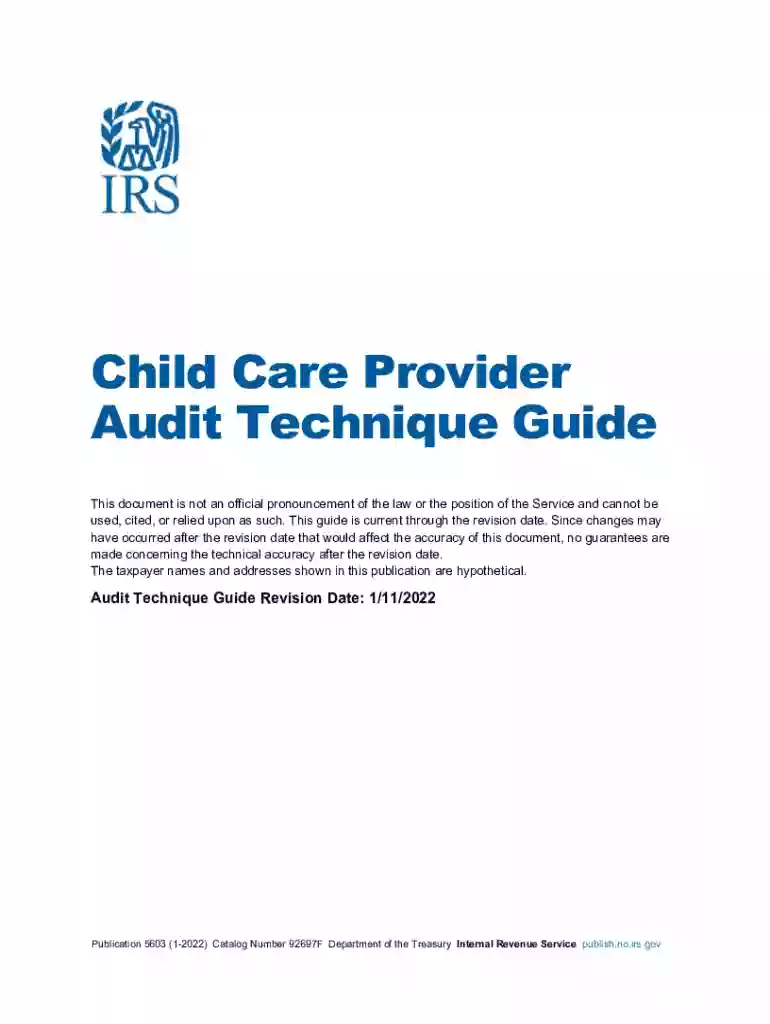
The "Child Care Provider Audit Technique Guide" is a detailed resource crafted to assist examiners during audits of child care providers. This guide outlines critical procedures and offers comprehensive insights into auditing practices specific to the child care industry. It delineates the types of child care services audited, exploring potential income and expense issues. By emphasizing accurate record-keeping and understanding tax obligations, the guide serves as an essential tool for examiners. It also covers unique dedications that are applicable within this sector, such as food program reimbursements and business use of home deductions.
The guide is meant to streamline the audit process by providing a structured approach to examine the financial and operational aspects of child care services. Examiners can follow the guide to verify a provider’s income streams and expense claims effectively. It helps auditors to:
Typically, the guide is available through the Internal Revenue Service (IRS) or other official government channels. Being an integral part of audit training, access might also be provided through professional organizations or upon employment in a relevant auditing position.
To complete a child care provider audit using the guide, follow these core steps:
This guide plays a pivotal role in maintaining compliance and accuracy within the child care sector. By systemizing audit methods, it ensures consistency and thoroughness, thereby:
The primary users of this guide include IRS auditors and tax examiners who are responsible for conducting audits on child care services. However, it can also be utilized by:
The guide underscores the legal frameworks relevant to the child care industry, particularly about tax documentation and deduction claims. Users must be mindful of regulations concerning:
Key elements of the Child Care Provider Audit Technique Guide include comprehensive sections on:
These components collectively form a robust framework that supports detailed and accurate audits of child care providers.
We've got more versions of the Child Care Provider Audit Technique Guide form. Select the right Child Care Provider Audit Technique Guide version from the list and start editing it straight away!
At DocHub, your data security is our priority. We follow HIPAA, SOC2, GDPR, and other standards, so you can work on your documents with confidence.



IRS Audit Technique Guide available at IRS.gov. day care providers often overstate the deduction for business use of the home. Inadequate records. Page 4Read more
Title Child Care Provider Audit Technique Guide, Revision Date Jan 2022 Title IRC Section 48A and 48B Audit Technique Guide Advanced Coal and Gasification


