




01. Edit your form online
Type text, add images, blackout confidential details, add comments, highlights and more.

Type text, add images, blackout confidential details, add comments, highlights and more.

Draw your signature, type it, upload its image, or use your mobile device as a signature pad.

Send it via email, link, or fax. You can also download it, export it or print it out.
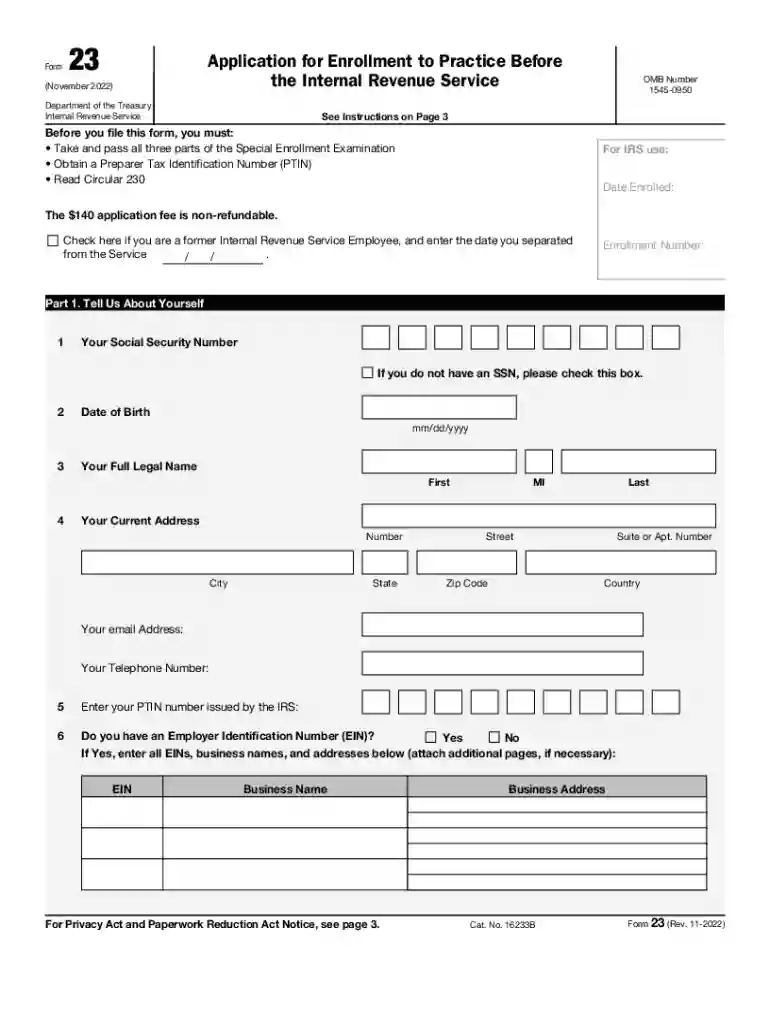
Form 23 (Rev 11-2022) is an application form required for individuals seeking enrollment to practice before the IRS, primarily catering to roles such as Enrolled Agent. It involves a detailed application process that establishes eligibility to represent taxpayers. To qualify, applicants must pass the Special Enrollment Examination, ensure tax compliance, and familiarize themselves with Circular 230, which governs practice before the IRS. This form also collects essential personal and professional information to verify qualifications under penalty of perjury.
To correctly use Form 23 (Rev 11-2022), applicants must follow specific steps to ensure their application is processed smoothly. Start by downloading the form from an official IRS source. Complete each section accurately, providing personal details such as your Preparer Tax Identification Number (PTIN) and addressing all tax compliance inquiries. Be mindful of the requirement for a valid signature as it serves as a certification of your truthfulness and understanding of your obligations under Circular 230. Finally, mail the completed form to the appropriate IRS office as instructed.
Eligibility for Form 23 (Rev 11-2022) requires meeting specific criteria outlined by the IRS. Applicants must have passed the Special Enrollment Examination, which verifies their competency in tax matters. In addition to meeting educational or experiential requirements, maintaining an active PTIN and compliance with tax obligations is crucial. Former IRS employees may have additional considerations, such as eligibility waivers for the examination requirement. Ensuring these criteria are met is vital for a successful application.


The primary users of Form 23 (Rev 11-2022) are individuals aiming to become Enrolled Agents. This group often comprises tax professionals looking to legally represent clients before the IRS. Accountants, tax preparers, and former IRS employees with the requisite experience and qualifications may also pursue this credential. The form acts as a formal application to demonstrate readiness and competence in tax representation.

Certain documents are necessary to accompany Form 23 (Rev 11-2022). These include proof of passing the Special Enrollment Examination or documentation supporting eligibility waivers for previous IRS employees. Applicants must also provide evidence of a registered PTIN. Additional documentation may include prior work history or educational qualifications relevant to tax practice, ensuring all submitted materials validate claims made in the form.
Legal compliance is crucial when dealing with Form 23 (Rev 11-2022). The form ensures only qualified individuals are authorized to practice before the IRS. Applicants certify their truthfulness and adherence to professional conduct by signing under penalty of perjury. Misstatements or omissions can lead to severe penalties, including denial of enrollment or legal action. Understanding the legal implications establishes the importance of accuracy and honesty in the application process.
Form 23 has several submission options, primarily by mail, following the address-specific instructions provided on the form. The IRS does not currently accept this form electronically, so it is vital to carefully package the form and any accompanying documents to prevent any processing delays. Organizing your submission with a checklist ensures no items are inadvertently omitted, facilitating a smoother application experience.
We've got more versions of the Form 23 (Rev 11-2022) form. Select the right Form 23 (Rev 11-2022) version from the list and start editing it straight away!
At DocHub, your data security is our priority. We follow HIPAA, SOC2, GDPR, and other standards, so you can work on your documents with confidence.


The planned retirement of coal-fired power stations across the globe can be estimated through various commitments, including country level commitments and
The purpose of this policy is to establish a process for the development, revision, review and approval of all UW System Finance and General Administration


