01. Edit your form online
Type text, add images, blackout confidential details, add comments, highlights and more.

Type text, add images, blackout confidential details, add comments, highlights and more.

Draw your signature, type it, upload its image, or use your mobile device as a signature pad.

Send it via email, link, or fax. You can also download it, export it or print it out.
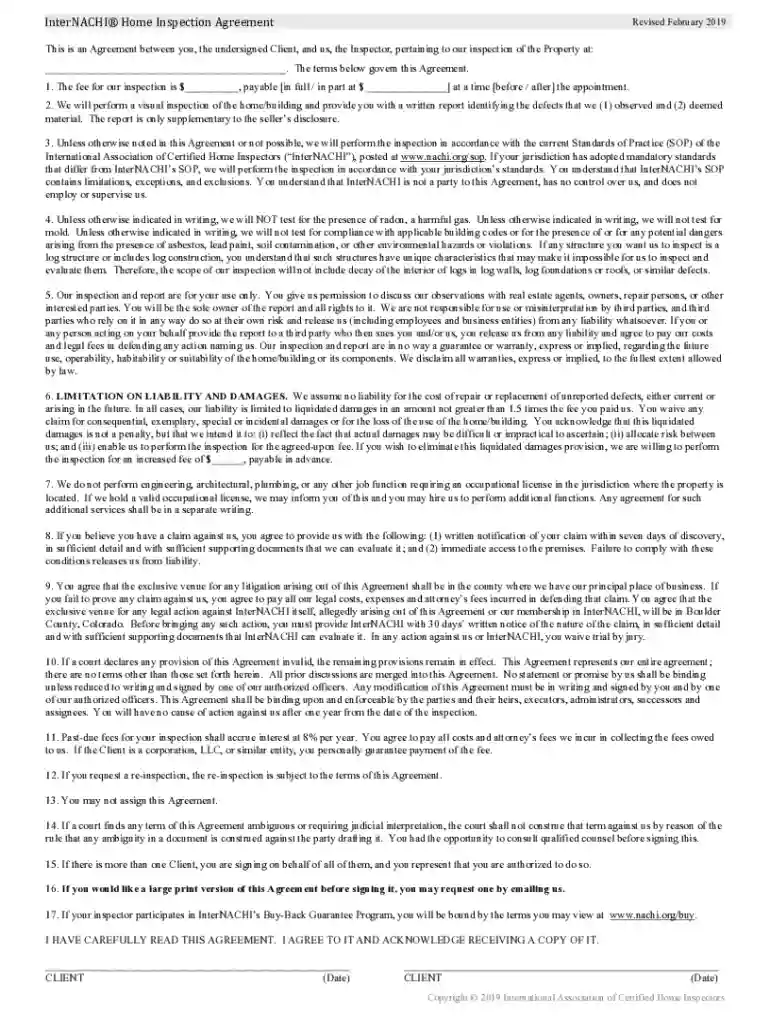
The InterNACHI® Home Inspection Agreement, as revised in February 2019, serves as a legal contract outlining the responsibilities and expectations between a home inspector and their client. It specifies the scope of the inspection, the services included, and the liabilities of the inspector. By establishing these terms, the agreement aims to mitigate misunderstandings, ensure clarity, and protect both parties legally.
To effectively utilize the InterNACHI® Home Inspection Agreement, the document should be thoroughly reviewed by both the inspector and the client before any services are rendered. Each party should understand the scope of the inspection, acknowledge the limitations stated in the document, and agree on the terms regarding liability and claims. Once reviewed, both parties should sign the agreement to confirm their consent.
The agreement is structured to be legally binding and enforceable under U.S. law, primarily serving to protect the inspector from legal claims arising from services rendered. It stipulates that any amendments to the agreement must be made in writing, ensuring any changes are formally documented and agreed upon by both parties.
Different states may have variations in home inspection regulations which can affect the terms of this agreement. Inspectors must ensure that their agreements comply with the specific legal requirements of the state in which they operate. This may include additional clauses or changes to existing clauses to align with local laws and regulations.
Consider a scenario where a client hires an inspector for a pre-purchase home evaluation. The InterNACHI® Home Inspection Agreement is used to detail what the inspection will cover and what services are not included. If the client later finds an undiscovered plumbing issue, they refer to the agreement to review potential courses of action.
The InterNACHI® Home Inspection Agreement is issued by the International Association of Certified Home Inspectors (InterNACHI®). As a professional body, InterNACHI® provides standardized legal documents that its members can use to ensure protection and clarity in their business dealings.
Though the February 2019 version is widely used, previous editions and variations might exist, which reflect minor differences in legal language or service terms. Inspectors should use the most current version to ensure compliance with any updated industry standards.
The primary users are certified home inspectors who are members of InterNACHI®, along with homebuyers or sellers who seek inspection services before completing real estate transactions. This formal agreement helps in setting clear expectations and protecting both parties’ interests throughout the inspection process.


The agreement can be executed in both digital and paper formats. For convenience and efficiency, digital versions allow for easy sharing and e-signatures, promoting a seamless transaction process. However, some clients may prefer a physical document, and both methods remain legally valid if appropriately signed and stored.
DocHub's platform supports editing and signing agreements like the InterNACHI® Home Inspection Agreement, allowing users to import the document from various sources, edit as needed, and apply legally binding electronic signatures. Its integration with cloud services like Google Drive streamlines handling and management of such contracts.
We've got more versions of the InterNACHI-Home-Inspection-Agreement-rev'd-Feb-2019 docx form. Select the right InterNACHI-Home-Inspection-Agreement-rev'd-Feb-2019 docx version from the list and start editing it straight away!
At DocHub, your data security is our priority. We follow HIPAA, SOC2, GDPR, and other standards, so you can work on your documents with confidence.