01. Edit your sa466 online
Type text, add images, blackout confidential details, add comments, highlights and more.

Type text, add images, blackout confidential details, add comments, highlights and more.

Draw your signature, type it, upload its image, or use your mobile device as a signature pad.

Send it via email, link, or fax. You can also download it, export it or print it out.
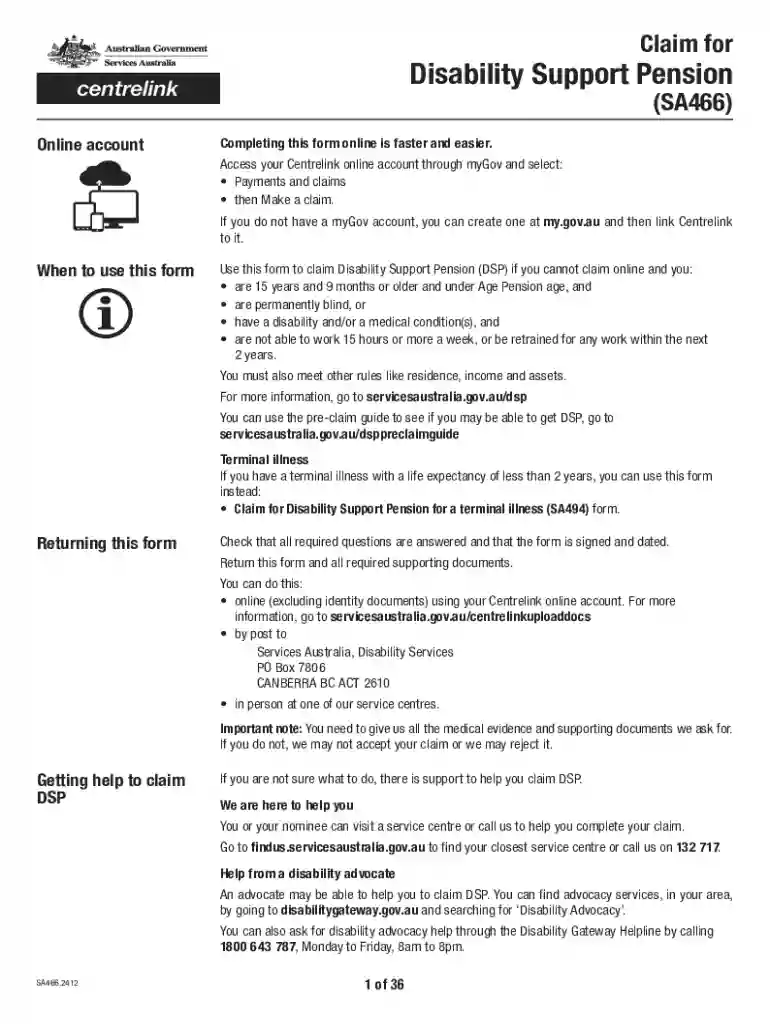
The Disability Support Pension (DSP) is an Australian government financial assistance program designed to support individuals with disabilities who are unable to work full-time due to their condition. This pension helps cover basic costs of living and aims to provide financial security for eligible individuals who meet specific medical, age, and work capacity criteria. The DSP is meant to ensure that people with disabilities can maintain a standard of living despite their inability to earn a sufficient income on their own.
To qualify for the DSP, applicants must satisfy several criteria. First, age requirements mandate that the individual be 16 years or older and below the age pension eligibility age. Secondly, applicants must provide evidence of a permanent physical, intellectual, or psychiatric impairment. The condition must result in an assessed work capacity of less than 15 hours per week within the next two years. Furthermore, applicants should be Australian residents, having lived in the country for at least ten years. Supporting documents, such as medical reports and income statements, are essential in proving eligibility.


Gather Necessary Documents:
Complete the SA466 Form:
Submit Supporting Documents:
Review and Submit:
When applying for the DSP, various documents are necessary to support the claim. These typically include identification documents like a birth certificate or passport, medical reports that detail the nature and permanency of the disability, and financial records such as recent payslips or bank statements. Additional documents might be required depending on specific circumstances, such as guardianship papers if the claimant is represented by someone else. It is critical to ensure that all submitted documents are accurate and reflect the current situation of the applicant.
There are three primary methods for submitting the DSP claim form:
Online Submission: Through the MyGov portal linked with Centerlink services, which allows applicants to upload documents and receive updates.
Mail Submission: Applicants can post their completed form and supporting documents to the appropriate Services Australia address.
In-Person Submission: Take the completed form and documents to a local Services Australia service center for submission assistance.
Each submission method comes with its own set of instructions, and applicants should ensure compliance with all stated requirements to facilitate the claim process.
Applicants have the option to complete their DSP application using either digital or paper versions of the SA466 form. The digital version offers convenience, with features like online help and immediate submission. Conversely, the paper form may be preferred by those without easy Internet access or who are more comfortable with hard copies. Regardless of the choice, both versions require the same information and supporting documents to be submitted for the application to be considered valid and complete.
Once a claim for the DSP is submitted, the assessment process begins, which can take several weeks to months, depending on the complexity of the case and the completeness of the application. During this period, the applicant might be contacted for further information or clarification. After the review, applicants receive notification of the decision. If approved, payments commence usually within a fortnight, while those declined are provided with the rationale and options for appeal or reconsideration.
Understanding certain terms is crucial when dealing with DSP applications:
Familiarity with these terms aids applicants in accurately completing the SA466 form and enhances comprehension of the processes involved.
Applicants may seek help when completing their DSP claim through various channels. Community legal services, disability advocacy groups, and financial counselors offer support in understanding eligibility, gathering evidence, and filling out the application. Additionally, Services Australia's customer service centers provide direct assistance and guidance tailored to individual needs, ensuring all necessary steps are carried out effectively to enhance the success rate of the application.
We've got more versions of the sa466 form. Select the right sa466 version from the list and start editing it straight away!
At DocHub, your data security is our priority. We follow HIPAA, SOC2, GDPR, and other standards, so you can work on your documents with confidence.