




01. Edit your form online
Type text, add images, blackout confidential details, add comments, highlights and more.

Type text, add images, blackout confidential details, add comments, highlights and more.

Draw your signature, type it, upload its image, or use your mobile device as a signature pad.

Send it via email, link, or fax. You can also download it, export it or print it out.
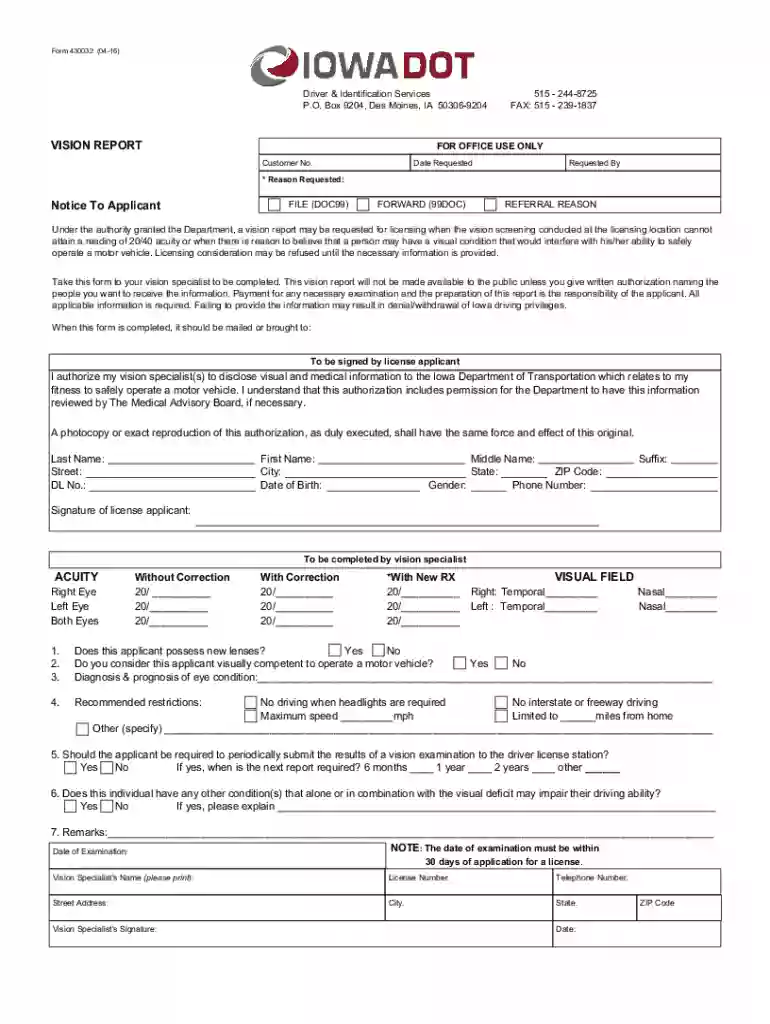
The Bureau of Motor Vehicles - Eye Examination Form is a crucial document utilized by state motor vehicle departments to evaluate a driver's visual capabilities. It is typically employed when an individual's visual acuity does not meet the standard requirement during a license renewal or application process. The form is completed by a certified vision specialist, such as an optometrist or ophthalmologist, who assesses the patient's visual acuity, field of vision, and any corrective measures needed for safe driving. This standardized form ensures a reliable assessment, emphasizing road safety and compliance with legal mandates.
Acquiring the Bureau of Motor Vehicles - Eye Examination Form is usually straightforward. It is often available directly from the state's department of motor vehicles (DMV) website, where it can be downloaded and printed. Alternatively, the form may be obtained in person at a local DMV office. Some DMV branches may offer to mail the form upon request. It is advisable to check with your specific state's DMV for the most accurate and accessible way of obtaining this form. In certain states, eye examination forms might also be distributed by licensed vision specialists.
Completing the Bureau of Motor Vehicles - Eye Examination Form involves several essential steps:
The primary users of the Bureau of Motor Vehicles - Eye Examination Form are individuals who either apply for a new driver's license or renew an existing one without meeting the required vision standards. This group includes older drivers who may experience age-related vision changes requiring validation of their driving suitability. Additionally, those with medical conditions affecting eyesight are also frequent users, as their vision must be regularly assessed to maintain a valid driving privilege. Vision specialists also frequently engage with the form, as they are responsible for conducting the tests and verifying results.


The Bureau of Motor Vehicles - Eye Examination Form comprises several key elements:
Different states in the U.S. have varying rules concerning the Bureau of Motor Vehicles - Eye Examination Form:
The Bureau of Motor Vehicles - Eye Examination Form serves an essential legal purpose in ensuring that drivers meet the mandatory eyesight standards for safe operation of vehicles. It is employed to enforce compliance with state laws and regulations regarding driver fitness and public safety. The form acts as a legal document verifying that an individual’s vision has been adequately evaluated, confirming eligibility or identifying restrictions necessary for maintaining their driving privileges. Non-compliance or submission of falsified information may lead to legal penalties, including fines or suspension of driving rights.
The Bureau of Motor Vehicles - Eye Examination Form can typically be accessed and submitted in both digital and paper formats, though this availability may vary by state. The digital version often provides the convenience of easy storage and sharing, as well as compatibility with various document workflow platforms like DocHub, facilitating electronic completion, signing, and submission. Paper versions remain widely used, particularly where digital access is limited or for individuals who prefer physical documentation. Both versions aim to ensure that filing the form is a straightforward process while maintaining the integrity of the information provided.
We've got more versions of the Bureau of Motor Vehicles - EYE EXAMINATION FORM form. Select the right Bureau of Motor Vehicles - EYE EXAMINATION FORM version from the list and start editing it straight away!
At DocHub, your data security is our priority. We follow HIPAA, SOC2, GDPR, and other standards, so you can work on your documents with confidence.



Vision Test Report (PDF) English Completed by authorized vision test provider to DocHub a driver meets basic DMV vision standard (otherwise, use form MV-80L).
by LM Lari 2016 The new cycles last anywhere form 1-5years (14). Under most state regulations/statutes, an eye exam is required for an older driver to renew their license. OutRead more


