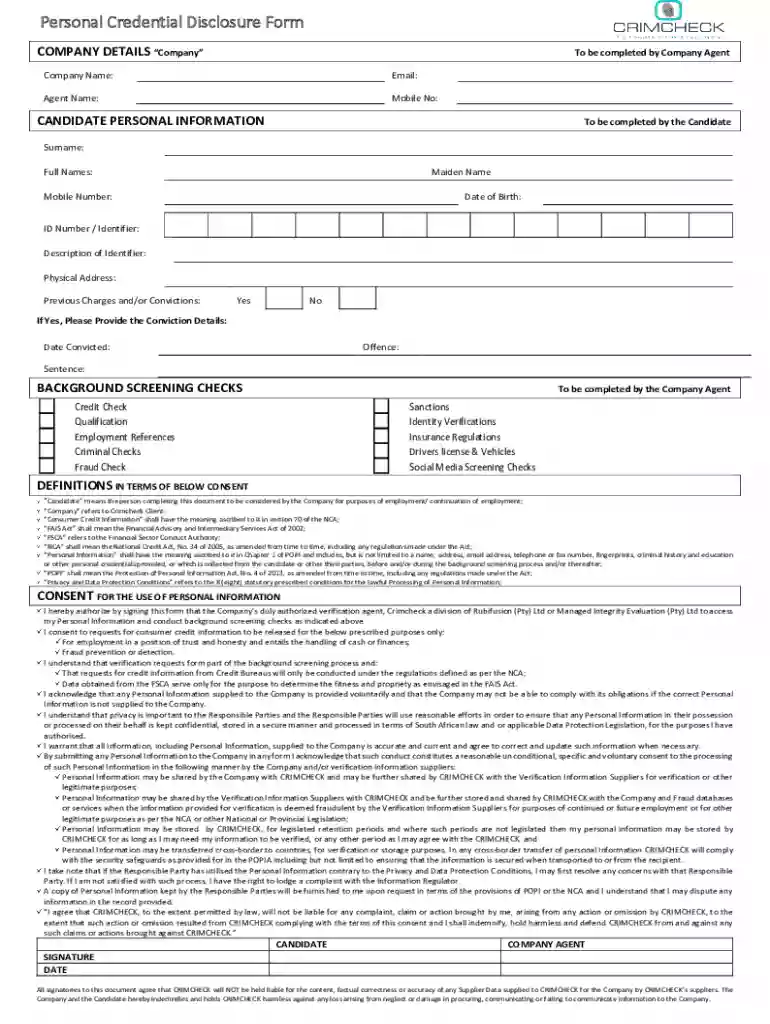
Personal Credential Disclosure Form - CrimCheck Preview on Page 1

Personal Credential Disclosure Form - CrimCheck 2026

Here's how it works

  • 01. Edit your form online

    Type text, add images, blackout confidential details, add comments, highlights and more.

  • 02. Sign it in a few clicks

    Draw your signature, type it, upload its image, or use your mobile device as a signature pad.

  • 03. Share your form with others

    Send it via email, link, or fax. You can also download it, export it or print it out.

Definition & Meaning

The Personal Credential Disclosure Form - CrimCheck is a specialized document used primarily for employment screening processes. It collects vital personal information necessary to conduct background checks on candidates. The form ensures compliance with legal frameworks while safeguarding personal data. In essence, it acts as a consent mechanism, enabling organizations to verify an individual's credentials effectively.

How to Use the Personal Credential Disclosure Form - CrimCheck

To utilize the Personal Credential Disclosure Form - CrimCheck effectively, follow these steps:

  1. Download the Form: Obtain the form from the designated company or third-party service offering CrimCheck-related services.

  2. Complete Personal Information: Input accurate personal details including full name, address, social security number, and contact information.

  3. Review and Sign: Carefully read the consent section to understand how your personal information will be used. Sign the document to authorize the background check.

  4. Submit the Form: Send the completed form back to the requesting organization via the preferred method specified, whether digital or hardcopy.

Steps to Complete the Personal Credential Disclosure Form - CrimCheck

  1. Initiate the Process:

    • Obtain the form from the organization requiring the background check.
    • Ensure you have all necessary personal documents on hand before starting.
  2. Fill Out Each Section:

    • Personal Information: Include your full legal name, date of birth, and current address.
    • Employment History: Provide past employment details relevant to the screening.
  3. Consent and Signature:

    • Carefully read the consent and declaration sections.
    • Sign and date the form to provide explicit consent for the disclosure.
  4. Final Review:

    • Double-check all entries for accuracy and completeness.
    • Correct any errors before submitting.

Why Use the Personal Credential Disclosure Form - CrimCheck

Using the Personal Credential Disclosure Form - CrimCheck is crucial for several reasons:

  • Compliance: Aligns with legal mandates ensuring valid and transparent background checks.
  • Security: Establishes a structured procedure for handling sensitive information securely.
  • Efficiency: Streamlines the hiring process by facilitating prompt verification of candidate credentials.

Key Elements of the Personal Credential Disclosure Form - CrimCheck

  • Personal Data Section: Captures essential information like name, address, and social security number.
  • Employment and Education History: Documents past employment and educational qualifications for verification purposes.
  • Consent Clause: Details the permissions given by the candidate for using their information in the background check.
  • Data Protection Information: Describes the measures in place to protect personal data per applicable laws.

Legal Use of the Personal Credential Disclosure Form - CrimCheck

The legal use of the Personal Credential Disclosure Form - CrimCheck involves:

  • Consent Management: Ensuring candidates provide informed consent for background checks.
  • Regulatory Compliance: Adhering to laws such as the Fair Credit Reporting Act (FCRA) and other applicable state-specific regulations.
  • Data Security Obligations: Implementing robust data protection protocols to maintain privacy and integrity of candidate information.

Important Terms Related to the Personal Credential Disclosure Form - CrimCheck

  • Consent: Authorization given by the candidate for the use of personal data in screenings.
  • Background Check: An investigation into a candidate's history, typically covering criminal records, employment, and education.
  • Data Protection: Measures and policies deployed to secure personal information against unauthorized access or breaches.

Who Typically Uses the Personal Credential Disclosure Form - CrimCheck

Entities that frequently use the Personal Credential Disclosure Form - CrimCheck include:

  • Employers: Corporations, small businesses, and hiring agencies in need of verifying candidate backgrounds comprehensively.
  • Background Check Companies: Specialized firms that perform in-depth screenings on behalf of employers.
  • Legal and Regulatory Bodies: Entities tasked with ensuring compliance with employment and data protection laws.
decoration imageratings of Dochub

Digital vs. Paper Version

The Personal Credential Disclosure Form - CrimCheck is available in both digital and paper versions:

  • Digital Version: Offers convenience and quicker processing, often integrated with digital solutions like DocHub for added functionality.
  • Paper Version: May be preferred in environments with limited digital infrastructure or where traditional paper handling is required.

Choosing between these versions often depends on the organization's technological setup and candidate preference.

be ready to get more

Complete this form in 5 minutes or less

Security and compliance

At DocHub, your data security is our priority. We follow HIPAA, SOC2, GDPR, and other standards, so you can work on your documents with confidence.

be ready to get more

Complete this form in 5 minutes or less

Related links

Market Snapshot Background Screening Reports

Background screening reports may include many types of information, including credit history, such as bankruptcy filings. Crimcheck

Learn more
Exploring The Use Of Criminal Background Checks In

by T Edwards 2015 Criminal background checks have become one of the most to negligent hiring lawsuits. These organizations are revisiting the practice of conducting criminal

Learn more
If you believe that this page should be taken down, please follow our DMCA take down process here