




01. Edit your form online
Type text, add images, blackout confidential details, add comments, highlights and more.

Type text, add images, blackout confidential details, add comments, highlights and more.

Draw your signature, type it, upload its image, or use your mobile device as a signature pad.

Send it via email, link, or fax. You can also download it, export it or print it out.
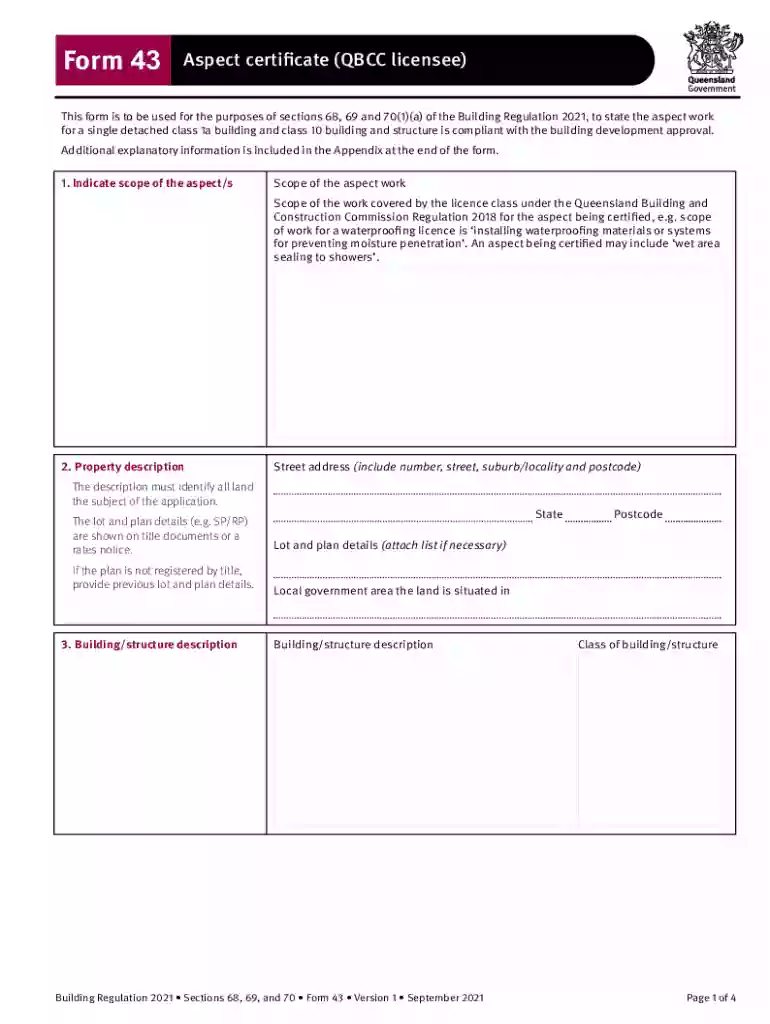
Form 43, known as the Aspect Certificate, is a crucial document issued by the Queensland Building and Construction Commission (QBCC). It serves to confirm that specific aspect work on single detached class 1a buildings and class 10 structures complies with the approved building regulations as per the Building Regulation 2021. This form outlines the scope of work done, includes property and building descriptions, and specifies the basis of certification. It ensures that all work complies with local regulations and standards, providing assurance to property owners and regulatory bodies.
Form 43 is pivotal for QBCC licensees looking to certify compliance with building standards. To use the form effectively, licensees should meticulously document all aspect work, ensuring each component meets the necessary regulations. The form should be completed with precise details regarding the nature of the work, including property specifics and the basis of compliance. It is essential for licensees to provide clear, accurate, and comprehensive information to avoid any legal issues or delays in project approval.
Gather Necessary Information:
Complete the Certification Section:
Provide Detailed Descriptions:
Review for Accuracy:
Submit the Form:
Scope of Work: Thoroughly describes the aspect of work undertaken, detailing how it aligns with the approved building plans and standards.
Property and Building Information: Includes specific descriptions of the property and structures involved, ensuring clarity in location and context.
Basis of Certification: Outlines the regulatory standards and guidelines used for certifying the work, providing a framework for compliance.
Licensee Details: Involves entering the QBCC licensee's information to confirm accountability and qualification for the work certified.
Using Form 43 correctly is paramount for legal compliance. Incorrect or incomplete submissions could lead to regulatory penalties or project delays. The form's thorough completion guarantees that all building standards are met, protecting against potential legal disputes regarding non-compliance. For QBCC licensees, adhering to the legal use of this form is essential not only for certification purposes but also to maintain trust and legitimacy in construction processes.
Form 43 is primarily used by QBCC licensees, including builders and contractors working on class 1a buildings and class 10 structures. These professionals require the form to certify that their work complies with relevant building standards and regulations. Additionally, the form is valuable for property owners, architects, and construction managers who must ensure that all aspect work on a property meets regulatory compliance before project completion.
Form 43 is vital to maintaining quality assurance and regulatory compliance in the building industry. It acts as a safeguard, ensuring that all work performed adheres to established building codes and standards. The form offers peace of mind to property owners, builders, and regulators by confirming that construction projects are conducted following lawful practices, reducing the risk of future legal or structural issues.
While Form 43 is specific to Queensland, its requirements may vary slightly depending on regulatory updates or statewide initiatives. Licensees must remain informed about any changes to ensure compliance. Engaging regularly with QBCC announcements and educational resources will help industry professionals stay adept at meeting both state-specific and broader Australian building regulations consistently.
We've got more versions of the Form 43 Aspect certificate (QBCC licensee) Form 43 Aspect certificate (QBCC licensee) form. Select the right Form 43 Aspect certificate (QBCC licensee) Form 43 Aspect certificate (QBCC licensee) version from the list and start editing it straight away!
| Versions | Form popularity | Fillable & printable |
|---|---|---|
| 2021 | 4.7 Satisfied (35 Votes) |
At DocHub, your data security is our priority. We follow HIPAA, SOC2, GDPR, and other standards, so you can work on your documents with confidence.


This application was generated using the PDF functionality. The PDF functionality automatically numbers the pages in this application.Read more
by S Patton 2022 The proposed sample will be male and female pre-licensure first nursing semester associate degree (AAS) students, age 18 and over. Queensborough Community


