What is a conflict of interest? - Author Services 2026

Get Form
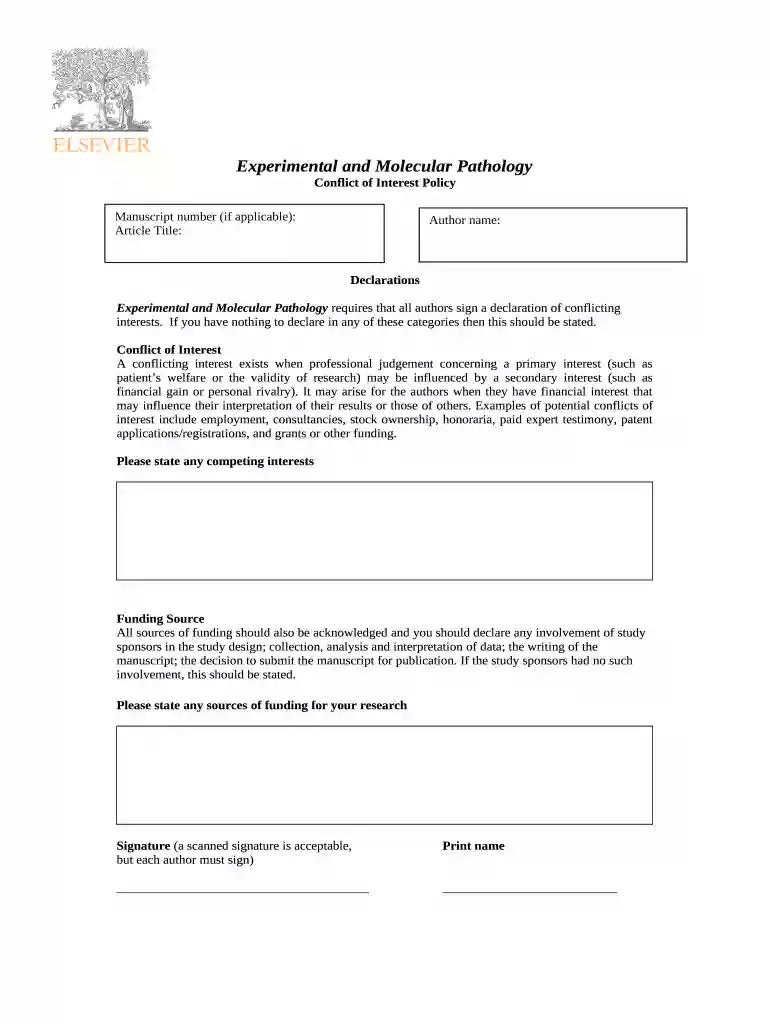
What is a conflict of interest? - Author Services Preview on Page 1

Here's how it works

01. Edit your form online
Type text, add images, blackout confidential details, add comments, highlights and more.

02. Sign it in a few clicks
Draw your signature, type it, upload its image, or use your mobile device as a signature pad.

03. Share your form with others
Send it via email, link, or fax. You can also download it, export it or print it out.

Definition and Meaning of Conflict of Interest in Author Services

A conflict of interest in author services occurs when an author's personal, financial, or professional relationships could potentially influence their research outcomes. This situation can pose ethical dilemmas, impacting the study's credibility and objectivity. In the context of author services, conflicts may arise due to financial gains tied to research results, such as funding from parties with direct interests in the study's outcomes or competitor collaborations. Recognizing these conflicts is crucial in maintaining academic integrity and transparency within the research community.

Examples of Potential Conflicts

  • Financial Interests: Ownership of stock or shares in a company funding the research.
  • Personal Relationships: Collaborations with family members that may bias the study results.
  • Professional Rivalries: Aligning with competitors that might influence unbiased reporting.

How to Use the Conflict of Interest Form

The conflict of interest form for author services is a tool designed to help authors declare any conflicts that could affect their research. Authors should fill out this form when submitting their research to a journal, ensuring that any potential biases are disclosed. By doing so, they uphold the transparency standards expected by the academic community, allowing peer reviewers and readers to assess the research without questioning its integrity.

Completing the Form

  1. Identify Conflicts: Reflect on personal and financial connections that may influence research.
  2. Detailed Disclosure: Provide a comprehensive account of any affiliations and financial interests.
  3. Acknowledge Funding: Include all funding sources and their role in the research.

Steps to Complete the Conflict of Interest Form

Completing the conflict of interest form involves a series of steps to ensure thorough disclosure. This process is pivotal for maintaining integrity in academic publishing.

  1. Read the Guidelines: Familiarize yourself with form instructions and requirements specific to your journal.
  2. Gather Information: Compile details of any projects, financial stakes, or relationships relevant to your research.
  3. Fill Out Sections: Input accurate, complete information about each identified conflict.
  4. Review Your Submission: Double-check for completeness and accuracy before submitting.
  5. Submit the Form: Follow the submission procedures provided by your journal.

Why Declaring Conflicts is Essential in Author Services

Declaring conflicts of interest is not merely a procedural formality but a critical part of ethical scholarly publishing. Transparent disclosure allows peer reviewers and the wider academic audience to objectively interpret research, free from bias or undisclosed motives. Furthermore, it safeguards the author's reputation, preventing future credibility issues due to overlooked potential conflicts.

Impact of Non-Compliance

  • Academic Sanctions: Journals may reject submissions or issue retractions post-publication.
  • Reputational Damage: Authors risk losing credibility and professional esteem.
  • Legal Consequences: Undisclosed conflicts can sometimes lead to legal challenges within certain jurisdictions.

Important Terms Related to Conflict of Interest in Author Services

Understanding terminology related to conflicts of interest aids authors in completing their forms accurately.

  • Disclosure: Providing all necessary information about potential conflicts.
  • Bias: A tendency to influence research outcomes by subjective factors.
  • Transparency: Ensuring open communication of all relevant research affiliations and interests.

Related Legal Terminologies

  • Non-disclosure: Failure to reveal conflicts that may compromise research objectivity.
  • Conflict Resolution: Measures taken to alleviate the impact of conflicting interests.

Legal Use of the Conflict of Interest Form

The conflict of interest form is a legally recognized document in academic publishing. It assures stakeholders of the study's objectivity and integrity. The form is often required by the journal to legally protect authors and the institution against potential claims of research misconduct. Proper completion and submission of this form is a proactive approach to avoiding disputes related to biases or undeclared interests.

Key Elements of the Conflict of Interest Form

The conflict of interest form contains several critical sections that authors must complete with precise information.

Sections to Include

  • Personal Information: Author's name, institution, and contact details.
  • Disclosure of Conflicts: Detailed account of financial, personal, or professional interests related to the research.
  • Funding Sources: List of all entities providing research funding, detailing their involvement or influence on the study.

Examples of Using the Conflict of Interest Form

Examples help to illustrate practical applications of the conflict of interest form in various scenarios.

  • Case Study: An author receives funding from a pharmaceutical company; they detail this relationship on the form when submitting a paper on drug efficacy.
  • Scenario Analysis: A researcher collaborates with a competing team member and highlights this on the form to avoid perceived biases.

Required Documents for Submission Alongside the Form

When submitting the conflict of interest form, authors may be required to include supplementary documents that support their disclosures.

Necessary Attachments

  • Funding Agreements: Copies of contracts with funding agencies to substantiate declarations.
  • Collaborative Agreements: Documentation laying out terms of collaboration when multiple parties are involved.
  • Conflict of Interest Policy: Any policy documentation specific to the institution's expectations and requirements.
be ready to get more

Complete this form in 5 minutes or less

Get form

Got questions?

We have answers to the most popular questions from our customers. If you can't find an answer to your question, please contact us.
Contact us
The types of conflict of interest include romantic or relational, financial, competitive, and confidential conflict of interests. They all involve individuals engaging in activities that lead to personal gain at the expense of the organizations they work for.
What is a Conflict of Interest? A conflict of interest occurs when an individuals personal interests family, friendships, financial, or social factors could compromise his or her judgment, decisions, or actions in the workplace.
An employee who is working for one company while talking to a vendor about coming to work for their company at a future date. A person buys company stock based on insider information theyve received. An individual signs a non-compete agreement before starting their job at a company.
A conflict of interest can occur when you, or your employer, or sponsor have a financial, commercial, legal, or professional relationship with other organizations, or with the people working with them, that could influence your research. When you submit your paper to a journal, full disclosure is required.
A conflict of interest statement should include all sources of financial support (for example, sponsors, and grant numbers) other support for the study (such as collecting, analyzing, or interpreting data), writing or revising the manuscript, or any factor that limited (or will limit in the future) the investigators

Security and compliance

At DocHub, your data security is our priority. We follow HIPAA, SOC2, GDPR, and other standards, so you can work on your documents with confidence.
Learn more
ccpa2
pci-dss
gdpr-compliance
hipaa
soc-compliance
be ready to get more

Complete this form in 5 minutes or less

Get form

People also ask

Authors must state all possible conflicts of interest in the manuscript, including financial, consultant, institutional and other relationships that might lead to bias or a conflict of interest. If there is no conflict of interest, this should also be explicitly stated as none declared.

Related links