






Definition & Meaning
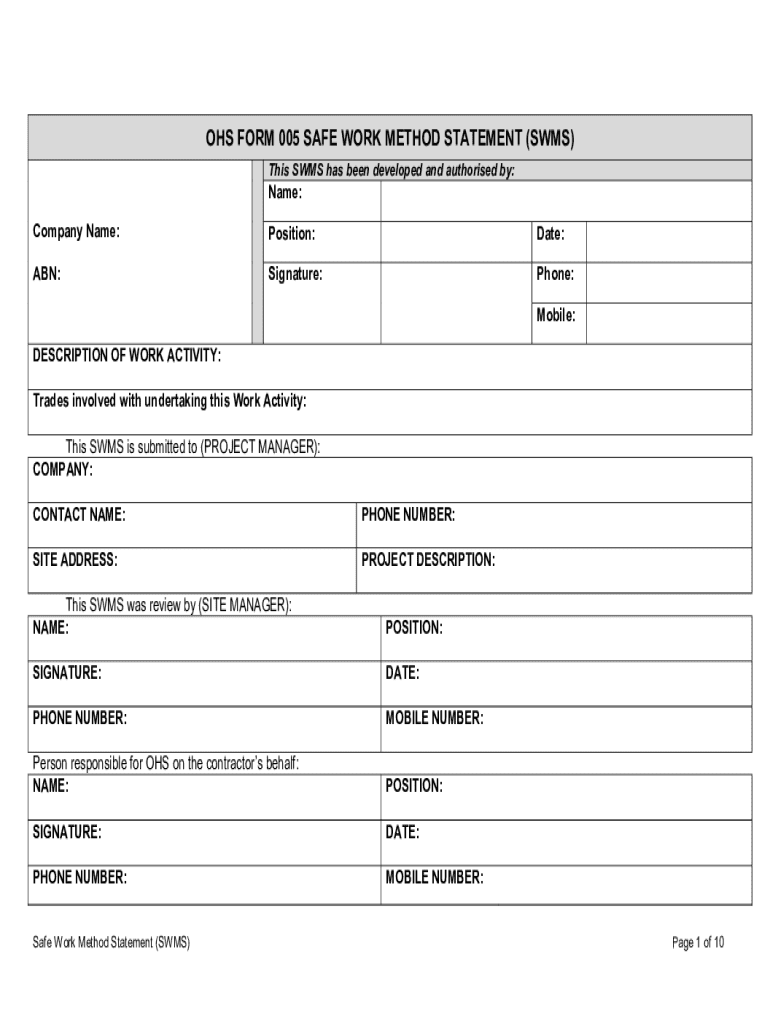
The OHS FORM 005 Safe Work Method Statement (SWMS) is a document utilized primarily in occupational health and safety contexts to outline specific procedures and risk management strategies necessary for various work activities. Its primary aim is to ensure safe work environments by identifying potential hazards, systematically assessing risks, listing essential personal protective equipment (PPE), and detailing control measures. SWMS is vital in regulatory compliance and helps align workplace practices with safety protocols through structured documentation.
How to Use the OHS FORM 005 Safe Work Method Statement (SWMS)
Using the SWMS involves several key steps to ensure effectiveness in enhancing workplace safety. Start by consulting with team members to gather insights about potential work-related hazards. Document these hazards within the form and assess their risks according to severity and likelihood. Next, outline the necessary PPE and controls based on a hierarchy of controls, including elimination, substitution, engineering, administrative, and personal protective measures. Once the form is filled, it should be reviewed with team members to ensure understanding and compliance, followed by obtaining the necessary signatures from all involved parties as a confirmation of agreement and awareness.
Steps to Complete the OHS FORM 005 Safe Work Method Statement (SWMS)
-
Identify Work Activities: Begin by listing out all activities associated with the task or project at hand. This includes both primary operations and ancillary tasks that could potentially impact safety.
-
Hazard Identification: For each activity, determine potential hazards that could arise. Consider environmental, physical, and procedural risks that may not be immediately apparent.
-
Risk Assessment: Evaluate the identified hazards by determining the likelihood of occurrence and potential severity of outcomes. Use a risk matrix to provide a visual representation of these assessments.
-
Implement Control Measures: Introduce measures aimed at mitigating risks associated with each hazard. Follow the hierarchy of controls, prioritizing elimination and substitution over other methods.
-
Assign Responsibilities: Clearly designate who is responsible for implementing each control measure. This might include supervisors, safety officers, or specific team members.
-
Review and Sign: Once completed, the SWMS should be reviewed by all stakeholders. Signatures from all key personnel act as acknowledgment and commitment to the presented methods and procedures.
Key Elements of the OHS FORM 005 Safe Work Method Statement (SWMS)
- Project/Work Activity Details: Basic information about the project, including location, date, and duration.
- Team Member Details: Names and roles of individuals involved in the task.
- Task Breakdown: Comprehensive list of all tasks associated with the project.
- Hazard Identification and Risk Assessment: Detailed sections outlining potential hazards and their assessed risks.
- Control Measures: Specific methods for hazard mitigation, categorized by control type.
- Signature Page: Space for necessary signatures from individuals acknowledging their understanding and agreement to the safety plan.
Legal Use of the OHS FORM 005 Safe Work Method Statement (SWMS)
The SWMS serves as a legal instrument to demonstrate compliance with occupational health and safety laws in the United States, specifically aligned with Occupational Safety and Health Administration (OSHA) standards. By providing a formalized record of risk assessments and control measures employed, it can be used as evidence of due diligence in safety management, proving that reasonable steps were taken to protect workers from harm within a job site. Employers can refer to it during inspections, audits, or inquiries related to workplace incidents to validate their adherence to statutory safety requirements.
Who Typically Uses the OHS FORM 005 Safe Work Method Statement (SWMS)
The primary users of the SWMS are professionals involved in industries where risk management is essential, such as construction, manufacturing, and logistics. Safety officers, project managers, and compliance teams are commonly tasked with form compilation and enforcement. In addition, team leaders might use the SWMS to educate their crews, ensuring that all members are aware of potential risks and control measures. Regulatory bodies might also reference it during safety assessments and audits to confirm that requisite safety protocols are in place.


Examples of Using the OHS FORM 005 Safe Work Method Statement (SWMS)
In a construction project involving high-rise building activities, the SWMS might be used to manage risks associated with working at heights. It might detail necessary PPE such as harnesses, include risk assessments for potential falls, and specify control measures like safety nets and restricted access zones. Another example involves manufacturing, where it could outline procedures for managing risks in operating heavy machinery, including equipment lockout/tagout procedures and operator training protocols. These examples highlight the document's practical application in mitigating work-related hazards.
Versions or Alternatives to the OHS FORM 005 Safe Work Method Statement (SWMS)
There might be variations of the SWMS tailored to specific industries or activities, ensuring relevance and precise coverage. For instance, industry-specific versions could include additional sections relevant to sector-specific hazards, such as chemical exposure in pharmaceuticals. Additionally, organizations might develop internal variants to address unique operational requirements or integrate with broader safety management systems. These customized versions maintain the core structure while enhancing relevance to precise operational contexts.
Software Compatibility
The SWMS can be used with various document management software, including platforms like DocHub, that support PDF editing and electronic signatures. This compatibility ensures ease of accessibility and streamlined collaboration among stakeholders, as they can make edits, input supplementary data, and submit signatures within the digital document. Compatibility with cloud storage options also facilitates maintaining version control and accessing documents remotely, enhancing flexibility and efficiency in safety documentation practices.