Definition & Meaning
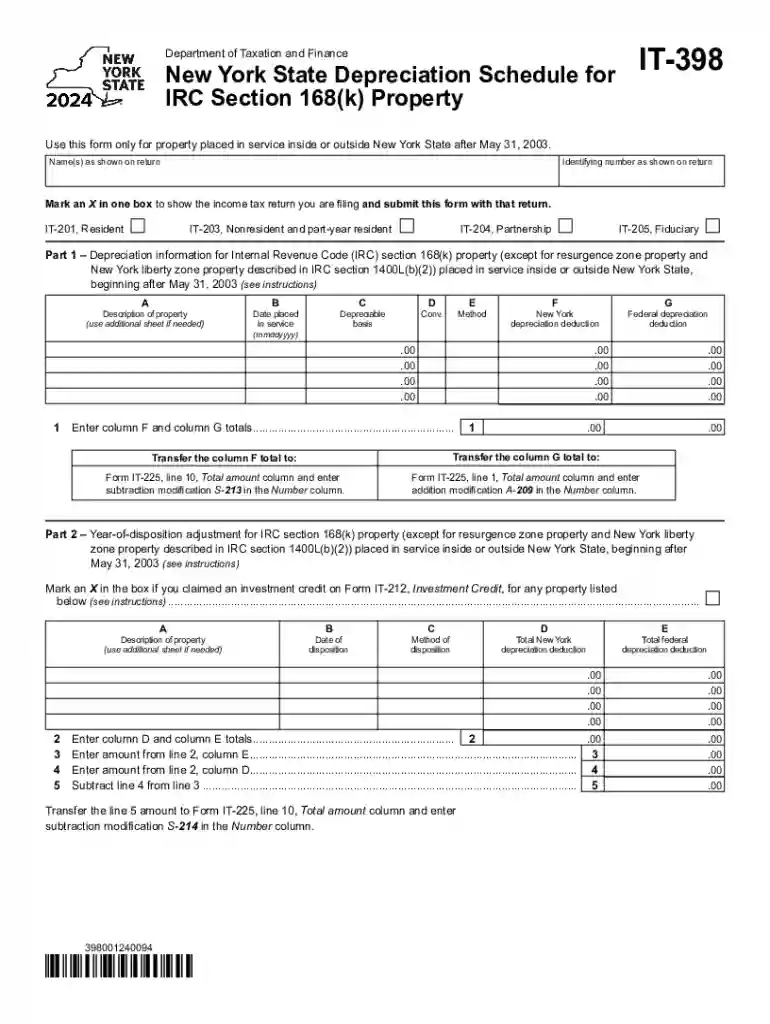
The Form IT-398 New York State Depreciation Schedule for IRC Section 168(k) Property Tax Year 2024 is a tax document used to report depreciation deductions for property in New York that qualifies under Internal Revenue Code Section 168(k). This form is critical for accurately calculating both state and federal depreciation differences for assets placed in service after May 31, 2003. It applies to various taxpayer categories, including individuals, partnerships, limited liability companies, corporations, and fiduciaries. Its purpose is to aid in documenting adjustments required between federal and state depreciation calculations, especially for assets eligible for bonus depreciation.
Key Terms and Concepts
- Depreciation: A method for allocating the cost of a tangible asset over its useful life.
- Bonus Depreciation: An additional amount of deductible depreciation offered by the federal government, which states may or may not adopt in full.
- IRC Section 168(k): Refers to the section within the IRC that provides guidelines for special bonus depreciation.
Steps to Complete the Form IT-398
Completing the Form IT-398 requires meticulous attention to detail and accuracy. Follow these steps:
- Identification Information: Begin by entering the taxpayer's full name, identification number, and any relevant tax IDs.
- Asset Details: List all eligible properties, including descriptions, dates placed in service, and their respective asset classifications.
- Depreciation Calculations:
- Calculate the federal depreciation claimed for the year under IRC Section 168(k).
- Compute the state depreciation under New York's guidelines.
- Document any necessary adjustments between federal and state calculations.
- Record Disposition Information: For assets disposed of within the tax year, fill in specific sections detailing the date of disposition and corresponding adjustments.
- Final Review and Submission: Double-check all entries for accuracy, ensure proper addition of totals, and follow submission guidelines for the form.
Required Documents
- Detailed asset listing with service dates
- Previous years’ depreciation schedules if applicable
- Federal Form 4562 for cross-referencing federal depreciation claims
Who Uses the Form IT-398
The Form IT-398 is typically utilized by New York-based taxpayers who are required to reconcile differences in depreciation between federal and state rules. These users include:
- Individuals: Homeowners or property investors with depreciable assets.
- Businesses: Companies of various entities, such as LLCs, corporations, and partnerships, that hold depreciable assets.
- Fiduciaries: Trusts and estates managing depreciable property.
Business Entity Types
- Corporations: Use Form IT-398 for depreciable business assets claimed under business activities.
- Partnerships: Report each partner's share of depreciation for state reconciliation.
- LLCs: Limited liability companies may opt to complete separate schedules based on the business structure.
Important Terms Related to Form IT-398
When handling the Form IT-398, familiarize yourself with these terms:
- Depreciation Method: The type of formula used to allocate asset cost over time (e.g., straight-line, double-declining balance).
- Year-End Adjustments: Corrections required to align state-based depreciation figures with federal tax returns.
- Property Classifications: Differentiates between types of assets such as office furniture, machinery, and vehicles.
Depreciation Variations
- Straight-Line Method: Equal expense year over year until the asset's value is fully depreciated.
- Accelerated Methods: Allow for greater deductions in early years (e.g., double-declining balance).
State-Specific Rules for IT-398
New York State has specific rules regarding the use of Form IT-398:
- Non-conformity with Federal Bonus Depreciation: Unlike the federal government, New York may not always follow federal bonus depreciation allowances.
- Add-Back Requirements: Additional adjustments may be necessary for state tax returns to adhere to New York's regulations.
- Special Asset Classes: Certain assets may require unique treatment, as outlined by state tax authorities.
Legal Use of Form IT-398
The Form IT-398 serves as a legally binding document that must be completed accurately to avoid issues with the New York Department of Taxation and Finance:
- Accuracy in Reporting: Misinformation can lead to penalties and interest charges.
- Documentation Requirements: Maintain copies of all supporting documents and schedules used in preparation.
- Timely Filing: Adhere to New York state's filing deadlines to avoid late fees.
Penalties for Non-Compliance
- Fines and Penalties: May be imposed for inaccurate filing or failure to submit necessary adjustments.
- Audit Risks: Inaccurate or incomplete schedules can trigger audits and increased scrutiny.
How to Obtain the Form IT-398
Accessing the Form IT-398 can be done through several methods:
- Online Platforms: Directly download from the New York State Department of Taxation and Finance’s website.
- Tax Software: Many programs like TurboTax and QuickBooks include state-specific forms that can auto-populate based on inputted data.
- Professional Tax Preparers: CPA firms or tax professionals may provide direct access and assistance in completing the form.
IRS Guidelines
Although Form IT-398 is specific to New York State, IRS guidelines for federal depreciation deductions are essential for comparison:
- Federal Form 4562: Used for calculating and reporting federal depreciation and amortization.
- Current Depreciation Limits: Ensure familiarization with national limits affecting bonus depreciation claims.
Form Submission Methods
- Electronic Filing: Fastest method through approved tax software or directly via the state website.
- Mail-In Submission: If electronic filing is not possible, ensure all paper forms are sent to the appropriate address provided by the NY tax authority.
Filing Deadlines / Important Dates
Adhering to filing deadlines for Form IT-398 is essential to avoid penalties:
- Regular Filing Deadline: Corresponds with the individual taxpayer's or business entity's state income tax return due date.
- Extensions: Possible through valid extension requests, though full state tax payment is required by the original due date.
Key Elements of the Form IT-398
The structure of Form IT-398 consists of key elements for accurate reporting:
- Part I: Details asset descriptions, service dates, and initial cost basis.
- Part II: Breaks down federal versus state depreciation calculations, including mandated add-back amounts.
- Final Section: Summarizes totals, asset life terms, and necessary transfers between federal schedules.