




01. Edit your form online
Type text, add images, blackout confidential details, add comments, highlights and more.

Type text, add images, blackout confidential details, add comments, highlights and more.

Draw your signature, type it, upload its image, or use your mobile device as a signature pad.

Send it via email, link, or fax. You can also download it, export it or print it out.
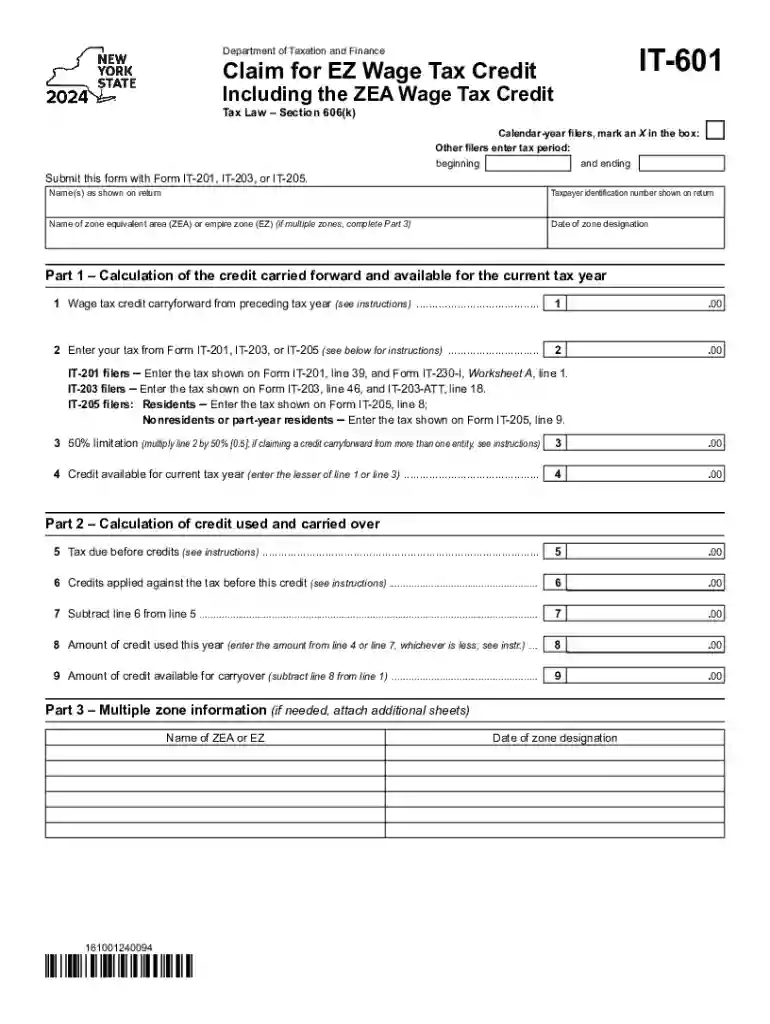
Form IT-601, the Claim for EZ Wage Tax Credit, including the ZEA Wage Tax Credit for Tax Year 2024, is a tax document used by businesses in New York State to claim credits for wages paid to employees within Empire Zones and Zone Equivalent Areas. This form is crucial for businesses that aim to reduce their taxable income by taking advantage of these specific wage tax credits offered under Tax Law Section 606(k).
The form IT-601 can be acquired through multiple channels. For digital access, the form is available on the official website of the New York State Department of Taxation and Finance. For those preferring a physical copy, visiting a local tax office or requesting a mailed version through the department's contact services may be viable options. Online platforms like DocHub also streamline the process, allowing for downloading and online editing.
To qualify for the EZ and ZEA Wage Tax Credits, businesses must meet several conditions:


New York State mandates that the Form IT-601 only be used by businesses within its jurisdiction. The specific criteria for wage credits are dictated by state policy, which includes legislative updates pertinent to the economic zones. It is critical for filers to keep abreast of any changes to ensure compliance and maximize credit claims.
While Form IT-601 is a New York State tax form, it supplements federal business tax filings. The IRS requires accurate representation of state tax credits and mandates transparency regarding any credits that might affect the federal tax obligation.
For businesses filing on a calendar-year basis, the deadline for submitting Form IT-601 aligns with the annual corporate income tax return deadlines, generally set for April 15 of the following year. Businesses should confirm the exact date annually, as variations might occur based on legislative adjustments or public holidays.
Forms with similar utility include variations associated with different tax credits under New York State law. Historical versions or older formats might exist, but Form IT-601 is the standardized document for contemporary claims relevant to EZ and ZEA credits for 2024.
Primarily, small to medium-sized enterprises (SMEs) located in Empire Zones or similar areas benefit most, particularly those in sectors like manufacturing, technology, and services which often lead economic revitalization efforts in these zones.
Businesses can opt for electronic submissions via the New York State Department of Taxation and Finance’s online portal, a preferred method for faster processing and confirmation. Traditional paper filing is an option for those who prefer or require it due to access or other constraints.
By providing an in-depth understanding of the Form IT-601, businesses can make informed decisions, ensuring they maximize available tax credits while adhering to state-specific regulations.
We've got more versions of the Form IT-601 Claim for EZ Wage Tax Credit Including the ZEA Wage Tax CreditTax Year 2024 form. Select the right Form IT-601 Claim for EZ Wage Tax Credit Including the ZEA Wage Tax CreditTax Year 2024 version from the list and start editing it straight away!
At DocHub, your data security is our priority. We follow HIPAA, SOC2, GDPR, and other standards, so you can work on your documents with confidence.





by K Bryant Cited by 4 The Earned Income Tax Credit (EITC) is a federal tax credit for low- and moderate-income tax filers that is refundable, or distributed as a
Dec 12, 2025 The EZ wage tax credit, including any ZEA wage tax credit, is limited to 50% of the tax imposed under Tax Law section 601 before the allowanceRead more
Apr 3, 2023 the current and deferred taxes are determined consistently with the tax treatment in the income tax filings. If it is not probable that the.Read more


