




01. Edit your form online
Type text, add images, blackout confidential details, add comments, highlights and more.

Type text, add images, blackout confidential details, add comments, highlights and more.

Draw your signature, type it, upload its image, or use your mobile device as a signature pad.

Send it via email, link, or fax. You can also download it, export it or print it out.
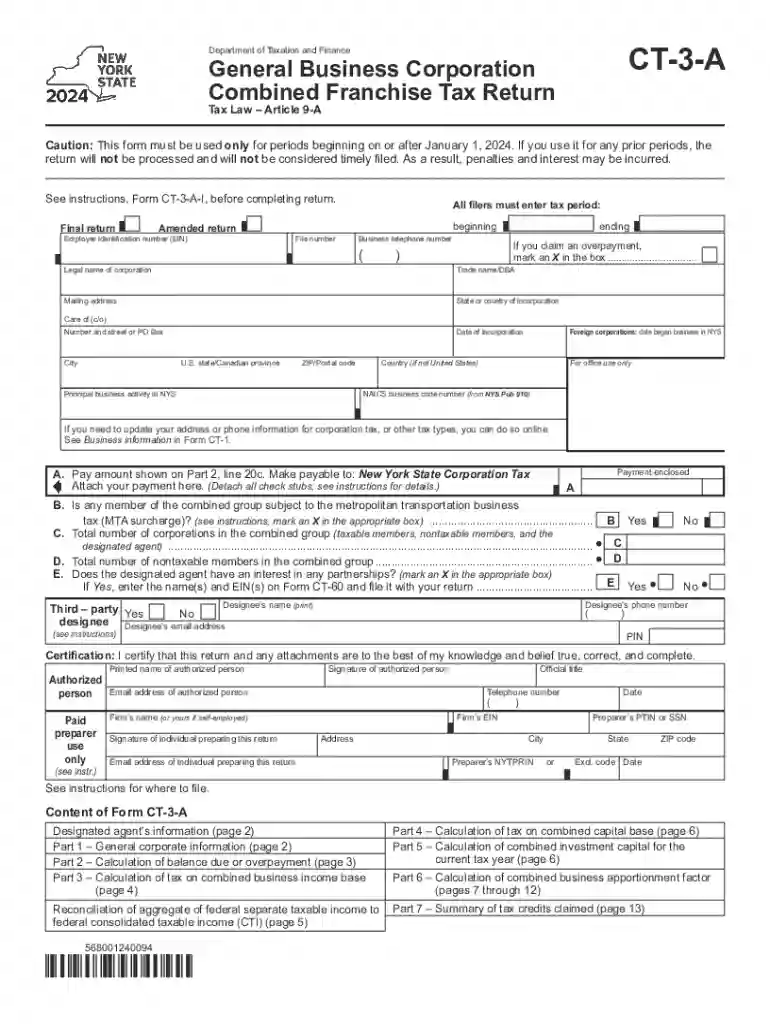
The Form CT-3-A is a Combined Franchise Tax Return specifically designed for General Business Corporations operating within the state of New York. This form is utilized for tax periods beginning on or after January 1, 2024. It mandates corporations to report their income, deductions, and tax liabilities accurately. It includes essential sections that cover general corporate information, calculations of both business income and capital taxes, as well as apportionment factors and any tax credits claimed. Compliance with this form is crucial as it ensures that corporations are adhering to New York State's tax regulations and avoiding potential penalties.
To effectively utilize Form CT-3-A, corporations should start by gathering all necessary financial data for the tax year in question. The process involves meticulously entering corporate income and deductions, which serve as the foundation for calculating tax liabilities. Important sections on this form also require the listing of any applicable tax credits that can reduce the overall tax burden. Additionally, corporations must provide details on apportionment factors, which determine the portion of the business's income taxable in the state of New York. The form serves as a comprehensive tool for tax reporting and compliance, ensuring that all financial activities are accurately reflected.
Completing the Form CT-3-A involves a detailed and structured approach. Adhering to the following process can streamline the completion:
Understanding certain key terms is crucial while dealing with the Form CT-3-A:
New York State imposes specific criteria and rules that govern the use of Form CT-3-A. Corporations must be aware of these regulations to ensure compliance:
Timely filing of the Form CT-3-A is imperative to avoid penalties:
Failure to comply with the filing and payment requirements associated with Form CT-3-A can result in:
Corporations should ensure accurate and timely submissions to mitigate these risks.
The Form CT-3-A is designated for specific corporate entities, including:
Understanding eligibility is essential to determine the correct suite of tax forms for any given business.


We've got more versions of the Form CT-3-A General Business Corporation Combined Franchise Tax Return Tax Year 2024 form. Select the right Form CT-3-A General Business Corporation Combined Franchise Tax Return Tax Year 2024 version from the list and start editing it straight away!
At DocHub, your data security is our priority. We follow HIPAA, SOC2, GDPR, and other standards, so you can work on your documents with confidence.





Oct 3, 2015 Finally, the Tax Court did agree that Legacy Insurance Company should be included in the combined return as the company was unitary in nature.Read more
Dec 10, 2025 Form CT‑3‑A/BC is an individual certification which includes a detail schedule of the members business and investment capital and businessRead more


