







Definition & Meaning
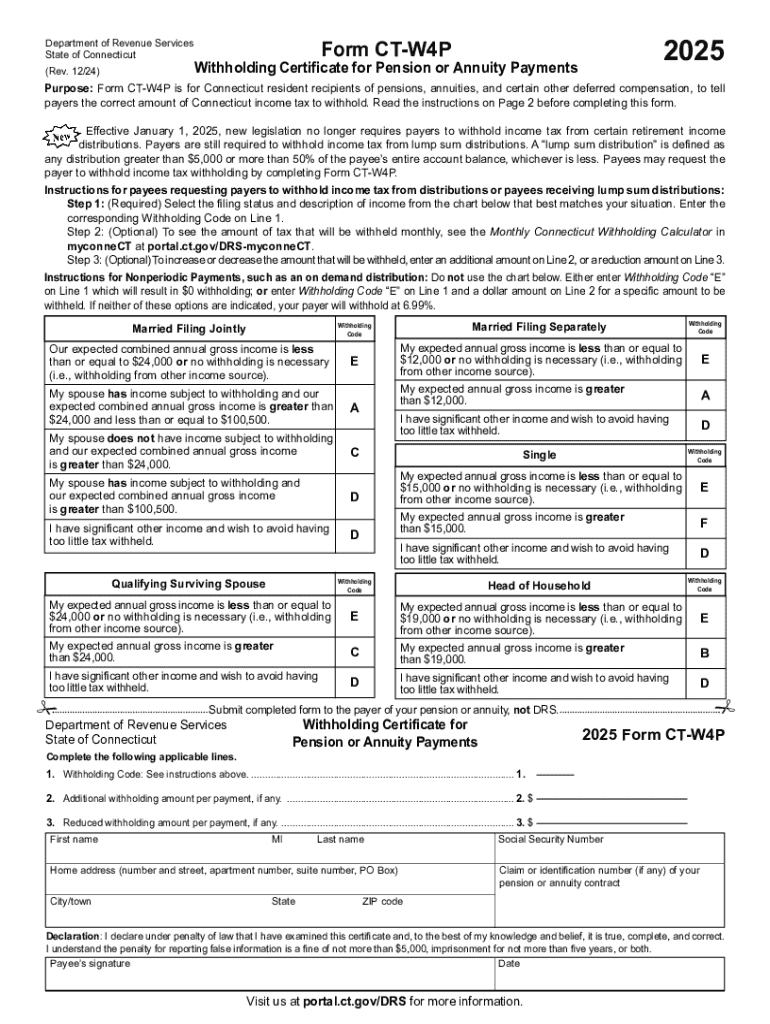
The CT CT-W4P 2 form is a specific tax document used by Connecticut residents receiving pensions or annuities. This form allows recipients to specify the amount of state income tax that should be withheld from their pension or annuity payments. It is crucial for managing tax liabilities efficiently, particularly in light of legislative changes effective January 1, 2025, which impact withholding requirements for certain retirement income distributions.
Steps to Complete the CT CT-W4P 2 - Fill out Tax Template Online
-
Gather Necessary Information
- Collect personal details such as your name, address, and Social Security number.
- Obtain any relevant tax forms from prior years for reference.
-
Access the Form Online
- Log in to the DocHub platform using a supported web browser.
- Use the search function to find the CT CT-W4P form within the tax templates section.
-
Fill in Personal Details
- Enter your identification details exactly as they appear in your official records.
- Double-check for accuracy to avoid discrepancies.
-
Specify Withholding Preferences
- Follow the form instructions to select your withholding preference based on your filing status and income level.
- Utilize the guidelines for determining appropriate withholding codes.
-
Review and Submit
- Carefully review all entered information to ensure completeness and accuracy.
- Submit the completed form to your pension or annuity payer, either electronically or by printing and mailing.
Key Elements of the CT CT-W4P 2 - Fill out Tax Template Online
-
Filing Status Designation
Understanding how your filing status impacts withholding is essential. The form provides codes and guidelines to help you choose the correct status, such as single, married, or head of household. -
Income Calculation Guidelines
Instructions are included to guide you through determining your adjusted income levels, which are crucial for proper tax withholding. -
Lump Sum Distribution Rules
For those receiving a one-time payment, the form includes specific rules and calculations to determine the necessary withholding.
Important Terms Related to CT CT-W4P 2 - Fill out Tax Template Online
- Payer: The institution or individual responsible for distributing the pension or annuity payments.
- Withholding Code: A unique identifier that determines the amount of tax withheld based on filing status and income.
- Annuity: A financial product that pays out income and is often used as part of retirement strategies.
Legal Use of the CT CT-W4P 2 - Fill out Tax Template Online
The CT CT-W4P form is in compliance with state tax regulations, and its correct use ensures that tax withholding aligns with legal requirements. It provides legally mandated instructions for calculating taxpayer obligations accurately.
Who Typically Uses the CT CT-W4P 2 - Fill out Tax Template Online
- Retired Individuals: Those receiving pension payments or life annuities, seeking to manage tax obligations effectively.
- Tax Advisors: Professionals assisting Connecticut residents in determining accurate tax withholding for pensions and annuities.
- Estate Planners: Individuals working with clients to optimize the tax impacts of retirement income.


State-Specific Rules for the CT CT-W4P 2 - Fill out Tax Template Online
Connecticut residents must adhere to specific rules outlined in the form that pertain to state income tax withholding. This includes the application of state-specific withholding codes and the compliance with Connecticut's tax brackets.
Penalties for Non-Compliance
Failure to accurately complete and submit the CT CT-W4P form may result in incorrect withholding and potential underpayment of taxes. This can lead to fines, penalties, or interest charges, making it essential to complete the form with precision.
Form Submission Methods (Online / Mail / In-Person)
- Online: Complete and submit the form through DocHub, which streamlines the process and ensures timely updates and tracking.
- Mail: Print and mail the form to your payer, ensuring delivery confirmation for added security.
- In-Person: Some may choose to deliver the form directly to their payer, particularly if local guidelines or payer preferences require it.


