




01. Edit your 3803 online
Type text, add images, blackout confidential details, add comments, highlights and more.

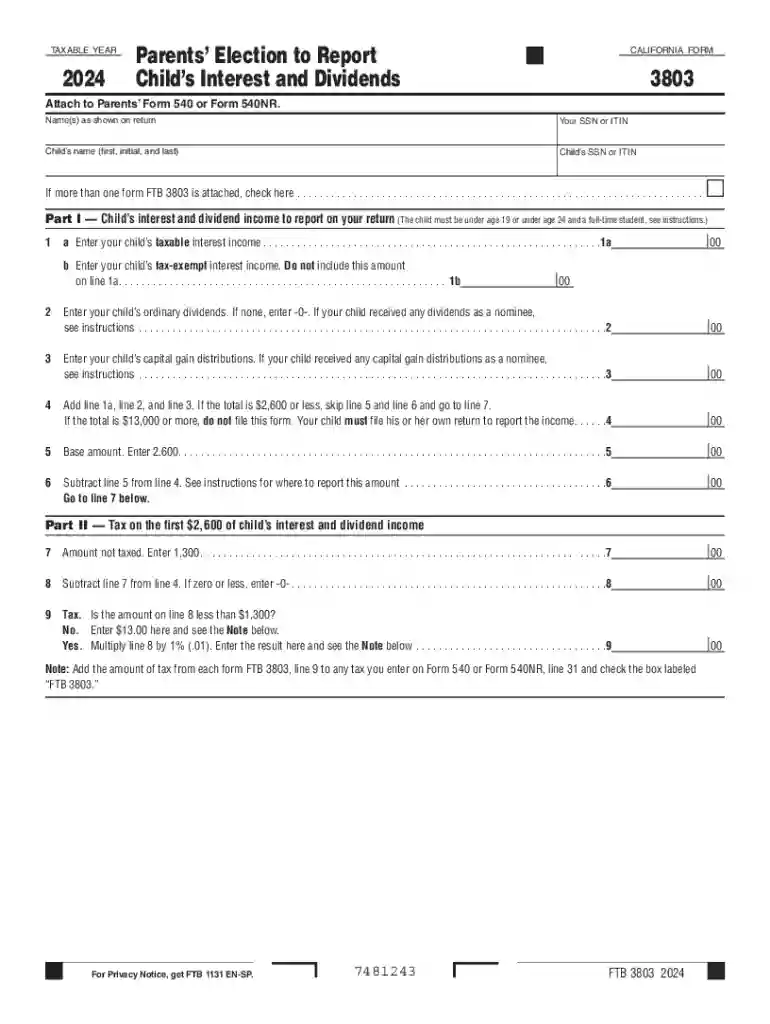
Type text, add images, blackout confidential details, add comments, highlights and more.

Draw your signature, type it, upload its image, or use your mobile device as a signature pad.

Send it via email, link, or fax. You can also download it, export it or print it out.
The CA Form 3800 is specifically designed for parents to report their child's investment income. It captures details about the child’s unearned income from sources like interest, dividends, and capital gains. The form serves as a mechanism for parents to integrate their child’s investment profits into their tax returns, simplifying the tax reporting process for families whose children have modest investments.
To appropriately use CA Form 3800, first gather all relevant financial documents concerning your child’s investment earnings, such as 1099 forms, statements from brokerage accounts, or documentation of dividends received. Ensure that you accurately transfer this information into the specified sections of CA Form 3800. Utilize the form to consolidate the child’s investment earnings, and apply the listed income thresholds to determine if this income is reportable on your tax return or if your child needs to file independently.
Collect Investment Income Records: Obtain all pertinent records of your child’s investment income over the taxable year, including any interest, dividends, or capital gain distributions.
Fill Out Required Sections: Enter the child’s taxable interest, ordinary dividends, and other relevant financial figures within their designated areas on the form.
Calculate Total Income: Use the form instructions to ensure calculations are correct and thresholds are not exceeded, impacting whether the child must file a separate return.
Submit with Parent’s Tax Return: Finally, attach CA Form 3800 to the relevant section of your tax return for submission to the state tax agency.
Parents or guardians must meet specific conditions to use CA Form 3800. Your child should be under a certain age threshold, typically under 19 or a full-time student under 24. Moreover, the child’s unearned income must not surpass the stated limits within the form’s guidelines. These stipulations ensure the form is used appropriately and aligns with California's tax regulations.


Using CA Form 3800 ensures compliance with state tax regulations. Accurately reporting your child’s investment income prevents legal repercussions and potential penalties. The form also affords legal protection for families by clarifying tax liabilities and offsetting the need for children to file separately under certain conditions.
Aligning with the federal tax season, the typical deadline for CA Form 3800 submission is April 15. However, in instances where this date falls on a weekend or holiday, deadlines could be extended. Stay updated with official announcements from tax authorities to handle any deadline shifts.
Ensure you collect:
Consider a family where a child earns $2,500 in unearned income from a savings account, significantly under the total threshold for requiring an independent filing. The parents utilize CA Form 3800 to report this investment income directly on their tax return, avoiding the complexity of a separate child return. This real-world application showcases how effectively the form streamlines tax responsibilities for families.
Failure to accurately report the required income on CA Form 3800 or neglecting to include it in a timely manner within the parent’s tax return can result in penalties. These can include fines calculated as a percentage of the unpaid tax amount or interest on the delayed payments. Compliance mitigates the risk of these financial setbacks and fosters a trustworthy rapport with tax authorities.
We've got more versions of the 3803 form. Select the right 3803 version from the list and start editing it straight away!
At DocHub, your data security is our priority. We follow HIPAA, SOC2, GDPR, and other standards, so you can work on your documents with confidence.




Use form FTB 3800, Tax Computation for Certain Children with Unearned Income, to figure the childs tax. Complete form FTB 3800 if all of the followingRead more
by RCE Beck 1996 Current income may be avoided until the child DocHubes age fourteen in a variety of ways, most obviously including investment in growth stock which pays noRead more


