




01. Edit your form online
Type text, add images, blackout confidential details, add comments, highlights and more.

Type text, add images, blackout confidential details, add comments, highlights and more.

Draw your signature, type it, upload its image, or use your mobile device as a signature pad.

Send it via email, link, or fax. You can also download it, export it or print it out.
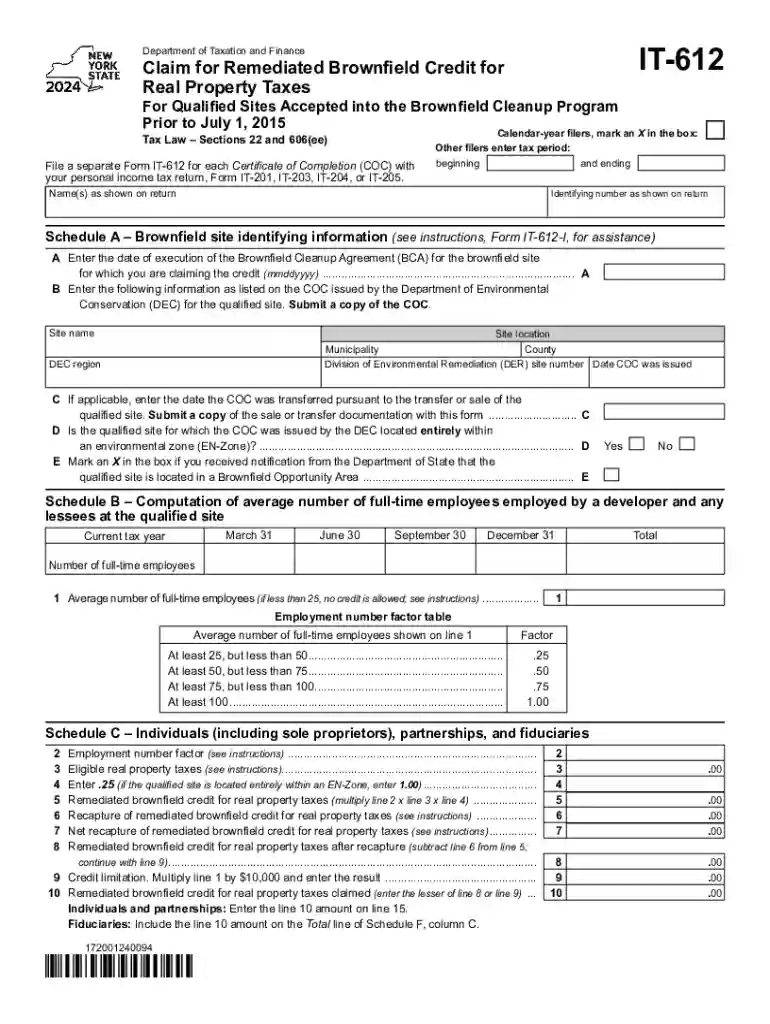
The IT-612 form is a tax document issued by the Department of Taxation and Finance, intended for taxpayers who are claiming the Remediated Brownfield Credit for real property taxes in the tax year 2024. This form applies to sites that have been accepted into the Brownfield Cleanup Program prior to July 1, 2015. By filling out this form, eligible taxpayers can claim credits on property taxes associated with qualified brownfield remediation projects, aiding in environmental cleanup efforts and reducing financial burdens on property owners.
To leverage the IT-612 form, recipients must accurately gather all pertinent data pertaining to the brownfield redevelopment project, including property details, employment information, and any eligible credit calculations. This document must accompany a personal income tax return, necessitating precise alignment of numbers with those presented in other tax filings. Inaccuracies can lead to delays or denial of credits. Income related to the property, such as rentals or sales, must be declared in tandem with the brownfield credit claims.
Eligibility to file Form IT-612 requires that the brownfield site has been entered into the Brownfield Cleanup Program before July 1, 2015, and that there is a completion of the associated environmental cleanup work. Businesses and individuals need to show evidence of remediation and compliance with all program specifications to qualify for tax credits.


Failing to comply with the requirements for filing Form IT-612 can lead to penalties and potential audits. This might include financial penalties or the disallowance of claimed credits. Noncompliance often stems from inaccuracies, missing information, or late filings, so thoroughness and punctuality are crucial when submitting this form.
To complete Form IT-612 effectively, taxpayers need several key documents, including:
The primary users of Form IT-612 are businesses and individuals involved in the remediation of brownfield sites for property development. This includes real estate developers, environmental cleanup companies, and property owners engaged in projects aiming to transform environmentally contaminated lands into usable properties. The focus is on those seeking tax relief for cleanup activities completed under the Brownfield Cleanup Program.

For those inclined to use software solutions for tax filings, Form IT-612 is compatible with many digital tax preparation tools, such as TurboTax and QuickBooks. These platforms can assist in automating calculations, reducing errors, and simplifying the submission process. It’s crucial, though, to ensure that the software is updated for the tax year 2024 to handle any form updates or regulatory changes.
We've got more versions of the Form IT-612 Claim for Remediated Brownfield Credit for Real Property Taxes Tax Year 2024 form. Select the right Form IT-612 Claim for Remediated Brownfield Credit for Real Property Taxes Tax Year 2024 version from the list and start editing it straight away!
At DocHub, your data security is our priority. We follow HIPAA, SOC2, GDPR, and other standards, so you can work on your documents with confidence.



The amount of the credit is 25% of the product of the following three factors: the benefit period factor,. the employment number factor, and. the eligibleRead more
Charts Graphs on Property Tax, 111 Debt Tax Digest sources as property taxes, sales taxes, utility transfers,


