




01. Edit your form online
Type text, add images, blackout confidential details, add comments, highlights and more.

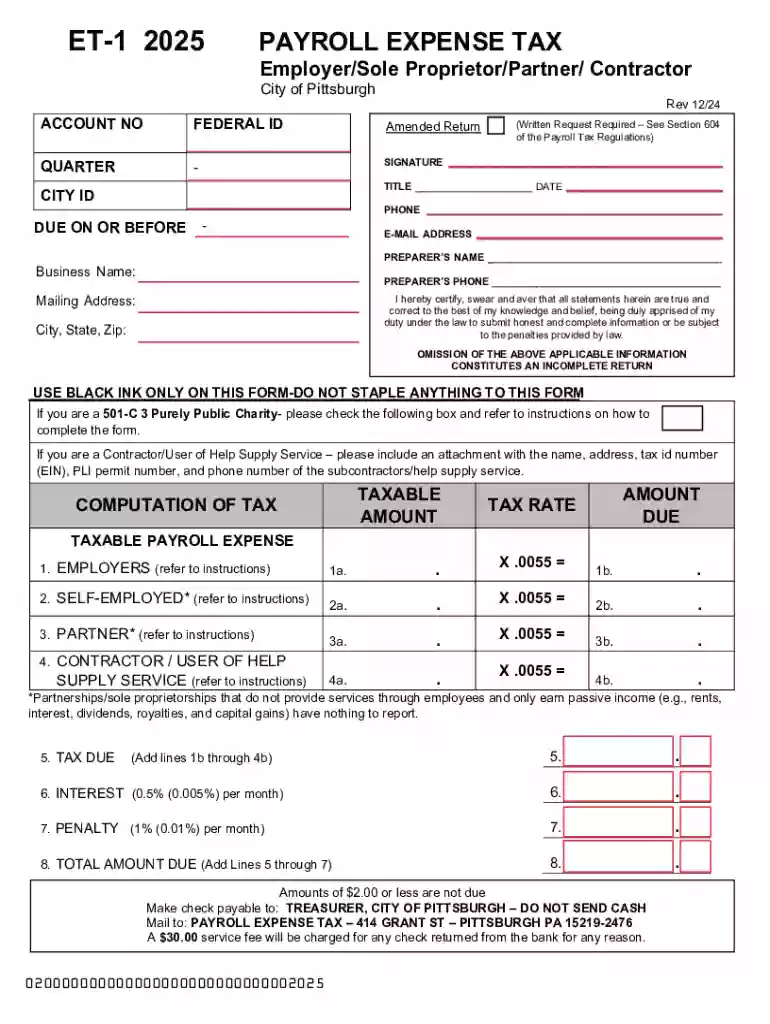
Type text, add images, blackout confidential details, add comments, highlights and more.

Draw your signature, type it, upload its image, or use your mobile device as a signature pad.

Send it via email, link, or fax. You can also download it, export it or print it out.
The Payroll Expense Tax FAQs serve as a comprehensive guide for understanding the nuances of payroll expense taxes, specifically focusing on Pittsburgh City regulations. This document provides employers, contractors, partners, and sole proprietors with essential information, ensuring clarity on compliance requirements. Payroll expense taxes are levied on businesses based on the total payroll amount paid to employees, aimed to support local government operations and services.
Understanding how to complete the Payroll Expense Tax FAQs efficiently ensures compliance and avoids potential penalties. To start:
Understanding key terms is crucial for accurately navigating the Payroll Expense Tax FAQs. Some important terms include:
Adhering to filing deadlines is critical to avoid penalties. Typically, the Payroll Expense Tax forms are due annually, with the specific date contingent on the fiscal year of the business. The FAQs detail important submission deadlines and conditions under which extensions may be requested.
Failure to comply with filing requirements for the Payroll Expense Tax may result in significant penalties, including fines and interest on unpaid taxes. The FAQs outline specific penalties, emphasizing the importance of timely and accurate submissions.
Various business types utilize the Payroll Expense Tax FAQs to ensure compliance with local tax regulations. These include employers with multiple employees, sole proprietors, and partners operating within Pittsburgh. The FAQs provide tailored guidance depending on the business structure and size.


Proper documentation supports the accurate completion of Payroll Expense Tax forms. Required documents include payroll records, employee compensation details, and financial statements. Having these on hand aids in precise calculations and form completion.
Businesses have multiple options for submitting Payroll Expense Tax forms:
The Payroll Expense Tax FAQs provide guidance specific to Pittsburgh, with rules that may differ from state-level regulations. It's critical for businesses operating in multiple jurisdictions to discern these differences to comply with local tax obligations accurately.
We've got more versions of the Payroll Expense Tax- FAQs form. Select the right Payroll Expense Tax- FAQs version from the list and start editing it straight away!
| Versions | Form popularity | Fillable & printable |
|---|---|---|
| 2025 | 4.1 Satisfied (22 Votes) | |
| 2024 | 4.4 Satisfied (50 Votes) | |
| 2023 | 4.8 Satisfied (208 Votes) | |
| 2022 | 4.8 Satisfied (106 Votes) | |
| 2021 | 4.4 Satisfied (170 Votes) | |
| 2020 | 4.3 Satisfied (109 Votes) | |
| 2019 | 3.8 Satisfied (27 Votes) | |
| 2017 | 3.8 Satisfied (33 Votes) | |
| 2016 | 4.4 Satisfied (556 Votes) | |
| 2015 | 4.4 Satisfied (1024 Votes) | |
| 2014 | 4 Satisfied (28 Votes) | |
| 2013 | 4 Satisfied (46 Votes) | |
| 2012 | 4 Satisfied (45 Votes) |
At DocHub, your data security is our priority. We follow HIPAA, SOC2, GDPR, and other standards, so you can work on your documents with confidence.


Frequently Asked Questions. View Payslips. Your current payslip will be available online on your scheduled pay date. You have access to the previous threeRead more
Aug 11, 2026 Our income tax calculator enables you to easily calculate your net wage, which remains after deducting all taxes and contributions.
What is the Payroll Preparation Tax? The Payroll Preparation Tax is a tax on an employers total payroll expense paid, including salaries, wages,Read more


