




01. Edit your form online
Type text, add images, blackout confidential details, add comments, highlights and more.

Type text, add images, blackout confidential details, add comments, highlights and more.

Draw your signature, type it, upload its image, or use your mobile device as a signature pad.

Send it via email, link, or fax. You can also download it, export it or print it out.
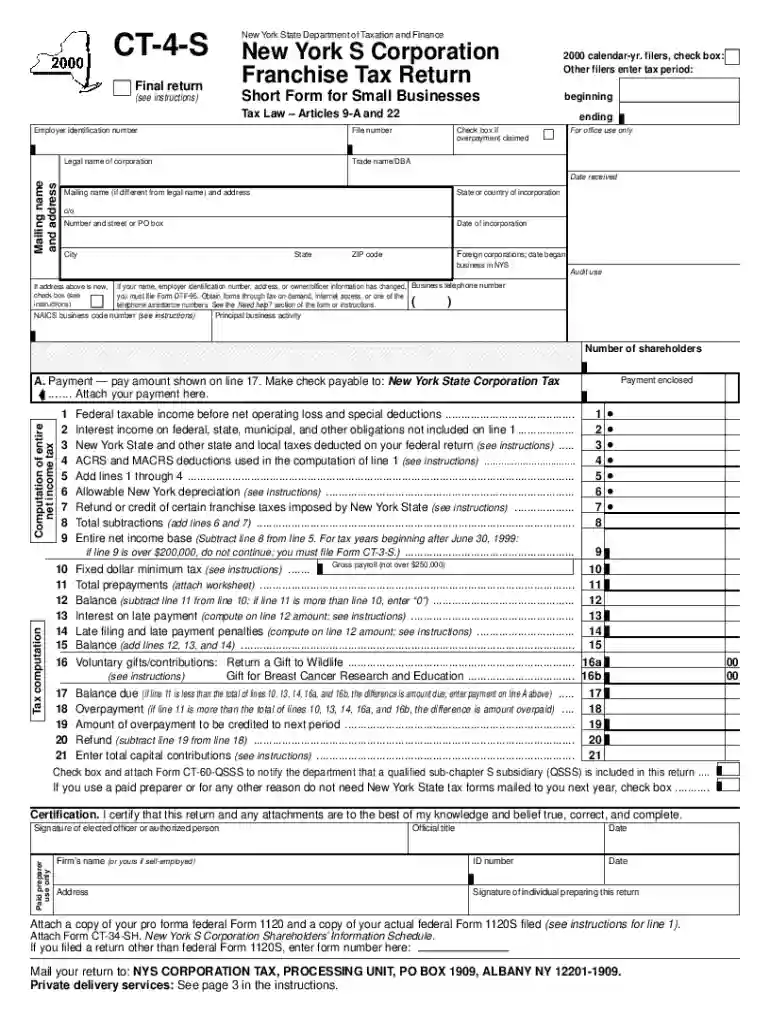
Form CT-4-S is a tax document known as the New York S Corporation Franchise Tax Return. It is specifically designed for S corporations operating within New York State. The primary purpose of this form is to allow small businesses, structured as S corporations, to report their income, deductions, and tax liabilities to the state's Department of Taxation and Finance. S corporations are pass-through entities, meaning their income or loss is passed to shareholders before tax is applied; however, certain state-level taxes and fees must still be reported and settled via this form.
The form consists of several critical sections that require detailed information from the taxpayer:
Corporate Identification: Basic information about the S corporation, including its name, address, federal employer identification number (EIN), and the nature of its business.
Tax Computation: This section involves calculations concerning federal taxable income adjusted for state requirements. It includes the total amounts of income earned, deductions, and applicable state modifications to reach the taxable income figure for New York State.
Payment Details: Information regarding any taxes owed or overpayments. This includes taxes paid during the year, estimated tax payments, and any credits applied or refunds requested.
Supporting Documentation: Directions on attaching necessary documentation for verification, such as schedules that detail calculations or any additional forms explaining the deductions or credits utilized.
Gather Required Information: Before starting the form, compile all necessary financial documents, including records of income, expenses, and previous year tax returns for reference.
Complete Corporate Identification: Fill out all details related to the S corporation, ensuring accuracy to avoid processing delays.
Calculate Federal Taxable Income: Begin by determining the federal taxable income, adjusting it as necessary to align with state requirements.
Adjust for State-Modifications: Make necessary adjustments according to New York State tax laws, including any add-backs or deductions that differ from federal provisions.
Finalize Tax Computation: Compute the tax due or refund expected based on adjusted taxable income and remittances throughout the year.
Attach Supporting Documents: Ensure all relevant schedules and documentation are included to validate the claims and figures reported.
Review and Submit: Double-check all entries for errors, sign the form, and submit it through the chosen method (e-file, mail, or in-person).
Form CT-4-S is typically utilized by small businesses operating as S corporations within New York State. These entities are often organized by:
Entrepreneurs and Small Business Owners: Individuals who prefer a business structure that offers pass-through taxation but still need to comply with state-level tax reporting.
Business Entities with Shareholders: Companies that distribute earnings to shareholders, who then report the income on their personal tax returns, while the corporation manages its state tax obligations through the CT-4-S.


Using Form CT-4-S is not merely procedural; it is a legal requirement for S corporations in New York State. Compliance ensures:
Accurate Reporting of Tax Liabilities: Legally binding the corporation to declare its income and pay any taxes owed at the state level.
Avoidance of Penalties: Filing correctly and on time prevents incurring penalties or interest charges for late payments or inaccurate submissions.
For timely filing, S corporations must adhere to New York State's deadlines:
Standard Filing Deadline: Typically, the form is due on March 15th following the end of the tax year. If this date falls on a weekend or public holiday, the deadline is extended to the next business day.
Extension Requests: Corporations can request an extension, usually up to six months, but must file the extension request before the deadline and pay any taxes due to avoid penalties.
Form CT-4-S can be submitted via the following methods:
Electronic Filing: The recommended method for most corporations as it ensures faster processing of the return and related payments.
Mail: Corporations may opt to send their completed form and associated documentation via postal services to the designated New York State Tax Department address.
In-Person Submission: Though less common, some entities may have the option to deliver their return to a local tax office directly.
Failure to comply with the CT-4-S filing requirements results in:
Late Filing Penalties: Imposed based on the delay duration past the original or extended due date.
Interest on Unpaid Taxes: Charged on outstanding tax amounts, calculated from the due date until the payment is received.
Potential Legal Action: In extreme cases, persistent non-compliance can trigger investigations or legal proceedings by the state tax authority.
Adhering to these requirements ensures businesses remain in good standing with the state's regulations and avoid unnecessary financial or legal challenges.
We've got more versions of the Form CT-4-S form. Select the right Form CT-4-S version from the list and start editing it straight away!
At DocHub, your data security is our priority. We follow HIPAA, SOC2, GDPR, and other standards, so you can work on your documents with confidence.



The information on Form CT-W4NA and Form CT-W4 will help your employer determine how much to withhold from your wages for services performed within Connecticut.
Form CT-588, Athlete or Entertainer Request for Reduced Withholding, to request a reduced Connecticut income tax withholding amount.


