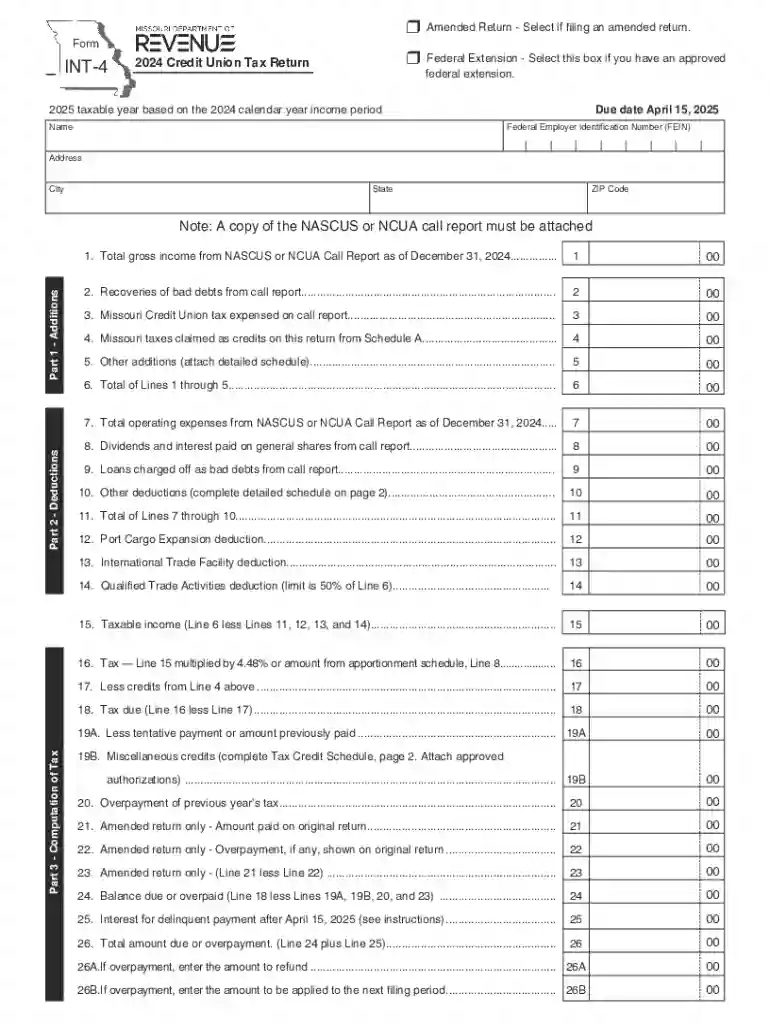
Form INT-4 - 2023 Credit Union Tax Return-2026

Get Form
Form INT-4 - 2023 Credit Union Tax Return Preview on Page 1

Here's how it works

01. Edit your form online
Type text, add images, blackout confidential details, add comments, highlights and more.

02. Sign it in a few clicks
Draw your signature, type it, upload its image, or use your mobile device as a signature pad.

03. Share your form with others
Send it via email, link, or fax. You can also download it, export it or print it out.

Definition and Purpose of Form INT-4

Form INT-4, also known as the 2023 Credit Union Tax Return, is a specialized tax document used by credit unions to report and file their annual tax returns. This form is essential for credit unions operating within state jurisdictions that require distinct reporting of financial activities. It provides a structured approach for credit unions to detail their income, deductions, and tax credits, aligning with specific tax obligations. The form ensures compliance with state tax laws and assists in standardizing the reporting process for credit unions across various regions.

Steps to Complete Form INT-4

Completing Form INT-4 requires a systematic approach to ensure all necessary information is accurately reported. Here's a step-by-step guide:

  1. Enrollment Details: Begin by filling out the credit union's identification details, including the name, address, and taxpayer identification number.
  2. Income Reporting: Carefully report all sources of income, which may include interest on loans, fees, and other income streams.
  3. Deductions and Credits: List all applicable deductions and tax credits to reduce the taxable amount. This section requires detailed documentation to substantiate the deductions claimed.
  4. Apportionment Details: If applicable, complete the apportionment schedules to report income derived from out-of-state activities.
  5. Final Calculation: Carefully compute the total tax liability, ensuring all entries are correct and aligned with the supporting documentation.
  6. Sign and Submit: Once verified, sign the form and submit it along with necessary schedules and attachments. Check for state-specific submission instructions to ensure compliance.

Key Elements of Form INT-4

Form INT-4 consists of several critical components, each serving a specific purpose in accurately representing a credit union's tax situation:

  • Basic Identity Information: This includes the credit union's full legal name, address, and federal taxpayer identification number.
  • Income and Revenue: Detailed sections where all income sources must be accurately reported.
  • Deductions and Credits: Areas to document all valid deductions, such as employee wages, and credits that apply to the credit union.
  • Apportionment and Allocation: Specific sections for credit unions operating interstate, allowing precise allocation of income and expenses.
  • Amended Returns: Guidelines and space for submitting amendments to previously filed returns.

Eligibility Criteria

Credit unions are the primary entities required to file Form INT-4. The eligibility can extend to:


  • State-Chartered Credit Unions: Those operating within states mandating this filing.
  • Federally-Chartered Credit Unions: When they have state-specific tax obligations.
  • Inactive Credit Unions: If they have any financial transactions during the tax period.
  • Multi-State Credit Unions: Those engaged in operations across state lines and required to apportion income.
decoration image ratings of Dochub

State-Specific Rules for Form INT-4

Different states may impose unique requirements for filing Form INT-4:

  • Income Apportionment: Some states demand detailed apportionment across jurisdictions, affecting how income is reported.
  • Deduction Limits: States may vary in the limitations or exclusions allowed for certain deductions.
  • Filing Deadline Variations: While the standard filing deadline is April 15, it is advisable to verify each state's specific due date to avoid penalties.
  • Special Incentives: Certain states might offer tax credits for credit unions engaging in community development activities.

Filing Deadlines and Important Dates

The standard filing deadline for Form INT-4 is April 15, 2025. It is crucial for credit unions to adhere to this timeline to avoid late filing penalties. If additional time is needed, federal extensions are acknowledged, contingent on state approval procedures.

  • Initial Filing Date: April 15, 2025
  • Extension Requests: Must be filed ahead of the deadline with appropriate justification.
  • Amended Returns: Allowed post-filing deadline with necessary documentation and rationale.
  • Late Filing Penalties: Imposed for filings beyond the deadline without a granted extension.

Penalties for Non-Compliance

Credit unions failing to comply with Form INT-4 filing requirements may face several penalties:

  • Late Filing Penalties: Imposed on returns submitted past the deadline without an approved extension.
  • Underreporting Penalties: Levied when there is significant underreporting of income or misrepresentation.
  • Interest on Unpaid Taxes: Accumulates from the original due date of the return until paid in full.
  • Suspension of State Licenses: In severe cases, non-compliance could impact licensure and the credit union's ability to operate legally within the state.

Required Documentation

Completing Form INT-4 necessitates a thorough compilation of documents to support each entry:

  • Income Statements: Detailed records of all income sources.
  • Expense Receipts: Proof of deductions claimed, such as payroll expenses and operational costs.
  • Apportionment Schedules: If relevant, documentation of how income and expenses are distributed across jurisdictions.
  • Tax Credit Certificates: Required when claiming state-specific tax incentives or credits.

Form Submission Methods

Credit unions have multiple options for submitting Form INT-4:

  • Online Submission: Streamlines the process and ensures quick acknowledgment of filing.
  • Mail Submission: Traditional method; must be sent to the specified state department address, ensuring timely postmarking.
  • In-Person Filing: Available for credit unions preferring direct interaction with tax authorities.

Digital vs. Paper Filing

The technological advancement in tax processing allows credit unions to choose between digital or traditional paper filing, each with distinct advantages:

  • Digital Filing: Offers expedited processing time and immediate confirmation of receipt.
  • Paper Filing: Ensures a physical record is maintained, with the added security of tangible documentation.
  • Hybrid Approach: Utilize digital submissions with print records retained for internal compliance checks.

Software Compatibility

Using tax software optimizes the Form INT-4 preparation and filing process. Compatible systems such as TurboTax and QuickBooks offer automated solutions, enhancing accuracy and efficiency.

  • Automated Calculations: Reduces manual errors with pre-set formulas for tax computations.
  • E-Filing Support: Direct submission to the state via integrated e-filing capabilities.
  • Comprehensive Data Management: Tracks and stores prior returns for ease in future filings and audits.
be ready to get more

Complete this form in 5 minutes or less

Get form

Got questions?

We have answers to the most popular questions from our customers. If you can't find an answer to your question, please contact us.
Contact us
Download income tax forms You can e-file directly to the IRS and download or print a copy of your tax return. Federal tax filing is free for everyone with no limitations, and state filing is only $14.99. Join the millions of taxpayers who have filed securely using FreeTaxUSA.
The Form 426 is used to request a refund of taxes or fees paid on a vehicle or marine in Missouri under specific circumstances such as total loss, local tax overcharge or rescinded sale. Required documentation includes proof of purchase, sale, or total loss along with other supporting documents.
The LLC needs to file a 1065 Partnership Return and issue a Schedule K-1 to the LLC owners. The K-1s report each owners distributive share of profits. And the K-1 income flows through to the owners. The income taxes are then paid by each owner on their personal income tax return (Form 1040).
Missouri franchise tax is paid by all corporations doing business in the state. Companies required to pay the tax must file Form MO-1120 or Form MO-1120S when paying their tax bill.
If you choose not to e-file, you may print any Missouri tax form from our website at dor.mo.gov/forms. Questions? Contact us at Income@dor.mo.gov or PropertyTaxCredit@dor.mo.gov.

Security and compliance

At DocHub, your data security is our priority. We follow HIPAA, SOC2, GDPR, and other standards, so you can work on your documents with confidence.
Learn more
ccpa2
pci-dss
gdpr-compliance
hipaa
soc-compliance

People also ask

Corporations/S Corporations Subject to Franchise Tax All domestic corporations must file a Form MO-1120, Corporation Income Tax/Corporation Franchise Tax Return or Form MO-1120S, S Corporation Income/Franchise Tax Return and Schedule MO-FT, Franchise Tax Schedule and pay any tax due.

Related links