






Definition & Meaning
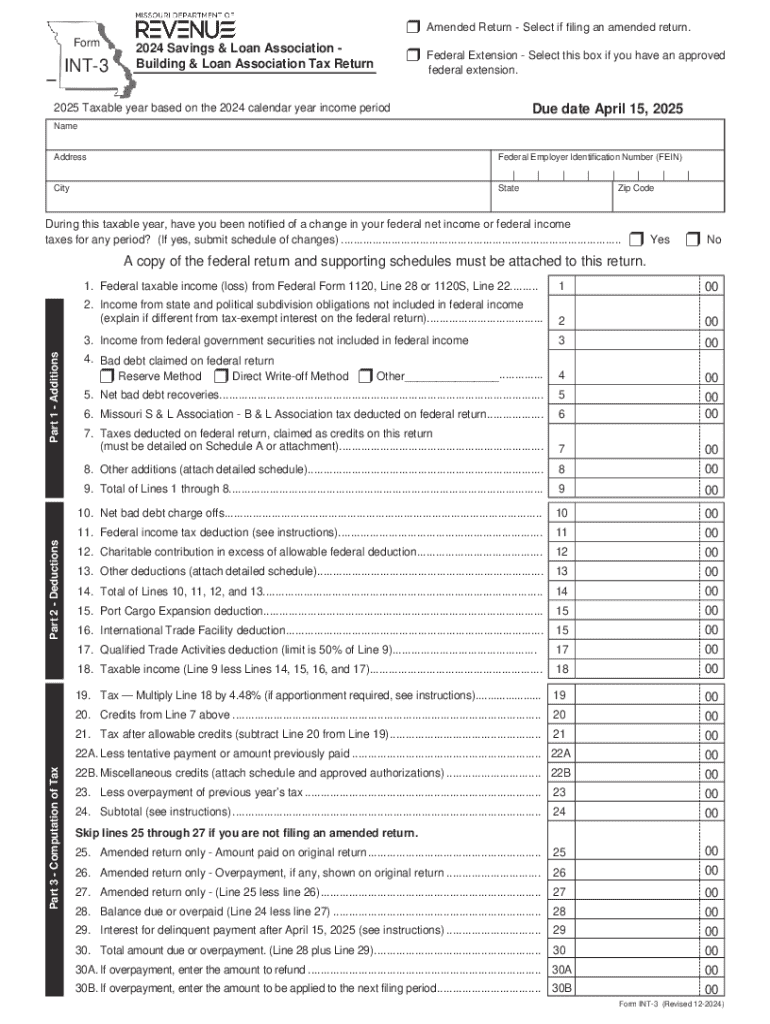
The Form INT-3, formally known as the 2024 Savings and Loan Association - Building and Loan Association Tax Return, is a tax document specifically designed for savings and loan associations in Missouri. This form serves as a comprehensive tool to report the financial activities of such entities, covering aspects like income, deductions, and tax liabilities. It ensures compliance with state tax laws and aligns with federal reporting standards, providing a detailed snapshot of an association's financial status for the tax year 2024.
- Purpose: Captures the fiscal data of savings and loan associations to compute state tax obligations.
- Necessity: Fulfills statutory requirements for tax reporting and remittance in Missouri.
- Usage: Primarily used by financial organizations classified under savings and loan or building and loan associations.
Related Financial Terms
- Gross Income: Total revenue a savings and loan association earns before deductions.
- Deductions: Allowable subtractions from gross income to determine taxable income.
- Tax Liabilities: Financial obligations to the state based on calculated taxable income.
How to Use the Form INT-3
Completing Form INT-3 involves several meticulous steps to ensure accurate reporting and compliance. Being a financial instrument, the form aids in the articulation of taxable activities within the fiscal year, promoting clarity and precision in tax filing.
Step-by-Step Guide
- Gather Required Financial Documents: Assemble accounting records that detail all income and expenses.
- Complete Income Sections: Record all sources of revenue under specified line items.
- Fill Out Deductions and Credits: Enter eligible deductions and any applicable tax credits.
- Calculate Tax Liabilities: Derive the amount of tax due using the form's computations.
- Attach Supporting Documents: Include a copy of the federal tax return and all schedules.
- Review and Submit: Ensure all entries are accurate before submission to the appropriate state tax office.
- Note: Fields must be completed with precision to avoid discrepancies that could lead to audit flags or penalties.
Steps to Complete the Form INT-3
Ensuring thoroughness when filling out the Form INT-3 requires attention to detail and an understanding of the form's architecture. The process is designed to systematically capture the association's financial activities and determine its tax liability.
Detailed Filing Steps
- Section A: Identify the organization with its legal name and tax ID number.
- Section B: Declare the total income from all sources, itemized by category.
- Section C: List permissible deductions; common deductions may include operational expenses and interest.
- Section D: Report taxable income, followed by the calculated state tax due.
- Section E: Detail any tax credits or prepayments, adjusting the final amount owed or refunded.
Real-World Examples
- Example 1: A savings association reports an interest income of $500,000 and claims $150,000 in operational expenses as deductions.
- Example 2: A building and loan association utilizes a tax credit for energy-efficient improvements, reducing their overall tax obligation by $10,000.
Who Issues the Form
Form INT-3 is issued by the Missouri Department of Revenue. This state department is responsible for setting tax policies, collecting state taxes, and enforcing the tax laws in Missouri. The issuance of Form INT-3 ensures that savings and loan associations have the correct tool for fulfilling their tax return obligations.
- Contact Information: Missouri Department of Revenue, Taxation Division.
- Support: Assistance available for form-related inquiries fills a critical need for organizations navigating tax regulations.
Filing Deadlines / Important Dates
Timely submission of Form INT-3 is crucial to avoid any late filing penalties or interest charges. The stipulated deadline provides associations with ample time to prepare and finalize their financial reporting.
Key Dates
-
Filing Deadline: April 15, 2025, corresponds with the traditional federal tax deadline.
-
Amendment Cut-off: Associations have until October 15, 2025, to file any amendments to their tax return.
-
Extension Requests: Deadline for extension applications is March 15, 2025.
-
Implication of Missing Deadlines: Late submissions incur financial penalties and may attract additional scrutiny from tax authorities.
Required Documents
Filing Form INT-3 mandates the assembly of comprehensive documentation to substantiate all reported information. Accurately preparing these documents is imperative to streamline the filing process and ensure validation of entries.
Document Checklist
- Federal Tax Return Copy: Necessary to cross-reference financial declarations.
- Internal Financial Statements: Including balance sheets and income statements.
- Bank Statements: Detailed records evidencing income and expenditures.
- Expense Receipts: Documentation for all claimed deductions.
Exceptions and Considerations
- Special Income Items: Unique income sources may require additional documentation or explanation.
- Large Deductions: Significant deductions might necessitate further evidence to validate claims.
Legal Use of the Form
Form INT-3's design ensures compliance with Missouri's distinct state tax laws while aligning with federal requirements. Its legal utility extends beyond compliance, providing insights into an association's financial health.
Compliance Requirements
-
Accuracy Assurance: Misreporting can lead to legal repercussions or financial penalties.
-
Audit Preparedness: Proper documentation supports associations in case of state-led audits.
-
Legal Representation: Engaging legal or financial advisors can enhance comprehension and accuracy.
-
Use Case: Associations undergoing structural financial changes must reflect these on the form to maintain compliance.
Digital vs. Paper Version
Form INT-3 is available in both digital and paper formats, each offering distinct advantages depending on the association's technological capabilities and preferences. The digital form facilitates ease of use and storage efficiency, while paper versions cater to traditional filing preferences.
Considerations for Each Format
-
Digital Version: Offers environmentally friendly benefits and faster processing times. Compatible with e-filing systems and useful for digital record-keeping.
-
Paper Version: Preferred for those who prefer manual record-keeping or have limited access to digital filing resources.
-
Integration with Software: Leveraging tax preparation software such as TurboTax or QuickBooks may streamline the digital filing process for associations accustomed to using these tools.
Understanding the options available for filing can guide associations in selecting the method aligning best with their operational needs.