






Definition & Meaning
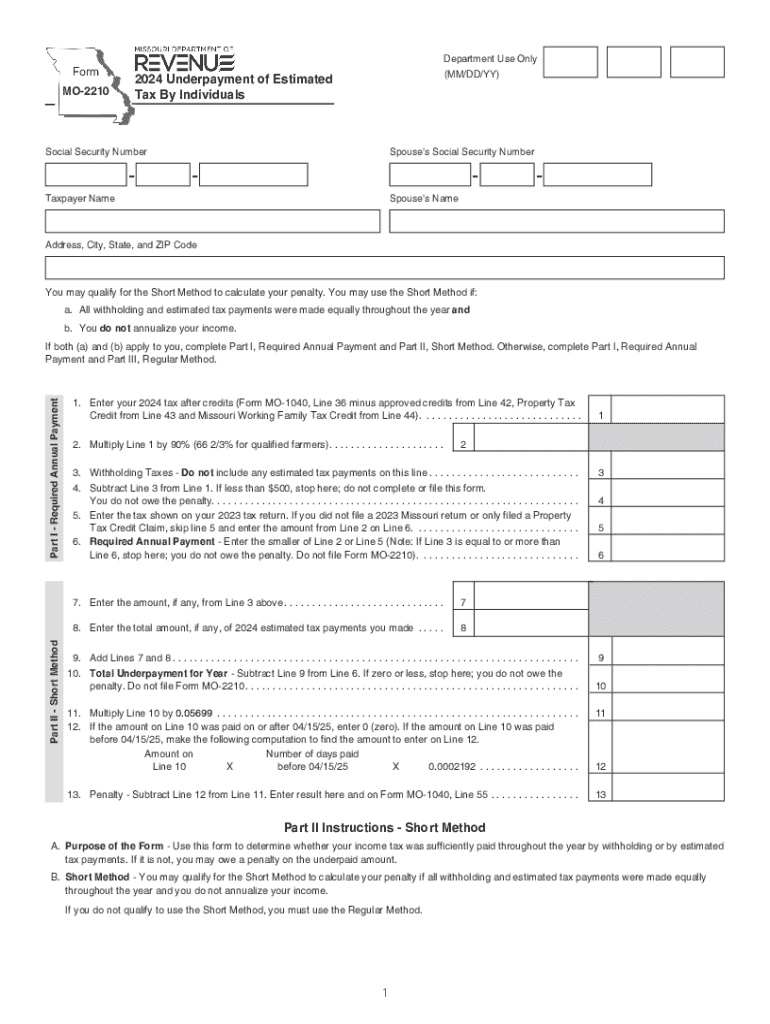
Form MO-2210 for 2024 is a tax document used by individuals in Missouri to compute any underpayment penalty related to estimated tax payments. This form helps taxpayers assess whether they have met their estimated tax payment requirements throughout the year to avoid penalties. It is crucial for anyone who does not meet the withholding threshold based on their annual income or those who prefer making estimated payments.
How to Use the Form MO-2210 for Calculating Penalties
To use Form MO-2210 effectively, Missouri taxpayers must follow the instructions provided, which entail using either the Short Method or Regular Method to calculate any underpayment penalties. This involves inputting the relevant withholding and estimated tax payment data, assessing the annualized income periods, and applying the corresponding penalty rate. Users should ensure each section is completed accurately to avoid discrepancies in penalty calculations.
Short Method vs. Regular Method
- Short Method: Suitable for simple scenarios where income and payments have remained steady.
- Regular Method: Recommended for complex situations with income fluctuations or varied payment schedules throughout the year.
Steps to Complete the Form MO-2210
- Gather Required Information: Collect details of all estimated payments and withholdings made throughout the year.
- Choose Calculation Method: Decide between the Short or Regular Method based on the complexity of income and payment scenarios.
- Fill Sections Accurately: Input details in relevant columns and rows as per the chosen method, ensuring all calculations follow the guidance in the given instructions.
- Review for Accuracy: Verify all inputs, calculations, and totals to ensure completeness.
Important Terms Related to Form MO-2210
- Estimated Tax: Payments made quarterly by individuals not subject to withholding or whose withholding is insufficient.
- Underpayment Penalty: A financial penalty imposed for not meeting the minimum tax payment requirements throughout the year.
- Withholding: Amounts deducted from income by employers and sent to the government as partial tax payment.
IRS Guidelines and Missouri State Regulations
- IRS Guidelines: Focus on federal procedures for calculating and submitting estimated tax payments at a national level.
- State-Specific Rules: Missouri adaptations include specific deadlines and criteria aligned with state tax requirements; deviations from federal guidelines should be noted and adhered to.
Who Typically Uses Form MO-2210
- Self-Employed: Individuals without withholding.
- Retirees: Those receiving pension income with insufficient withholding.
- High Income Earners: Individuals with income not entirely subject to withholding.
Distinct Categories
- Freelancers and Contractors: Conduct independent projects and require accurate tax assessments.
- Property Owners with Rental Income: To ensure they meet their tax obligations when rental income is their primary source.
Penalties for Non-Compliance
Failing to utilize Form MO-2210 when required can result in hefty penalties. These are calculated based on the amount underpaid and the length of time the payment was delayed. The form serves as a safeguard against penalties by ensuring all requisite tax payments are made on time.
Factors Affecting Penalty Calculation
- Payment Timing: Paying late leads to additional penalties.
- Amount Underpaid: Larger deficits cause higher penalties.
Filing Deadlines and Important Dates
Missouri taxpayers must adhere to specific deadlines for estimated payments and Form MO-2210 submissions. Typically, estimated tax payments are due quarterly, and the form submission aligns with the annual tax filing deadline. Being aware of these timelines is crucial to avoid penalties.
Key Payment Dates
- First Quarter: April 15
- Second Quarter: June 15
- Third Quarter: September 15
- Fourth Quarter: January 15 (of the following year)
Examples of Using Form MO-2210
Consider a freelancer in Missouri who receives varying income monthly and pays estimated taxes quarterly. They would use Form MO-2210 to ensure that they paid enough tax throughout the year. By selecting the Regular Method, they can dynamically account for fluctuations and minimize their chances of incurring penalties. Similarly, retirees receiving a varied pension income would need to ensure payments align with their total yearly tax liability.
Software Compatibility
Form MO-2210 can be completed using tax software such as TurboTax or QuickBooks, which streamline calculations and form submissions. These platforms integrate directly with Missouri tax guidelines, offering tools to automate calculations, fill forms, and even submit them directly online, minimizing manual errors and speeding up the process for users with digital copies of their financial information.