
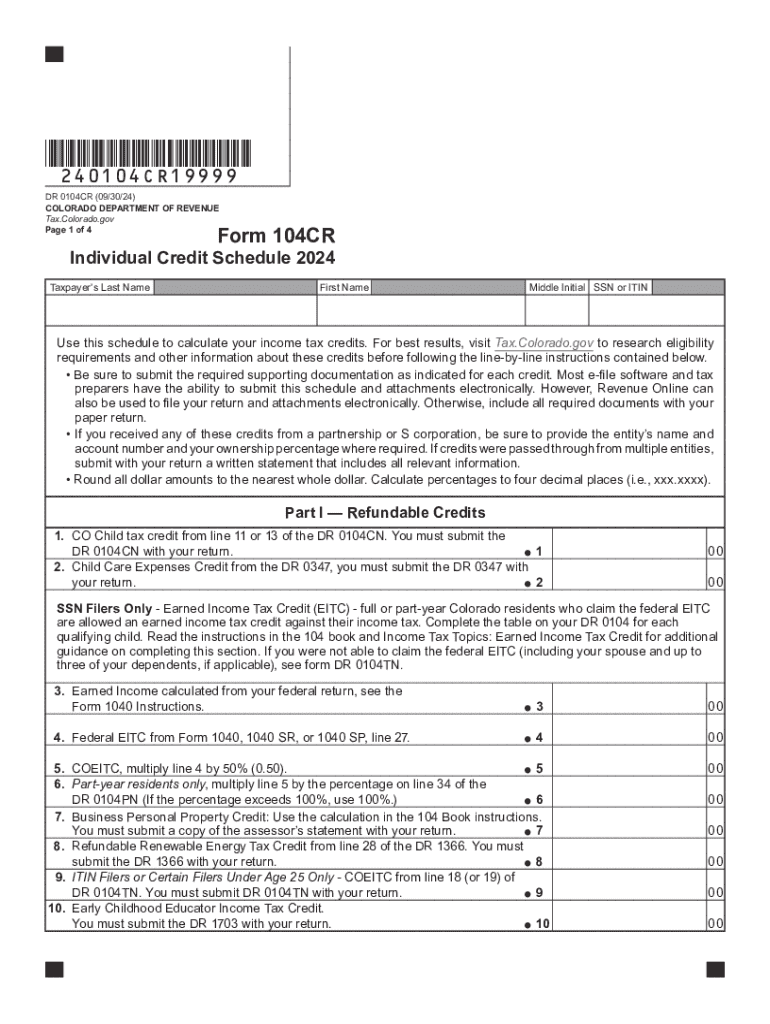







Definition and Purpose of the DR 0104CR, 2024 Individual Credit Schedule
The DR 0104CR, known as the 2024 Individual Credit Schedule, is a crucial tax form issued by the Colorado Department of Revenue. It's utilized by taxpayers to calculate specific income tax credits available in the state, allowing for the reduction of taxable income. This form includes detailed instructions for a variety of credits such as the Child Tax Credit, Earned Income Tax Credit, and several other refundable and nonrefundable credits. The primary purpose of this document is to ensure taxpayers can accurately report and claim credits they are eligible for, thus lowering their overall tax liability.
Steps to Complete the DR 0104CR, 2024 Individual Credit Schedule
-
Gather Necessary Information: Before beginning, collect all relevant tax documents and supporting paperwork, such as W-2s, 1099s, and any previous tax returns if needed for reference.
-
Determine Eligibility: Review the form's instructions to understand the eligibility criteria for each credit. Ensure all required conditions are met for claiming each specific credit listed.
-
Complete Identification Sections: Fill out personal details, including name, Social Security number, and filing status at the top of the form to ensure it’s properly identified.
-
Calculate Each Applicable Credit: For each credit you qualify for, enter the required information into the corresponding section. Use provided worksheets or instructions to determine amounts.
-
Sum Total Credits: Add the calculated amounts to find the total credits you are entitled to claim. Transfer this total to the appropriate line on your Colorado Individual Income Tax Return.
-
Verify Informations: Double-check all inputs for accuracy and completeness. Ensure that supporting documents are attached, if necessary.
-
Submit the Form: Follow the submission instructions, which may involve attaching the form to your main Colorado state tax return or submitting it electronically, depending on your filing method.
Eligibility Criteria for the DR 0104CR, 2024 Individual Credit Schedule
- Residency Requirements: Must be a resident or part-year resident of Colorado during the tax year.
- Income Thresholds: Some credits may have income limitations, especially for credits like the Earned Income Tax Credit.
- Filing Status: Certain credits may be available only to taxpayers with specific filing statuses, such as Married Filing Jointly.
- Specific Conditions: Each credit has unique criteria, such as supporting dependent children for the Child Tax Credit. Check each section for detailed requirements.


Key Elements of the DR 0104CR, 2024 Individual Credit Schedule
- Personal Identification Information: Section to include your basic personal details.
- Credit Computation Sections: Areas designated for calculating each applicable credit, with specific lines for refundable and nonrefundable credits.
- Documentation Requirements: Indication of necessary supplementary documentation to prove eligibility for claimed credits.
- Instructions and Worksheets: Accompany the form, providing detailed guidelines on properly completing each part and additional worksheets for complex calculations.
Important Terms Related to the DR 0104CR, 2024 Individual Credit Schedule
- Refundable Credit: A credit that can reduce your tax liability below zero, resulting in a refund.
- Nonrefundable Credit: A credit that can reduce your tax liability to zero but not further.
- Carryforward: The ability to apply unused credits to future tax years under certain conditions.
Examples of Using the DR 0104CR, 2024 Individual Credit Schedule
- Single Parent Claiming Child Tax Credit: A taxpayer claiming the Child Tax Credit will need to provide the child’s details and ensure income thresholds are met. Supporting documents, such as birth certificates or school records, may be required.
- Low-Income Earner Claiming Earned Income Tax Credit (EITC): Eligibility for EITC involves meeting income limits and age requirements. The taxpayer should be prepared to provide proof of earned income.
Required Documents for Filing
- W-2 and 1099 Forms: To confirm employment income and any other earnings.
- Social Security Cards or ITINs: For all individuals listed on the return.
- Proof of Residency: Such as a utility bill or lease agreement.
- Supporting Documents for Credits: Varies by credit but may include documents like school records or medical receipts.
Submission Methods for the DR 0104CR, 2024 Individual Credit Schedule
- Online Filing: Users can submit the form electronically using approved software programs compatible with Colorado tax filings.
- Mail: Paper forms can be mailed to the Colorado Department of Revenue. Ensure it is postmarked by the deadline.
- In-Person Submission: Available at designated Colorado Department of Revenue offices for those who prefer to submit copies in person.
Penalties for Non-Compliance
Failure to file the DR 0104CR, 2024 Individual Credit Schedule accurately can result in penalties or interest for underpayment. If found to have falsely claimed credits, the taxpayer may face fines or legal repercussions. Therefore, it is essential to ensure your form is completed truthfully and comprehensively.




