







Definition and Purpose
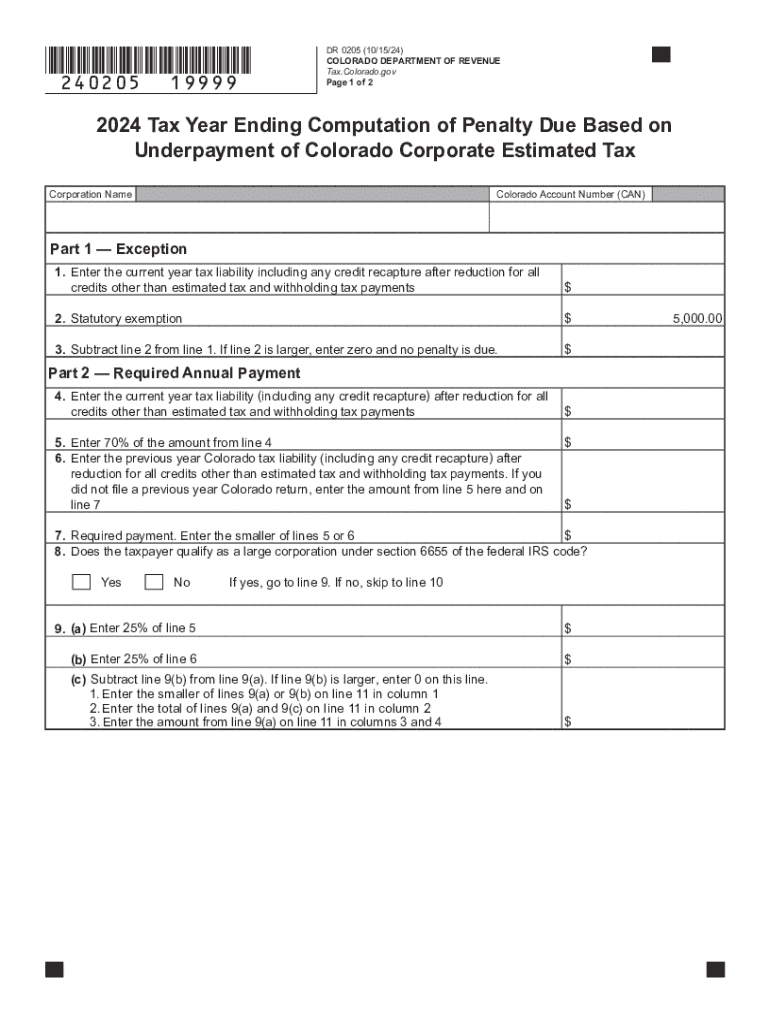
The DR 0205 form, known as the "2024 Tax Year Ending Computation of Penalty Due Based on Underpayment of Colorado Corporate," is a critical document for businesses operating in Colorado. This form is designed to help corporations calculate any penalties owed due to the underpayment of estimated state corporate taxes. The penalties apply to corporations that have not made adequate quarterly tax payments throughout the year, ensuring companies meet their tax obligations in a timely manner.
How to Use the DR 0205 Form
To use the DR 0205 form effectively, corporations should adhere to a few key steps:
-
Accurately Determine Income: Assess and determine all reportable income for the tax year. This involves reviewing financial statements and business records.
-
Estimate Tax Payments: Calculate estimated tax payments based on anticipated income. This includes assessing both state and federal tax obligations.
-
Identify Underpayments: Compare the estimated tax payments to actual liabilities. Any discrepancies or underpayments must be rectified through the DR 0205 form.
-
Compute Penalties: Use the form to calculate penalties, taking into account the interest rate and duration of the underpayment.
Steps to Complete the Form
Completing the DR 0205 form requires meticulous attention to detail:
-
Gather Financial Documents: Obtain all necessary financial records, including previous tax returns and quarterly financial statements.
-
Calculate Estimated Payments: Determine the total of all quarterly estimated payments made over the tax year.
-
Fill Out the Form: Carefully enter all required information on the DR 0205 form, ensuring accuracy in reported figures.
-
Verify Calculations: Double-check all calculations for errors, as incorrect entries can result in additional penalties or rejected filings.
-
Submit to State: File the completed DR 0205 form with the Colorado Department of Revenue by the specified deadline.
Important Terms Related to DR 0205
Several important terms are associated with the DR 0205 form:
- Estimated Tax Payments: These are approximate tax amounts paid quarterly based on expected company income.
- Underpayment: This refers to any situation where the estimated payments fall short of the actual tax due.
- Penalty Computation: The process of determining the additional fee due for underpayments based on established state formulas.
Penalties for Non-Compliance
Failing to properly complete and submit the DR 0205 form can lead to several consequences:
- Additional Penalty Fees: Unpaid taxes can result in higher penalty fees beyond the initial underpayment penalties.
- Interest Accrual: Interest continues to accrue on any outstanding tax balances until paid in full.
- Legal Actions: Continual non-compliance may lead to legal action from the state, impacting the business's operational standing.
Filing Deadlines and Important Dates
Corporations must pay attention to crucial deadlines related to the DR 0205 form:
- Quarterly Estimated Payments: Due on the 15th of April, June, September, and January of the following year.
- Annual Filing Date: Typically aligned with federal tax deadlines, generally the 15th of April.
- Extension Filing: Though extensions are available, they do not delay payment due dates.
Key Elements of the DR 0205 Form
The DR 0205 form contains several essential components:
- Corporate Information Section: Requires basic business identification details.
- Estimated Payment Entries: Involves a detailed listing of all payments made relative to estimated obligations.
- Penalty Calculation Section: Facilitates detailed calculation of owed penalties, incorporating applicable interest rates and periods of underpayment.
Software Compatibility
Many businesses find it beneficial to use tax software to assist in form completion:
- TurboTax and QuickBooks: These platforms often integrate state tax forms, including the DR 0205, to streamline the filing process.
- Compatibility Benefits: Utilizing compatible software reduces errors and expedites computations.
State-Specific Rules
Unique rules apply to the DR 0205 in Colorado:
- Annualized Income Installment Method: Optional method allowing firms to lessen penalties by aligning payments more closely with actual income fluctuations.
- State-Specific Adjustments: Corporations must factor in any state-specific deductions or credits applicable for the tax year.
Digital vs. Paper Version
Corporations may opt for digital or paper submissions for the DR 0205:
- Digital Submissions: Ensures faster processing and receipt confirmation.
- Paper Submissions: Viable for those preferring traditional methods; however, processing times may be longer.




