Get the free Supervisor MonthlyQuarterly General Safety Checklist 2026

Get Form
Get the free Supervisor MonthlyQuarterly General Safety Checklist Preview on Page 1

Here's how it works

01. Edit your form online
Type text, add images, blackout confidential details, add comments, highlights and more.

02. Sign it in a few clicks
Draw your signature, type it, upload its image, or use your mobile device as a signature pad.

03. Share your form with others
Send it via email, link, or fax. You can also download it, export it or print it out.

Definition and Meaning of the Supervisor MonthlyQuarterly General Safety Checklist

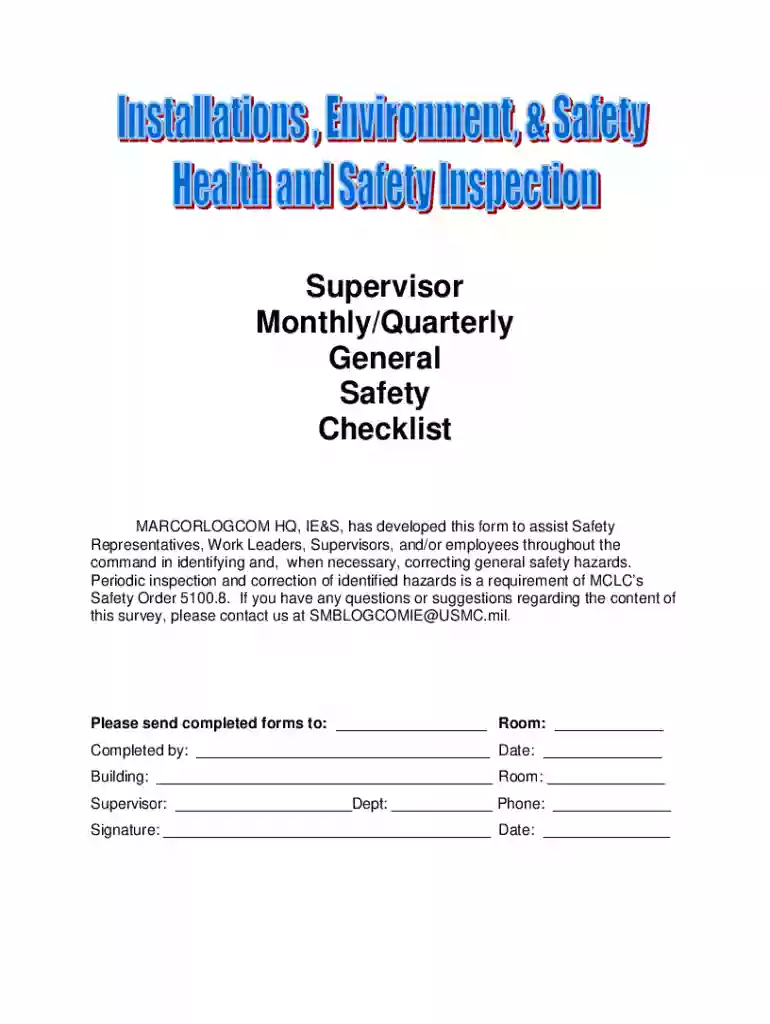
The "Get the free Supervisor MonthlyQuarterly General Safety Checklist" is a structured document designed to help Safety Representatives, Supervisors, and employees identify and address safety hazards in the workplace. Developed by MARCORLOGCOM HQ, IE&S, this checklist assists in carrying out routine safety inspections, which are vital for compliance with workplace safety regulations. It serves as a comprehensive tool for inspecting various safety aspects, including emergency preparedness, machinery safety, and hazardous materials handling.

How to Use the Checklist Effectively

Performing Safety Inspections

Safety inspections are crucial in maintaining a secure workplace. The checklist facilitates thorough evaluations across various categories, such as:

  • Work Environment Safety: Check for clear pathways, proper ventilation, and adequate lighting.
  • Housekeeping: Ensure that all work areas are clean and free of obstacles.
  • Electrical Safety: Inspect cords, outlets, and electrical panels for potential hazards.
  • Noise Control: Measure noise levels to prevent hearing damage.
  • Tools and Machinery Safety: Verify that tools are in good condition and used correctly.

Collaborative Review Process

Engage team members in the inspection process by utilizing the checklist to gather diverse perspectives on potential hazards. Facilitate discussions on corrective actions and assign responsibilities for follow-up tasks to enhance accountability and participation.

Steps to Complete the Checklist

  1. Preparation: Gather all necessary tools and allocate specific sections of the checklist to team members, ensuring comprehensive coverage.

  2. Inspection: Use the checklist as a guide to systematically inspect each safety aspect, taking note of any hazards identified.

  3. Document Findings: Record observations and any immediate actions taken during the inspection.

  4. Analysis: Review the documented findings to identify patterns or recurring issues that may need further investigation.

  5. Action Plan: Develop a corrective action plan based on the findings, assigning tasks to appropriate personnel.

  6. Follow-Up: Conduct follow-up inspections to verify the implementation of corrective measures and ensure ongoing compliance.

Reasons to Use the Checklist

Ensuring workplace safety is paramount for any organization. The checklist provides:

  • Compliance with Regulations: Helps ensure adherence to relevant safety standards and legal requirements.

  • Risk Mitigation: Aids in the proactive identification of hazards, reducing injury risks and potential liabilities.

  • Operational Efficiency: Streamlines the inspection process, facilitating quicker identification and resolution of safety issues.

Key Elements of the Checklist

The checklist is divided into key categories, each focusing on a specific aspect of workplace safety. Important elements include:

  • Emergency Preparedness: Plans and procedures for emergency situations.
  • Hazardous Materials Handling: Proper labeling, storage, and handling practices.
  • Personal Protective Equipment (PPE): Availability and use of appropriate PPE for various tasks.

Who Typically Uses the Checklist

This checklist is primarily used by:

  • Supervisors: To ensure their teams operate in a safe and compliant manner.
  • Safety Representatives: For conducting regular safety inspections and audits.
  • Employees: As a reference to understand and adhere to workplace safety practices.
decoration image ratings of Dochub

How to Obtain the Checklist

The checklist can be accessed through organizations implementing safety programs, often available as a downloadable PDF or as part of a broader safety management system. It can be stored electronically for easy distribution and use across teams.

Digital vs. Paper Version

Advantages of Digital Versions

  • Accessibility: Easy storage and accessibility on various devices, enabling real-time updates and distribution.
  • Collaboration: Facilitates online collaboration, allowing multiple users to contribute and review inspections simultaneously.

Advantages of Paper Versions

  • Simplicity: Paper versions are easy to use for teams more accustomed to traditional methods.
  • Reliability: Not dependent on electronic device availability or connectivity.

Notable Examples

Organizations across various sectors, such as manufacturing and logistics, utilize the checklist to maintain high safety standards and improve workplace culture. Regular use leads to noticeable improvements in safety awareness and incident reduction.

be ready to get more

Complete this form in 5 minutes or less

Get form

Got questions?

We have answers to the most popular questions from our customers. If you can't find an answer to your question, please contact us.
Contact us
Contractors and workers can quickly mitigate exposure to hazards and other health risks when they conduct health and safety checks with the general Take 5 procedure, i.e., stop, look, assess, control, monitor. This 5-minute safety process is primarily done to prevent possible near misses, injuries, and accidents.
What are the Take 5 Safety Steps? Stop and Think. Look and Identify. Assess the Risk. Control Hazards. Monitor Hazards.
The Neil George Safety System (or 5-Point Safety System) is an occupational health and safety program developed for and used in underground mining. The system was developed in 1942 by Canadian engineer Neil George, who at the time was an employee of Inco Limited in Sudbury, Ontario.
Supervision checklists are used during monitoring to verify if an activity has been implemented correctly. They can also be used to give feedback to the person running the activity to help them improve. Here are a few tips on how to design supervision checklists for international development / aid programs.
General routine inspections are meant to: look for workplace hazards or potential hazards its important to identify them before they cause harm. find out whether staff have any problems in doing their jobs. look at how work is being done are safe systems of work being followed?

Security and compliance

At DocHub, your data security is our priority. We follow HIPAA, SOC2, GDPR, and other standards, so you can work on your documents with confidence.

Learn more
ccpa2
pci-dss
gdpr-compliance
hipaa
soc-compliance
be ready to get more

Complete this form in 5 minutes or less

Get form

People also ask

A Take 5 Safety Checklist is a tool used to identify health and safety hazards before starting work on a site. Performing health and safety checks using the Take 5 Procedure (Stop, Look, Assess, Control, and Monitor) helps workers and contractors mitigate exposure to hazards and health risks.
A take 5 safety checklist is a tool used to identify health and safety hazards before starting work on a site. Performing health and safety checks using the take 5 procedure (Stop, Look, Assess, Control, and Monitor) helps workers and contractors mitigate exposure to hazards and health risks.

Related links