




01. Edit your form online
Type text, add images, blackout confidential details, add comments, highlights and more.

Type text, add images, blackout confidential details, add comments, highlights and more.

Draw your signature, type it, upload its image, or use your mobile device as a signature pad.

Send it via email, link, or fax. You can also download it, export it or print it out.
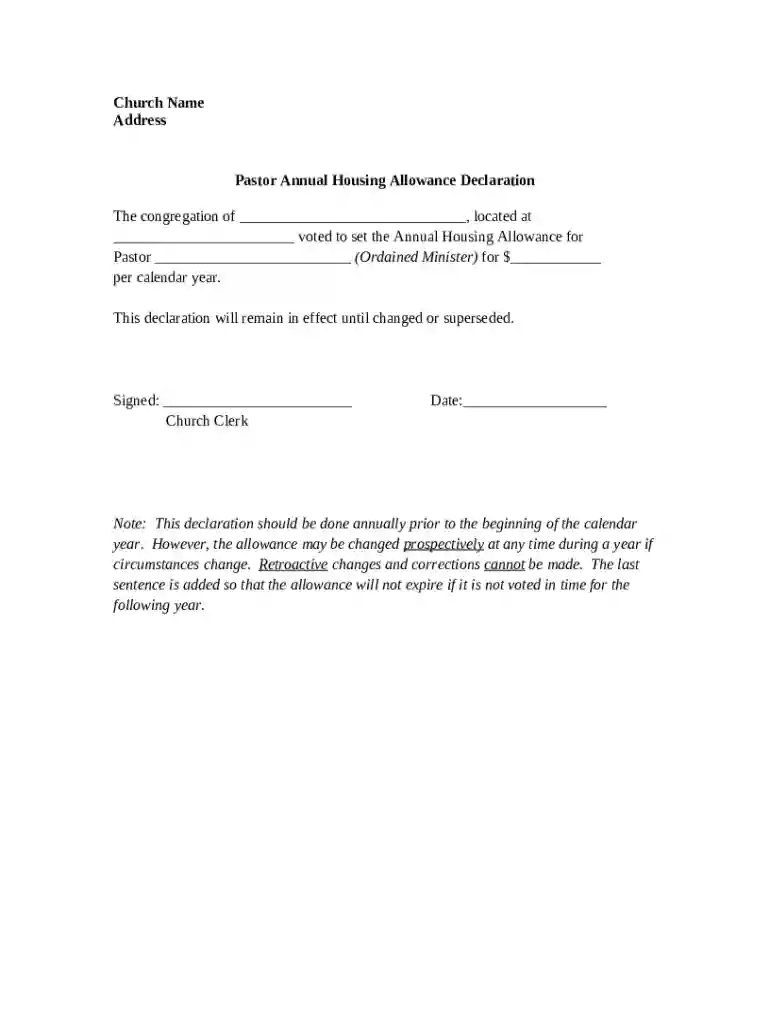
The Sample Clergy Annual Housing Allowance Declaration is a specialized form used within religious organizations to determine and document the annual housing allowance for clergy members, such as pastors or ministers. This allowance is a portion of compensation designated for a minister's housing expenses, which may include rent or mortgage payments, utilities, and maintenance costs. The allowance is tax-exempt under U.S. law, specifically outlined in Section 107 of the Internal Revenue Code. Proper declaration is crucial as it ensures compliance with IRS regulations, allowing clergy members to benefit from tax savings on designated housing expenses.
Using the Sample Clergy Annual Housing Allowance Declaration requires a clear understanding of its components. Church members or financial officers should begin by gathering necessary information, including the estimated housing expenses for the upcoming year. The declaration must detail the total amount allocated for housing along with any specific justifications for the estimate. Before the calendar year starts, the church board or designated leadership body must review and approve the declaration through a formal vote. The approved document should be filed for record-keeping and used as a reference for tax reporting purposes.
When dealing with the Sample Clergy Annual Housing Allowance Declaration, understanding certain terms is essential:
The legal implications of this declaration are rooted in U.S. tax law. Clergy members can exclude the allowed housing expenses from gross income, subject to several conditions enforced by the IRS:
According to IRS guidelines, the housing allowance must be accurately designated and utilized solely for housing-related expenses. It cannot exceed the lesser of the actual expenses, the reasonable compensation value, or the fair rental value of the home. Understanding these guidelines helps ensure compliance and maximizes the tax benefits for clergy members.
Completing the declaration involves a systematic approach:
Consider a pastor residing in church-provided housing. The church estimates $20,000 annually for the fair rental value combined with utility expenses. This amount is declared as the housing allowance, which is approved by the church board before January. Throughout the year, the pastor maintains all payment records. At tax time, the declared $20,000 is excluded from taxable gross income, contingent on those records proving the expenses.
Critical components of the declaration include:
These elements ensure the declaration meets both administrative and legal standards, offering protection and clarity to all involved parties.
We've got more versions of the Sample Clergy Annual Housing Allowance Declaration form. Select the right Sample Clergy Annual Housing Allowance Declaration version from the list and start editing it straight away!
| Versions | Form popularity | Fillable & printable |
|---|---|---|
| 2021 | 4.3 Satisfied (48 Votes) |
At DocHub, your data security is our priority. We follow HIPAA, SOC2, GDPR, and other standards, so you can work on your documents with confidence.



U.S. Code has allowed clergy to deduct any housing allowance they receive as part of their compensation since 1954. WHAT DID THE EVALUATION FIND? We found thatRead more
Aug 11, 2026 Our income tax calculator enables you to easily calculate your net wage, which remains after deducting all taxes and contributions.
Example: The ordained employees salary is $75,000 per their offer letter. They complete the housing allowance form and request $30,000 in housing allowance.Read more


