




01. Edit your form online
Type text, add images, blackout confidential details, add comments, highlights and more.

Type text, add images, blackout confidential details, add comments, highlights and more.

Draw your signature, type it, upload its image, or use your mobile device as a signature pad.

Send it via email, link, or fax. You can also download it, export it or print it out.
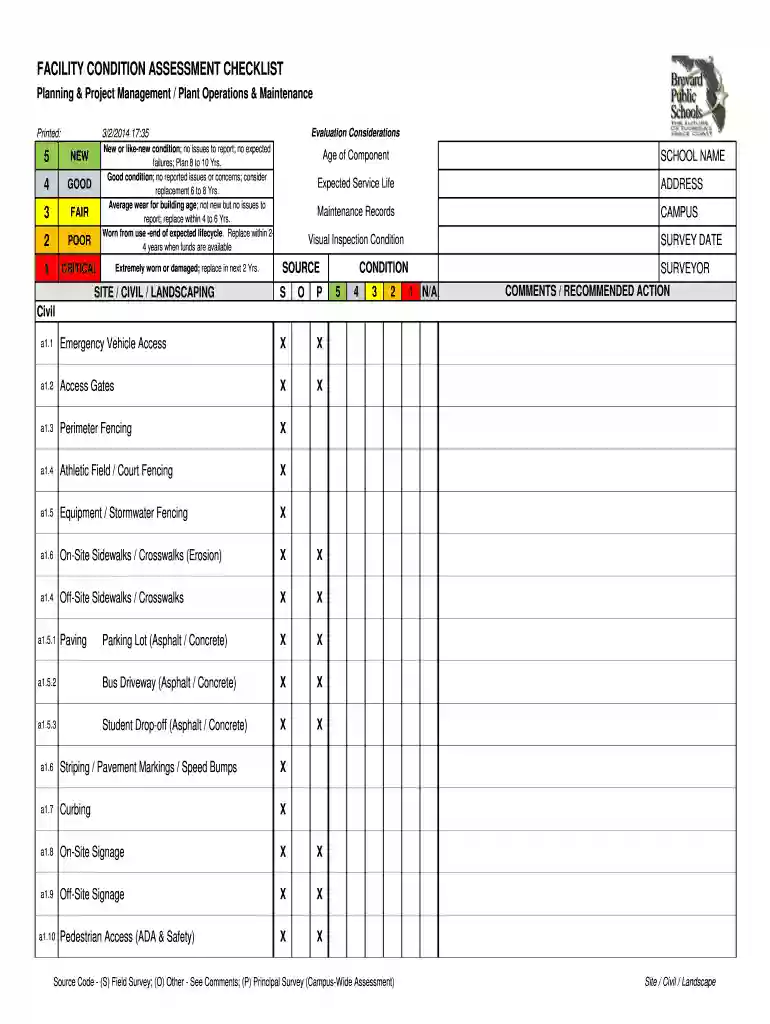
The Facility Condition Assessment Checklist is a methodical tool designed to evaluate the condition of various components within a school facility. This checklist provides a framework for systematically assessing the physical state of a building's infrastructure and systems, guiding maintenance planning and budget allocation. It employs a rating system from one (critical) to five (new), allowing evaluators to assign scores based on visual inspections. This aids in identifying immediate maintenance needs and planning for future replacements, ensuring that facilities maintain optimal operational standards and remain safe for use.
The checklist comprises several key areas, each critical to a comprehensive assessment:
Site/Civil/Landscaping: Evaluates the condition of paving, walkways, signs, landscaping, and drainage systems. This section addresses both the aesthetics and functionality of the exterior areas surrounding the facility, considering factors such as erosion, vegetation health, and accessibility compliance.
Exterior Building Envelope: Assesses the integrity of the building's exterior shell, including walls, windows, doors, and roofing systems. Evaluators inspect for signs of wear, such as cracks, leaks, or insulation issues, which could impact energy efficiency and structural integrity.
Interior Elements: Includes evaluation of walls, floors, ceilings, finishes, and fixtures within the facility. This section focuses on identifying issues such as water damage, mold, safety hazards, and overall cleanliness, which directly affect the well-being of occupants.
Plumbing Systems: Reviews the condition and performance of pipes, fixtures, and water heaters. The checklist helps identify leaks, corrosion, and potential areas of failure that might disrupt the facility's operations or lead to water damage.
Mechanical Systems: Involves examination of HVAC units, ductwork, and ventilation systems. Maintenance of these elements is crucial for ensuring comfortable indoor climates and air quality, influencing both health and operational efficiency.
Electrical Systems: Considers the safety and functionality of electrical panels, wiring, lighting, and alarms. Evaluators look for outdated or overloaded systems that could pose fire hazards or lead to power outages.
Preparation: Begin by reviewing the checklist and gathering any necessary tools, such as measuring equipment, cameras, and safety gear. Familiarize yourself with the facility’s layout and any previous assessment reports.
Initial Walkthrough: Conduct a preliminary inspection to identify any obvious issues or hazards. Note areas that may require more detailed inspection.
Detailed Assessment: Systematically evaluate each section of the checklist. Assign ratings based on observed conditions, using the provided rating system. Take detailed notes and photographs where necessary to document findings.
Consultation with Experts: For complex systems like HVAC or electrical networks, consider consulting specialists to provide a more thorough evaluation and recommendations.
Compile Results: Gather all data, including ratings, notes, and photographs. Develop a comprehensive report that outlines findings, recommended actions, and prioritization of maintenance tasks.
Review and Plan: Discuss the report with facility management to develop an action plan for addressing identified issues within budget and time constraints.
Employing this checklist is essential for several reasons:
Proactive Maintenance: Facilitates early detection of potential issues, preventing costly emergency repairs and extending the life of facility components.
Budget Management: Provides a clear understanding of maintenance priorities, enabling more effective allocation of financial resources.
Safety Assurance: Ensures that facilities meet safety standards, protecting occupants from hazards related to structural failures or environmental conditions.
Regulatory Compliance: Assists in maintaining compliance with local and state regulations, avoiding penalties and ensuring continued operational legality.
Schools, universities, and educational complexes frequently leverage this checklist to maintain facilities. For instance, a district might deploy the checklist to evaluate multiple schools, prioritizing repairs on older buildings requiring immediate attention. Another example is a university using the checklist during summer breaks to schedule necessary maintenance before the academic year resumes, minimizing disruption.
While the checklist is a universal tool, states may have unique regulations that impact how assessments are conducted. For example, certain states might enforce stricter building codes or health and safety regulations, necessitating adjustments to the checklist to meet compliance standards. Understanding these variations ensures comprehensive and legally compliant assessments.
The assessment checklist can be utilized in both digital and paper formats. Digital versions offer advantages such as ease of updating, sharing, and storing information. They enable real-time data entry and can integrate with software platforms for enhanced analysis and reporting. However, some assessors might prefer paper versions for simplicity, especially in areas with limited digital access.
To effectively use the checklist, gather documents such as:
These documents enrich the assessment process, providing a thorough understanding of the facility's condition and guiding accurate evaluations.
We've got more versions of the FACILITY CONDITION ASSESSMENT CHECKLIST form. Select the right FACILITY CONDITION ASSESSMENT CHECKLIST version from the list and start editing it straight away!
| Versions | Form popularity | Fillable & printable |
|---|---|---|
| 2014 | 4.6 Satisfied (54 Votes) |
At DocHub, your data security is our priority. We follow HIPAA, SOC2, GDPR, and other standards, so you can work on your documents with confidence.


EMGs Abbreviated Accessibility Checklist provided in Appendix D of this report. Facility Condition Assessment. Harriet Tubman Building, evaluate materials and
Evaluate all building systems in terms of their condition and recommended service life. Provide an objective and consistent evaluation of every building andRead more


