




01. Edit your form online
Type text, add images, blackout confidential details, add comments, highlights and more.

Type text, add images, blackout confidential details, add comments, highlights and more.

Draw your signature, type it, upload its image, or use your mobile device as a signature pad.

Send it via email, link, or fax. You can also download it, export it or print it out.
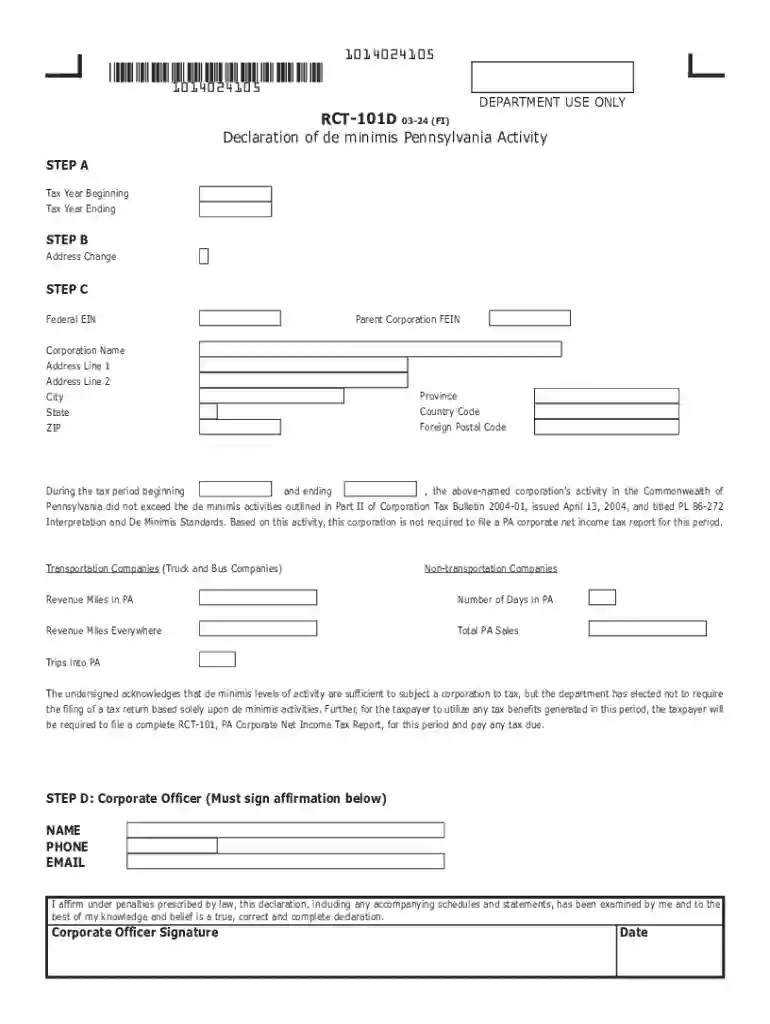
The "Declaration of de minimis Pennsylvania Activity (RCT-101D)" is a specific tax form used in Pennsylvania to declare limited or minor business activities conducted by corporations within the state. This declaration specifies that during the tax period in question, the corporation's activities did not surpass the thresholds set forth in Pennsylvania's tax guidelines. It acknowledges that while certain minimal activities may trigger tax obligations, corporations must submit a comprehensive tax report to leverage any potential tax benefits associated with these activities.
Corporations make use of the RCT-101D form to declare any de minimis business activities within Pennsylvania. It's crucial to ensure that the activities being declared do not exceed the threshold defined by state tax laws. Following these steps, a corporation can accurately file the form:
Corporations must be aware that even if activities are limited, they're required to file appropriate tax documentation.
Filing the RCT-101D involves several methodical steps:
These steps ensure the form is completed properly to support compliance with tax regulations.
The legitimate use of the RCT-101D is twofold: First, it functions as a formal declaration acknowledging minor business activities conducted in Pennsylvania that may be subject to state taxes. Secondly, it acts as a required document in the tax reporting process, ensuring that compliance is maintained with state laws. Legal compliance necessitates the correct and timely submission of this declaration by corporations to avoid penalties.
Understanding the form’s crucial elements helps ensure accurate completion:
Each element has distinct importance in validating the corporation’s tax position.
Pennsylvania's specific regulations around this form dictate the type and extent of activities classified as de minimis. These rules are critical as they:
These rules vary from those in other states, necessitating thorough comprehension by businesses operating in Pennsylvania.
Adhering to strict deadlines is imperative when filing the RCT-101D. Important dates include:
Remaining cognizant of these dates prevents last-minute rushes and minimizes the risk of late submissions.
For efficient handling of the RCT-101D form, companies often utilize tax software solutions compatible with Pennsylvania tax forms:
Utilizing such software ensures accuracy and can simplify the overall management of tax obligations associated with minor corporate activities in Pennsylvania.
We've got more versions of the Declaration of de minimis Pennsylvania Activity (RCT-101D) form. Select the right Declaration of de minimis Pennsylvania Activity (RCT-101D) version from the list and start editing it straight away!
At DocHub, your data security is our priority. We follow HIPAA, SOC2, GDPR, and other standards, so you can work on your documents with confidence.


Jun 9, 2001 The Pennsylvania Bulletin is the official gazette of the Commonwealth of Pennsylvania. It is published every week and includes a table of
A corporation not formed under the laws of the. Pennsylvania activity during a tax year is considered de minimis. RCT-101, for that period.


