01. Edit your form online
Type text, add images, blackout confidential details, add comments, highlights and more.

Type text, add images, blackout confidential details, add comments, highlights and more.

Draw your signature, type it, upload its image, or use your mobile device as a signature pad.

Send it via email, link, or fax. You can also download it, export it or print it out.
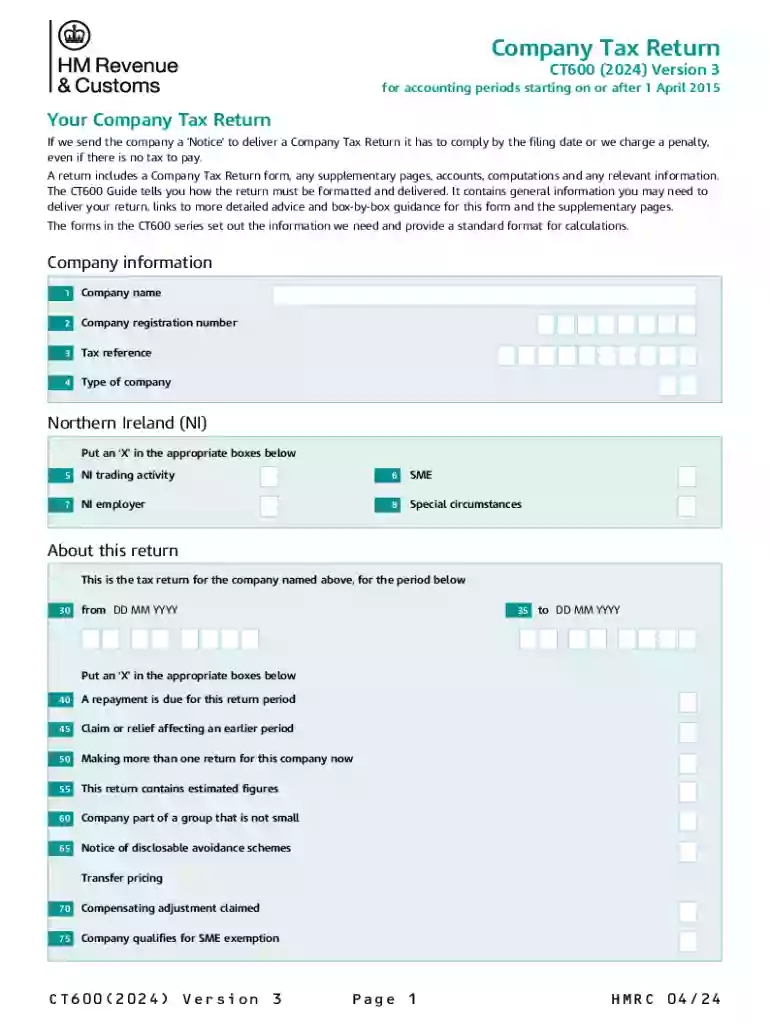
The Company Tax Return, commonly referred to as the CT600, is a pivotal document required by HMRC for companies to report their tax obligations in the UK. The CT600 for 2024, Version 3, includes essential information that defines the financial activities of a company within a fiscal year. Companies are required to complete this form to detail their taxable income and to facilitate the calculation of corporation tax due. The CT600 serves as a formal record of a company's earnings, allowable expenses, deductions, and any tax reliefs claimed.
All CT600 forms for a given fiscal year must be submitted to HMRC within twelve months following the end of the accounting period. Failing to comply with these deadlines results in penalties. For example, if a company's accounting period ends on December 31, 2024, the CT600 form must be filed by December 31, 2025.
Failure to submit the CT600 on time incurs automatic penalties of at least £100. Additional penalties apply if the delay continues beyond three months. Persistent non-compliance will lead to further financial penalties and potential interest on unpaid tax, impacting the company’s financial standing.
The CT600 is primarily used by various corporate entities in the UK, including:


The CT600 must be completed truthfully and accurately, ensuring compliance with UK tax laws. Any false declarations can lead to legal repercussions, including fines and potential prosecution. Proper completion of this form is crucial for legal compliance and accurate tax reporting.
We've got more versions of the Company Tax Return - CT600 (2024) Version 3 A return includes a Company Tax Return form, any supplem form. Select the right Company Tax Return - CT600 (2024) Version 3 A return includes a Company Tax Return form, any supplem version from the list and start editing it straight away!
At DocHub, your data security is our priority. We follow HIPAA, SOC2, GDPR, and other standards, so you can work on your documents with confidence.