




01. Edit your owcp 1500 online
Type text, add images, blackout confidential details, add comments, highlights and more.

Type text, add images, blackout confidential details, add comments, highlights and more.

Draw your signature, type it, upload its image, or use your mobile device as a signature pad.

Send owcp 1500 form via email, link, or fax. You can also download it, export it or print it out.
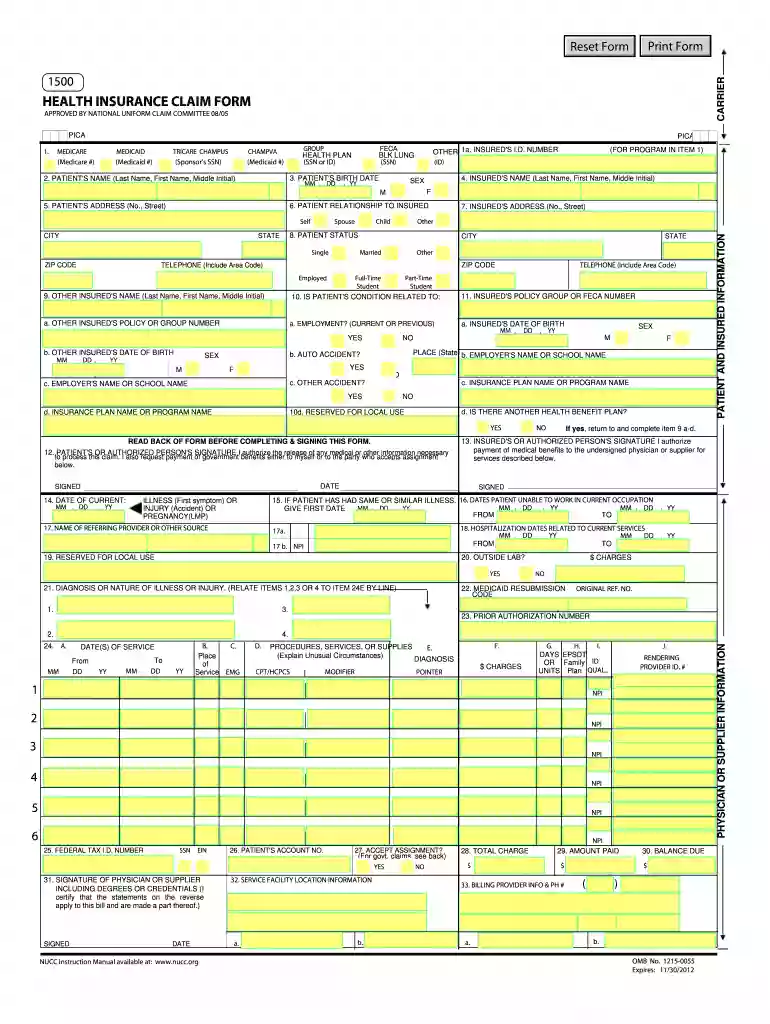
The OWCP 1500 form, also known as the Health Insurance Claim Form, is integral for individuals seeking reimbursement for medical claims under various federal programs, such as the Federal Employees' Compensation Act (FECA), the Black Lung Benefits Act (BLBA), and the Energy Employees Occupational Illness Compensation Program Act (EEOICPA). This form serves as a standardized method for submitting claims to ensure proper processing by the Department of Labor and other related entities. Patients and healthcare providers must fill out this form accurately to facilitate timely payment for services rendered.
Understanding the critical components of the OWCP 1500 form can streamline the claims process.
Each element must be accurately documented to avoid delays or denials in the claims processing.
Filling out the OWCP 1500 form is a meticulous process that requires attention to detail. Here are the general steps to follow:
These steps ensure that the OWCP 1500 is submitted correctly.
Claimants often encounter issues with the OWCP 1500 due to common mistakes. Awareness of these pitfalls can prevent unnecessary delays.
Addressing these common errors can significantly improve the chances of successful claims submission.
The OWCP 1500 form requires legally binding signatures to ensure authorization for release of medical information and payment processing.
Understanding the importance of these signatures helps ensure compliance with legal requirements during the claims process.
Submitting the OWCP 1500 form can be done through several methods, depending on the preferences of both the claimant and the healthcare provider.
Selecting the most suitable submission method is crucial for ensuring prompt processing of claims.
Along with the OWCP 1500 form, certain documentation is necessary to support the claim and expedite processing.
Providing complete and accurate documentation alongside the OWCP 1500 form significantly improves the likelihood of claim approval.
At DocHub, your data security is our priority. We follow HIPAA, SOC2, GDPR, and other standards, so you can work on your documents with confidence.
The physician or provider shall itemize the charges on Form OWCP-1500 or CMS-1500 (for professional services or medicinal drugs dispensed in the office), FormRead more
OWCP uses a relative value scale fee schedule and other tests to determine reasonableness. Schedule limitations are applied through an automated billing systemRead more
W czerwiec 2003 Koalicja powołała Iracką Grupę Zwiadowczą (ISG) w celu zbadania dawnych programw broni masowego rażenia w Iraku . Częścią śledztwa ISG byłoRead more


