
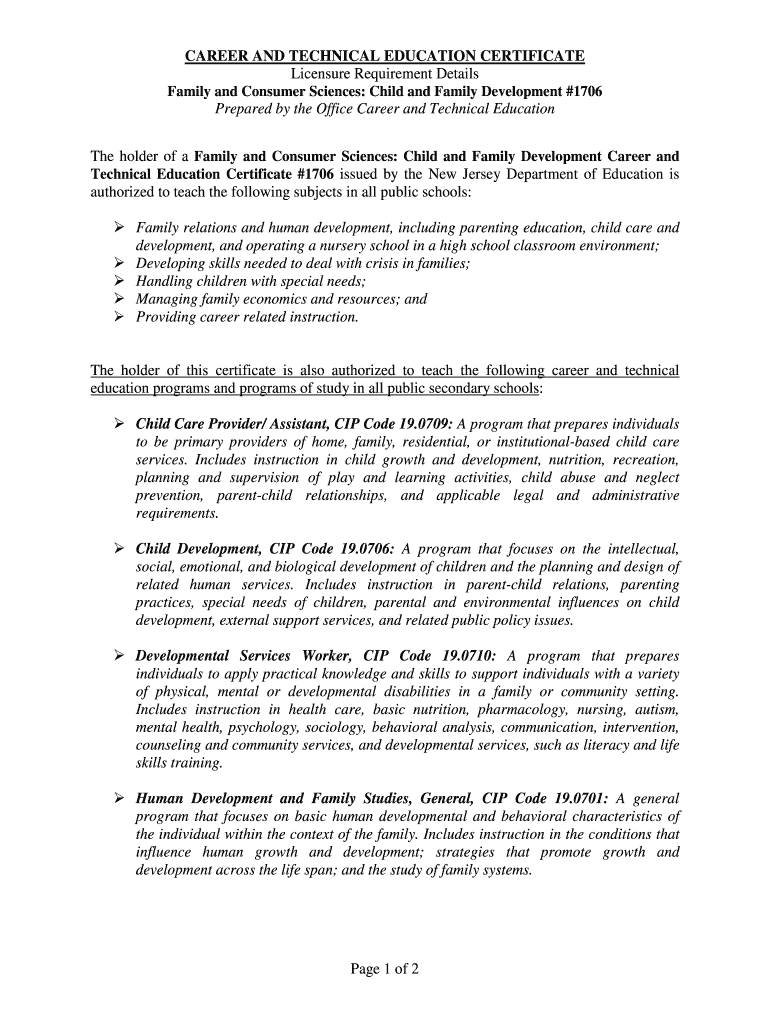







Definition & Purpose of the Family and Consumer Sciences: Child and Family Development #1706
The Family and Consumer Sciences: Child and Family Development #1706 is a certification pertinent to educators in the state of New Jersey, focusing on teaching various aspects of family relations and child development. This certification allows educators to engage in teaching subjects such as family dynamics, childcare, and management of crisis situations involving children. Furthermore, it covers specialized areas like assistance for children with special needs. This certification is part of New Jersey’s broader Career and Technical Education spectrum, aimed at equipping teachers with the necessary skills to educate students on critical life and family dynamics.
How to Obtain the Family and Consumer Sciences: Child and Family Development #1706
Acquiring this certification involves meeting certain educational and experiential prerequisites. Candidates must typically hold a relevant degree in Family and Consumer Sciences or a closely related field. Furthermore, candidates are often required to complete additional coursework specifically aimed at child and family development. After fulfilling the educational requirements, applicants must apply through the New Jersey Department of Education, providing transcripts, proof of coursework completion, and any necessary background checks.
Steps to Complete the Certification Process
- Educational Preparation: Enroll in a degree program in Family and Consumer Sciences or a closely related discipline.
- Field Experience: Gain relevant experience, either through internships or other practical engagements related to child and family development.
- Coursework Completion: Fulfill any required additional courses specific to child and family relations and development.
- Application Submission: Compile and submit an application to the New Jersey Department of Education, including all necessary documentation—transcripts, coursework proof, and possibly fingerprints for background checks.
- Certification Exam: Some candidates may be required to pass an exam demonstrating their knowledge in this field, depending on state requirements.
Key Elements and Topics Covered in the Certification
- Family Dynamics: Understanding family structures, roles, and the impact of different family models on child development.
- Childcare Techniques: Instruction on care, education, and developmental milestones of children from infancy through adolescence.
- Crisis Management: Procedures and strategies to manage family crises, including financial crises and emotional support systems.
- Special Needs Education: Strategies and teaching methodologies tailored for children with special needs, ensuring inclusivity in educational environments.
Who Typically Pursues the Family and Consumer Sciences: Child and Family Development #1706
This certification is primarily pursued by individuals interested in educational careers, specifically those aiming to teach at middle and high school levels. It is also ideal for professionals looking to transition into educational roles from other sectors of family and child services, providing them an opportunity to impact the educational system by promoting comprehensive understanding of family dynamics and youth development.
Legal and Ethical Considerations
Holders of this certification must adhere to various ethical and legal standards related to teaching and dealing with minors. It involves understanding legal mandates concerning child protection, confidentiality of student information, and reporting obligations for abuse or neglect cases. Educators are also expected to incorporate inclusivity in their teaching methodologies, ensuring all students, including those with special needs, receive equal educational opportunities.
Important Terms Related to the Certification
- Child Development: A field of study focusing on the changes that occur in children from birth through adolescence.
- Family Relations: The study of family interactions, roles, and structures.
- Special Needs Education: Educational techniques and practices designed to support children with differing educational requirements.
State-Specific Rules for the Certification
New Jersey's unique requirements for this certification include completion of state-designated courses on New Jersey educational laws and teaching ethics. Additionally, New Jersey might require applicants to pass certification exams that are specific to the state and its educational standards. It is vital for applicants to stay informed about these requirements to ensure compliance and successful certification acquisition.




