01. Edit your form mi 1041 online
Type text, add images, blackout confidential details, add comments, highlights and more.

Type text, add images, blackout confidential details, add comments, highlights and more.

Draw your signature, type it, upload its image, or use your mobile device as a signature pad.

Send it via email, link, or fax. You can also download it, export it or print it out.
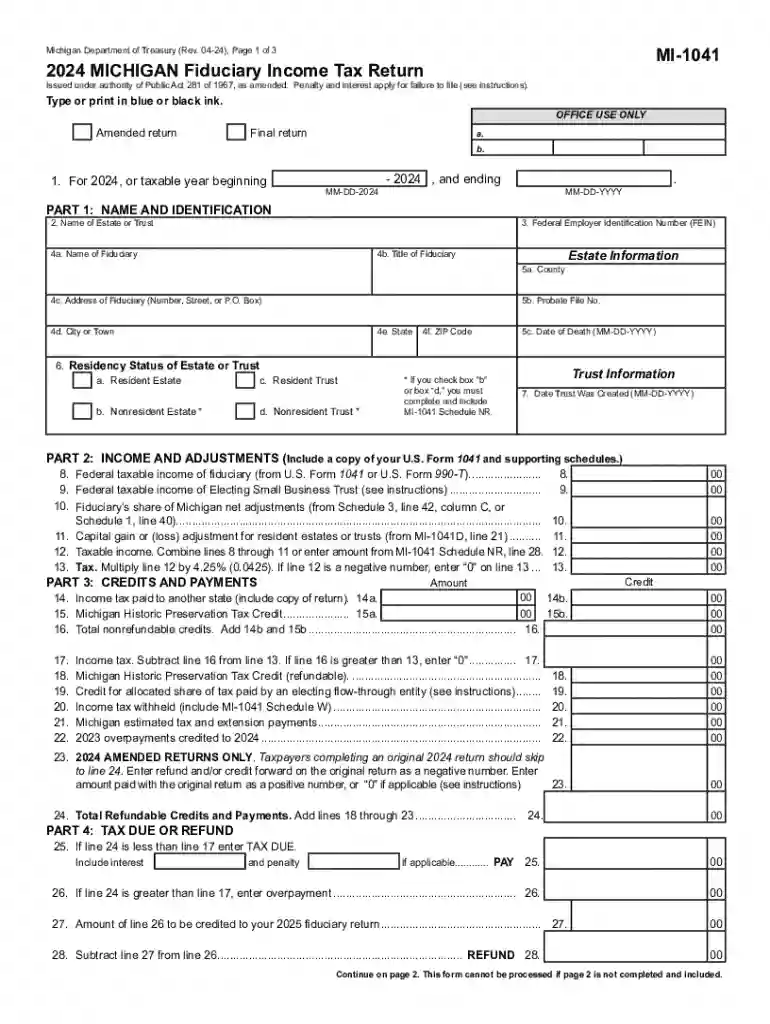
The 2024 Michigan Fiduciary Income Tax Return, also known as MI-1041, is a comprehensive form used by estates and trusts within the state to report income and calculate corresponding tax liabilities. This form encompasses multiple sections that collect critical information about the fiduciary entity, including its identification and residency status. It also allows for the reporting of various income sources, applicable deductions, credits, and the calculation of taxes due or potential refunds. The MI-1041 form is essential for ensuring that estates and trusts comply with Michigan state tax laws, facilitating accurate financial declarations and adjustments.
Gather Required Information: Before beginning the MI-1041 form, collect all necessary documents, including financial statements, income reports, and details about the fiduciary entity.
Complete Estate or Trust Identification: Accurately fill in details regarding the estate or trust's name, federal identification number, and fiduciary details.
Report Income and Adjustments: Document all forms of income, including dividends, interest, and capital gains, while considering specific state-level adjustments.
Claim Credits and Payments: Identify and claim any eligible state credits or payments that can offset the estate or trust's tax liability.
Determine Tax Due or Refund: Calculate the total taxes owed or refunds due by carefully examining and leveraging all deductions and credits.
Review and Submit: Ensure all sections of the MI-1041 are completed and error-free. Submit the form through chosen means, whether online, via mail, or in person.
The MI-1041 form is accessible through multiple channels to accommodate a variety of preferences:
Online Access: The form can be downloaded directly from the Michigan Department of Treasury's official website. This is typically the fastest and most convenient method.
Mail Requests: Taxpayers can request a physical copy of the form to be sent via mail by contacting the Department of Treasury.
In-Person Pick-Up: Visit local tax-related offices or certain libraries that stock tax forms, particularly during the filing season.
The MI-1041 form must be utilized in compliance with state regulations by those managing estates and trusts in Michigan. Legal mandates require accurate reporting within this form to ensure all taxable income, expenses, credits, and deductions are appropriately declared. Compliance with these legal standards supports transparent financial conduct and maintains trust fiduciaries' integrity within the state's tax framework.
Filing for the 2024 MI-1041 usually aligns with standard state tax deadlines, requiring submission by April 15. However, adjustments for weekends, holidays, or extensions must be monitored for each tax year. Taxpayers should ensure timely filing to avoid penalties.
Failure to file the MI-1041 form within set deadlines, or inaccuracies within the report, can result in financial penalties. These may include late fees and interest on overdue taxes. Further penalties might apply for deliberate misreporting or fraud, heightening the importance of meticulous and honest completion of the form.
We've got more versions of the form mi 1041 form. Select the right form mi 1041 version from the list and start editing it straight away!
| Versions | Form popularity | Fillable & printable |
|---|---|---|
| 2025 | 4.3 Satisfied (20 Votes) | |
| 2024 | 4.6 Satisfied (55 Votes) | |
| 2023 | 4.6 Satisfied (45 Votes) | |
| 2022 | 4.5 Satisfied (56 Votes) | |
| 2021 | 4.7 Satisfied (43 Votes) | |
| 2020 | 4.8 Satisfied (175 Votes) | |
| 2019 | 4.2 Satisfied (42 Votes) | |
| 2017 | 4.3 Satisfied (149 Votes) | |
| 2016 | 4.3 Satisfied (43 Votes) | |
| 2015 | 4.3 Satisfied (51 Votes) | |
| 2014 | 4.4 Satisfied (392 Votes) | |
| 1998 | 4.4 Satisfied (52 Votes) |
At DocHub, your data security is our priority. We follow HIPAA, SOC2, GDPR, and other standards, so you can work on your documents with confidence.