2024 MICHIGAN Adjustments of Capital Gains and Losses MI-1041D-2026

Get Form
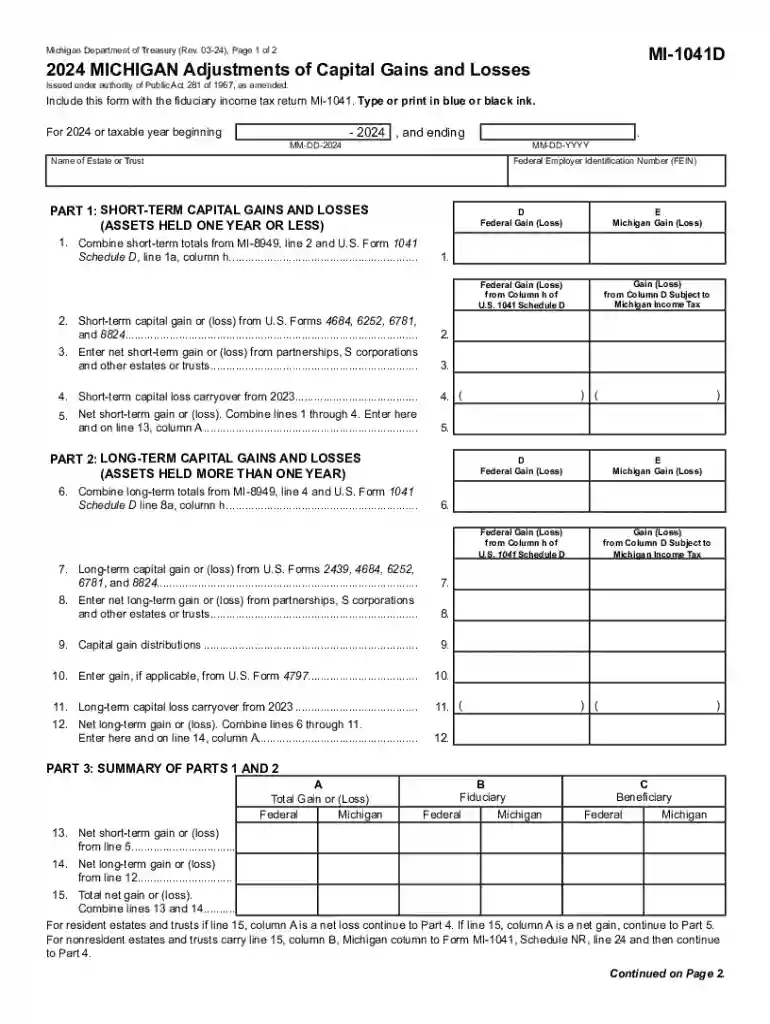
2024 MICHIGAN Adjustments of Capital Gains and Losses MI-1041D Preview on Page 1

Here's how it works

01. Edit your form online
Type text, add images, blackout confidential details, add comments, highlights and more.

02. Sign it in a few clicks
Draw your signature, type it, upload its image, or use your mobile device as a signature pad.

03. Share your form with others
Send it via email, link, or fax. You can also download it, export it or print it out.

Definition & Meaning

The 2024 Michigan Adjustments of Capital Gains and Losses form, commonly referred to as MI-1041D, is a crucial document issued by the Michigan Department of Treasury. It is designed for estates and trusts to report and adjust capital gains and losses in conjunction with the fiduciary income tax return (MI-1041). The form covers short-term and long-term capital gains and losses, provides calculations for capital loss limitations, and includes instructions for determining taxable income adjustments specific to Michigan tax laws.

Key aspects of the MI-1041D form involve:

  • Reporting both short-term and long-term capital transactions.
  • Adjustments in accordance with Michigan-specific tax regulations.
  • Ensuring accurate reporting for estates and trusts.

An understanding of this form is essential for catering to state-specific financial reporting requirements, aiding in the calculation and reporting of fiduciary income accurately and compliantly.

How to Use the 2024 MICHIGAN Adjustments of Capital Gains and Losses MI-1041D

Using the MI-1041D form involves detailed procedures to report capital gains and losses accurately:

  1. Gather Financial Data: Collect comprehensive records of all capital transactions including sales, exchanges, or other dispositions of property.
  2. Record Transactions: Enter short-term and long-term capital gains and losses in their respective sections.
  3. Calculate Net Gains or Losses: Compute the net capital gain/loss for both short-term and long-term transactions.
  4. Adjust for State-Specific Regulations: Make necessary adjustments to align with Michigan's tax laws, which may differ from federal calculations.

Understanding the proper use of this form helps in avoiding errors in capital gain/loss reporting, ensuring compliance, and potentially preventing financial penalties.

Steps to Complete the 2024 MICHIGAN Adjustments of Capital Gains and Losses MI-1041D

Successfully completing the MI-1041D form involves the following steps:

  1. Fill Out Basic Information: Include details about the estate or trust, such as its name, identification number, and the reporting period.
  2. Document Capital Transactions: Record all capital gain and loss transactions, ensuring separation of short-term from long-term.
  3. Calculate the Total Gains and Losses: Add up gains and losses to determine a net figure for tax reporting.
  4. Apply State Adjustments: Adjust figures as per Michigan-specific instructions available in the form itself.
  5. Review and Finalize: Double-check all entries for accuracy before submitting the form with the fiduciary income tax return MI-1041.

Following these steps ensures a thorough and accurate completion of the MI-1041D, which is critical for maintaining compliance with both state and federal tax obligations.

Who Typically Uses the 2024 MICHIGAN Adjustments of Capital Gains and Losses MI-1041D

The MI-1041D form is primarily used by fiduciaries managing estates or trusts. This includes:

  • Executors handling the financial affairs of a deceased individual's estate.
  • Trustees overseeing the distribution and management of trust assets.
  • Legal representatives responsible for filing taxes on behalf of another entity.

These users leverage the form to uphold their legal duty in accurately reporting capital gains and losses, ensuring compliance with state tax regulations.


decoration image ratings of Dochub

Important Terms Related to 2024 MICHIGAN Adjustments of Capital Gains and Losses MI-1041D

A myriad of terms are essential when dealing with the MI-1041D form:

  • Fiduciary: A person or organization managing assets on behalf of another, required to act in their best interest.
  • Capital Gains/Losses: Profit or loss derived from the sale of assets like property or investments.
  • Short-Term vs. Long-Term: Distinction based on the holding period of the asset; short-term is under one year, long-term is over one year.
  • Taxable Income Adjustments: Modifications made to income figures following Michigan-specific tax laws.

Understanding these terminologies is crucial for interpreting and accurately completing the MI-1041D form.

Key Elements of the 2024 MICHIGAN Adjustments of Capital Gains and Losses MI-1041D

Vital components of the MI-1041D form include:

  • Sections for Short-Term and Long-Term Gains/Losses: Specific entries for each category to delineate transactions.
  • Capital Loss Limitation Calculations: Guidelines on how to appropriately limit losses as per Michigan tax policies.
  • State Tax Adjustments: Areas designed to capture necessary adjustments to align with Michigan's unique tax requirements.

Each element plays a key role in ensuring the form is completed accurately, aiding in compliance with state fiduciary tax laws.

State-Specific Rules for the 2024 MICHIGAN Adjustments of Capital Gains and Losses MI-1041D

Michigan enforces distinct rules regarding the reporting of capital gains and losses:

  • Adjustment Mandates: Requirements for alteration of federal capital gain/loss figures to meet state guidelines.
  • Loss Limits: Restrictions on the amount of capital losses that can be used to offset other income, following Michigan's tax statutes.
  • Taxation Variances: Differences in how capital gains are taxed at the state level compared to federal norms.

Comprehension of these state-specific rules is paramount for fiduciaries tasked with preparing the MI-1041D form, ensuring adherence to local tax laws.

Filing Deadlines and Important Dates for MI-1041D

Key deadlines and dates must be observed when dealing with the MI-1041D:

  • Filing Date: Typically due on the same date as the federal tax return, unless extended.
  • Extension Requests: Procedures for obtaining extensions on filing, subject to approval.
  • Amendment Periods: Time frames within which corrections or amendments to filed forms can be made without incurring penalties.

Awareness of these dates is essential for maintaining compliance and preventing potential penalties for late filing or inaccuracies.

Required Documents for Completing MI-1041D

When preparing to complete the MI-1041D, the following documents are necessary:

  • Sale and Purchase Records: Documentation of transactions involving assets subject to capital gains calculations.
  • Previous Year Tax Returns: Information to ensure continuity and accuracy in reporting.
  • Supporting Schedules: Documents and worksheets that support the gain/loss calculations and adjustments made.

Collecting and organizing these documents beforehand simplifies the form completion process and aids in avoiding errors.

be ready to get more

Complete this form in 5 minutes or less

Get form

Got questions?

We have answers to the most popular questions from our customers. If you can't find an answer to your question, please contact us.
Contact us
Yes, FO losses can be set off against other gains, such as capital gains from the sale of assets or business income. The losses can be set off in the same financial year or carried forward for up to eight years.
If you still have a loss, it becomes part of the computation of your net capital loss for the year. You can use a net capital loss to reduce your taxable capital gain in any of the 3 previous years or in any future year. You can apply your net capital losses of other years to your taxable capital gains in 2024.
If your capital losses exceed your capital gains, you can apply up to $3,000 of the losses to offset ordinary income ($1,500 if youre married filing separately). You can also carry forward any remaining losses indefinitely to help offset gains or up to $3,000 of income in future tax years.
The Internal Revenue Code allows taxpayers to claim a capital loss deduction from their annual capital gains. Capital loss deductions are limited to $3,000 a year as of 2025. Losses over this limit can be carried forward and claimed in future tax years if you make use of a capital loss carryover.
Rules to carry forward losses: SectionLosses can be carried forwardTime limitation for carry forward 73A Loss from specified business No time limit 74 Short term capital loss 8 Years 74 Long term capital loss 8 Years 74A Loss from owning and maintaining horse races 4 Years3 more rows Feb 4, 2025

Security and compliance

At DocHub, your data security is our priority. We follow HIPAA, SOC2, GDPR, and other standards, so you can work on your documents with confidence.

Learn more
ccpa2
pci-dss
gdpr-compliance
hipaa
soc-compliance
be ready to get more

Complete this form in 5 minutes or less

Get form

People also ask

You must wait at least two years to sell your house in order to qualify for the capital gains exclusion. However, even if you dont qualify for the exclusion you still can ordinarily pay the reduced tax rate levied on investment assets. This reduced rate is whats known as the long-term investment rate.
Capital Losses A capital loss can be offset against capital gains of the same tax year, but cannot be carried back against gains of earlier years. If you have an unused capital loss, this can be carried forward indefinitely against gains of future years.