Definition and Meaning
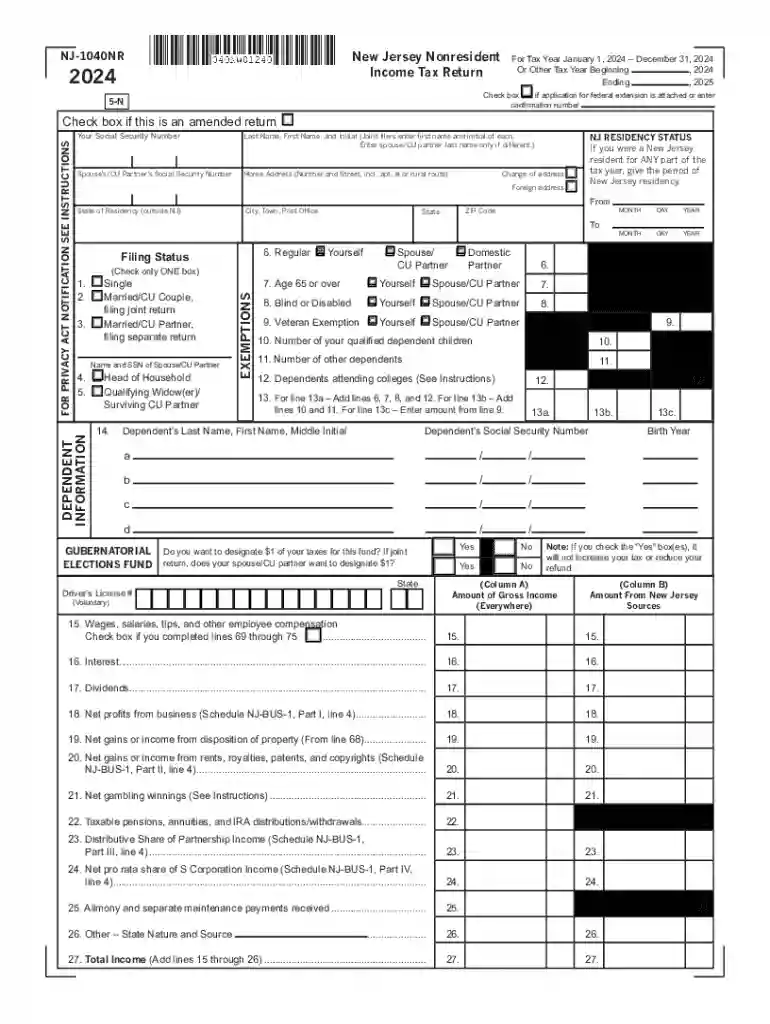
The 2024 New Jersey Nonresident Return, or Form NJ-1040NR, is a tax form utilized by individuals who earn income in New Jersey but reside in another state. It serves as a formal declaration of income earned within the state's jurisdiction. This form is essential for ensuring that nonresidents correctly report and remit taxes on income sourced from New Jersey. The form includes areas for detailing income, deductions, exemptions, and computing the tax obligation owed to New Jersey.
Key Concepts
- Nonresident Income: Income earned in New Jersey by individuals who do not have their primary residence in the state.
- Tax Liabilities: Financial obligation to pay state income tax based on earnings generated in New Jersey.
- Exemption Reporting: Documentation of applicable exemptions that may reduce overall tax liability.
Steps to Complete the 2024 New Jersey Nonresident Return, Form NJ-1040NR
Form NJ-1040NR requires careful attention to detail and accurate data entry to ensure compliance and correct tax calculations.
- Gather Required Documents: Collect all necessary documents, including W-2s, 1099 forms, and records of any other New Jersey-sourced income.
- Provide Personal Information: Enter your personal details, such as your name, address, and Social Security Number.
- Determine Residency Status: Confirm your residency status is nonresident for the tax year.
- Enter Income Details: Input information on all sources of income earned within New Jersey.
- Calculate Deductions and Credits: Compute eligible deductions such as federal tax paid and credits like taxes paid to other jurisdictions.
- Determine Tax Liability: Use income, deductions, and credits to calculate the total tax owed to New Jersey.
- Review and Sign: Carefully review all entries for accuracy before signing the form.
- Submit the Form: Choose a filing method and send the completed form.
Practical Example
A resident of Pennsylvania who works remotely for a company based in New Jersey would need to complete Form NJ-1040NR if they earned $50,000 during 2024, detailing this income and relevant deductions.
Important Terms Related to the 2024 New Jersey Nonresident Return, Form NJ-1040NR
Understanding specific terms enhances accuracy when completing Form NJ-1040NR.
- Gross Income: Total income earned before taxes and deductions.
- Withholding Tax: Taxes withheld from pay specifically for state tax requirements.
- Reciprocal Agreement: Agreements between states to simplify taxation for residents working across state borders.
Detailed Definitions
- Gross Income: Calculating gross income involves summing all earnings from New Jersey sources, including wages, salaries, and independent contractor fees.
- Withholding Tax: These are pre-paid taxes, often deducted directly from each paycheck by the employer.
- Reciprocal Agreement: New Jersey and neighboring states may have agreements allowing credit for taxes paid in the state of residence.
State-Specific Rules for the 2024 New Jersey Nonresident Return, Form NJ-1040NR
New Jersey enforces distinct rules regarding the taxation of nonresidents.
- Income Sourcing: Income is only taxable if it is sourced or derived from New Jersey activities.
- Deductions Specific to Nonresidents: Nonresidents can deduct specific items such as transitional payments from New Jersey employers or tuition reimbursements.
Examples of Compliance
- Consultants: A consultant living in Delaware must report New Jersey-derived consulting fees.
- Freelancers: A New York freelancer with clients in New Jersey files NJ-1040NR for income earned through client contracts.
Filing Deadlines and Important Dates
Adhering to deadlines is critical to avoid penalties.
- Filing Deadline: Typically, nonresident returns must be filed by April 15 of the following year.
- Extension Requests: Extensions can be filed to postpone the deadline, granting an additional six months to submit the return, but not to pay the tax.
Key Considerations
- Interest on Late Payments: Filing an extension does not exempt taxpayers from interest on unpaid taxes.
- Weekend/Holiday Rule: If April 15 falls on a weekend or holiday, returns are due the next business day.
Required Documents for Form NJ-1040NR
Preparation involves gathering relevant documents that indicate income and tax withholdings.
- W-2 Forms: These outline wages paid and taxes withheld by employers.
- 1099 Forms: Detail income from non-employment sources like freelance work.
- Supporting Tax Documents: Records supporting any fringe benefits, stock options, or severance packages.
Form Submission Methods
The NJ-1040NR can be submitted via several channels, each catering to different preferences and technical skills.
- Online Submission: Preferred for its speed, allowing quick and efficient processing.
- Mail-in Option: Traditional option for those who prefer paper documentation, though processing can be slower.
- In-Person Filing: Available at New Jersey Division of Taxation locations, sometimes necessary for complex filings.
Online Filing Process
- Access New Jersey E-File: Log into the NJ Division of Taxation portal.
- Upload Necessary Documents: Attach W-2, 1099, and other income verification files.
- E-Signature: Finalize filing with a digital signature for verification.
Penalties for Non-Compliance
Failure to comply with tax obligations for Form NJ-1040NR can result in various penalties.
- Late Filing and Payment Penalties: Fees increasing based on duration past the deadline without filing or payment.
- Interest on Unpaid Taxes: Accrues from the original due date till the payment is completed.
- Accuracy-Related Penalties: Fees imposed for underpayment due to negligence or disregard of rules.
Eligibility Scenarios
- Temporary New Jersey Workers: For those temporarily employed in New Jersey throughout the tax year.
- Multi-State Payroll: Employees receiving income from both New Jersey and other states must confirm if their total income exceeds applicable thresholds.